
Papers

All tags

LiftGS streams splat scenes coarse to fine with wavelet-style refinements

arXivPapers

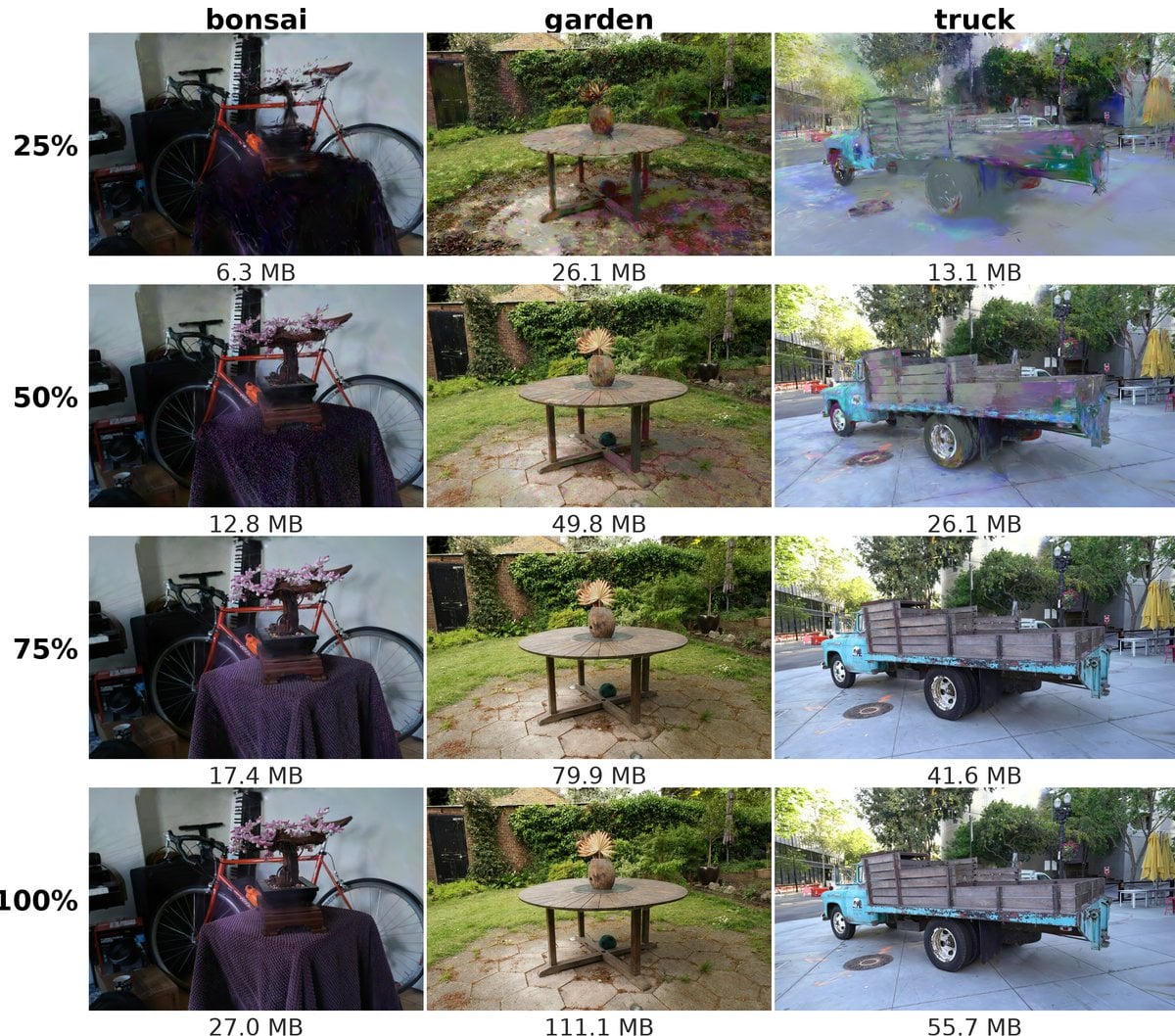
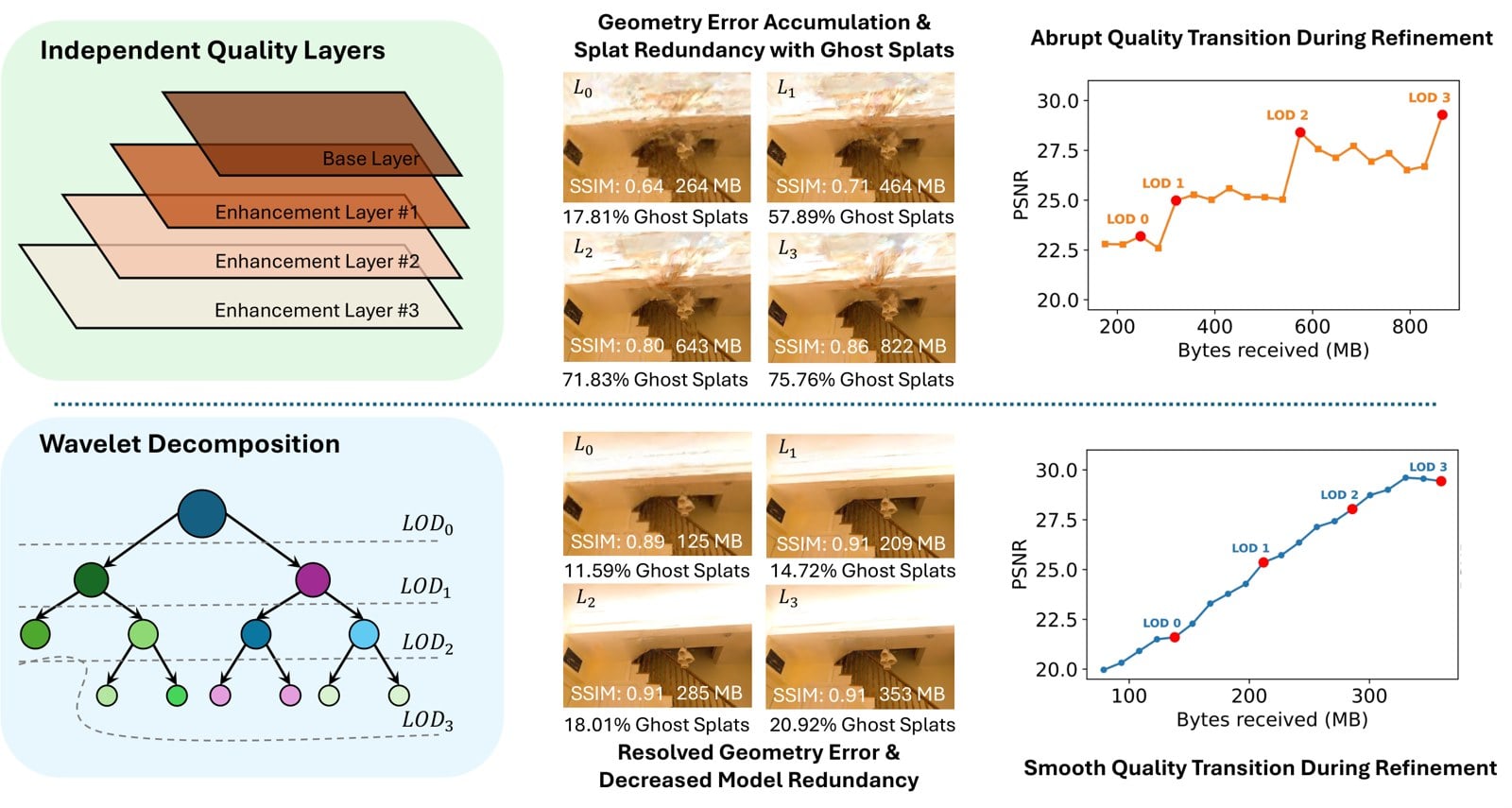
Yuang Shi, Simone Gasparini, Géraldine Morin and Wei Tsang Ooi have posted a revised version of Lifting 3D Gaussians: A Wavelet Multiresolution Representation for Scalable Gaussian Splatting Streaming (v2, 18 November 2026), which the project page lists for the ACM Multimedia Systems Conference (MMSys) 2027. LiftGS organises a scene as a coarse Gaussian set plus a tree of refinements, so a client can show a basic version first and add detail as data arrives.

Each refinement replaces one Gaussian with two finer children whose attributes are learned relative to the parent. Inspired by wavelet lifting, the change is encoded with a shared detail vector and per-attribute factors that let the two children differ asymmetrically, and replaced parents leave the active rendering set. On four benchmark datasets the authors report splat redundancy falling from over 65% to under 25%, up to 2.4 times less transmission payload and 5.5 times less GPU memory than scalable 3DGS baselines, and a further 8.7 times compression with standard coding at negligible quality loss. VideoTech Wire also covered the paper.
VideoRNG generates relightable Gaussian assets with fur and feathers from a prompt or one image

arXivPapers

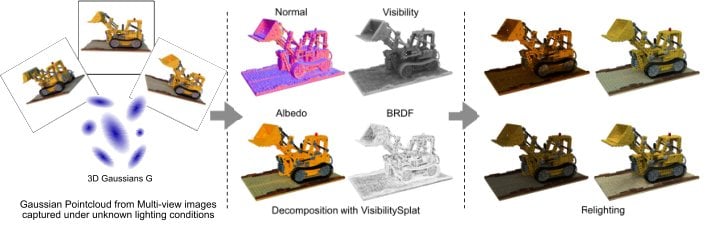
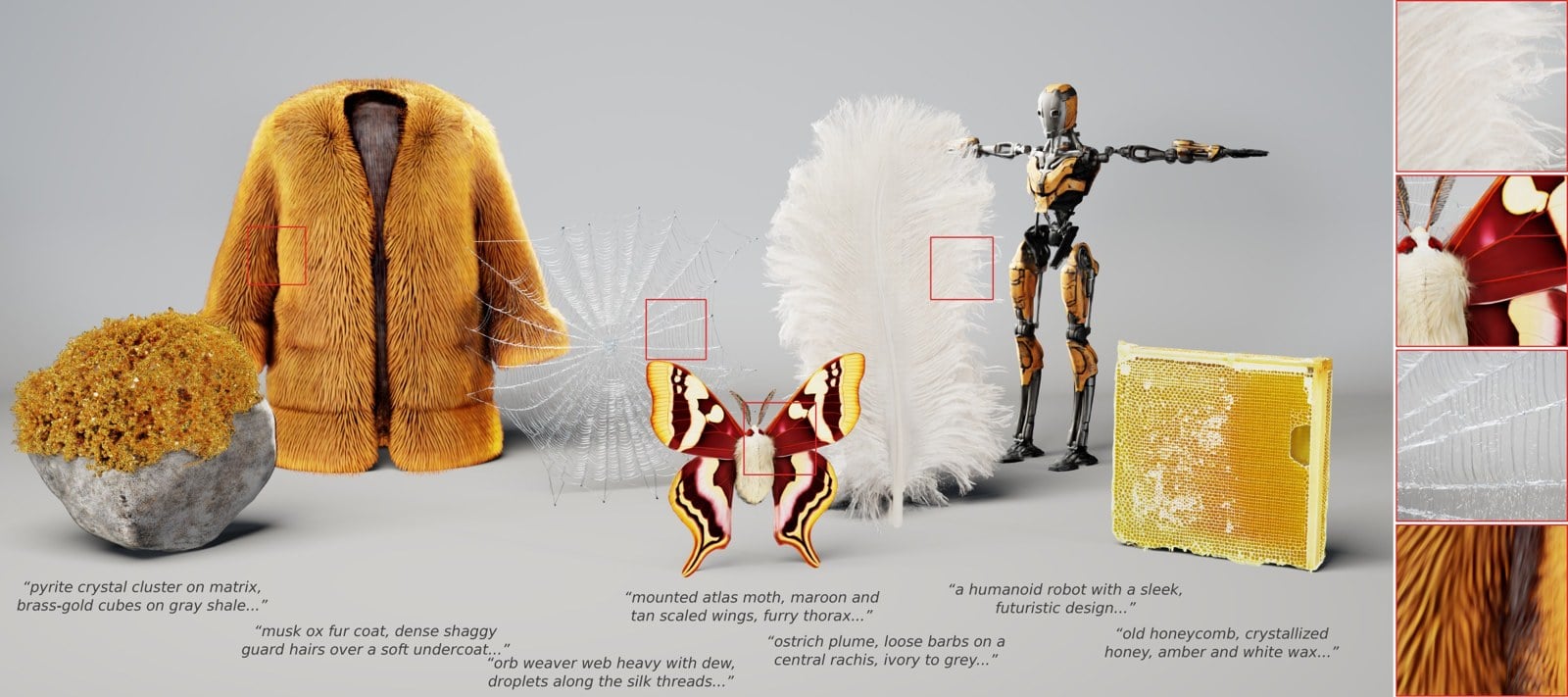
Bowen Xue, Saeed Hadadan, Fabrice Rousselle, Ravi Ramamoorthi, Zahra Montazeri and Miloš Hašan have posted VideoRNG: Relightable Neural Gaussians from Generative Video Models on arXiv. The two-stage method creates complete 3D assets from a text prompt or a single image without baking lighting into the result, which most Gaussian splat generators still do.

A video model fine-tuned from a pretrained video diffusion backbone first produces an RGBA turntable sequence under known pose, camera and lighting. A feed-forward reconstruction model then maps the video latents directly to millions of anisotropic Gaussians with learned neural appearance features, which a shared directional decoder and a stochastic Gaussian ray tracer turn into radiance under new viewpoints and illumination. The authors add depth-anchored appearance training to keep fine detail, and show assets such as fur, feathers and spider webs that can be rendered and relit interactively.

DOOM-GS trains city-scale dynamic splats on GPUs too small to hold them

arXivPapers

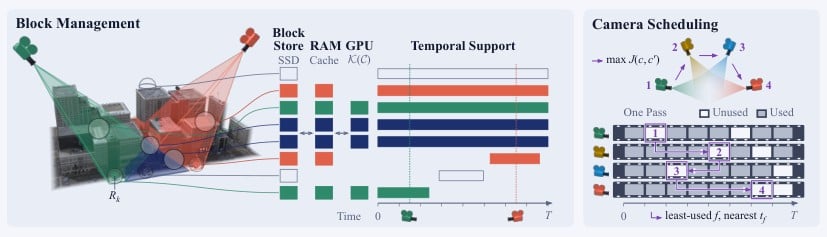
DOOM-GS (Dynamic Out-of-core Optimization for Massive Gaussian Splatting), by Doğa Yılmaz, Jialin Zhu, Binglun Wang and He Wang of University College London and Baidu Research, is presented as the first out-of-core training method for large dynamic Gaussian splatting scenes. Existing out-of-core methods move primitives between GPU, CPU and storage but assume static scenes, where nearby Gaussians stay together; dynamic Gaussians move and live only over limited time spans, which breaks those groupings.

DOOM-GS adds memory management and caching designed for spatio-temporal primitives and a fast learning method for very large primitive counts. The authors also contribute a new dataset for large-scale dynamic scenes and report that the method reconstructs city-scale dynamic scenes with high quality on moderate hardware.

Cornell's Pentimento uses Gaussian splats to document reclaimed timber builds

BlogPapersShowcases

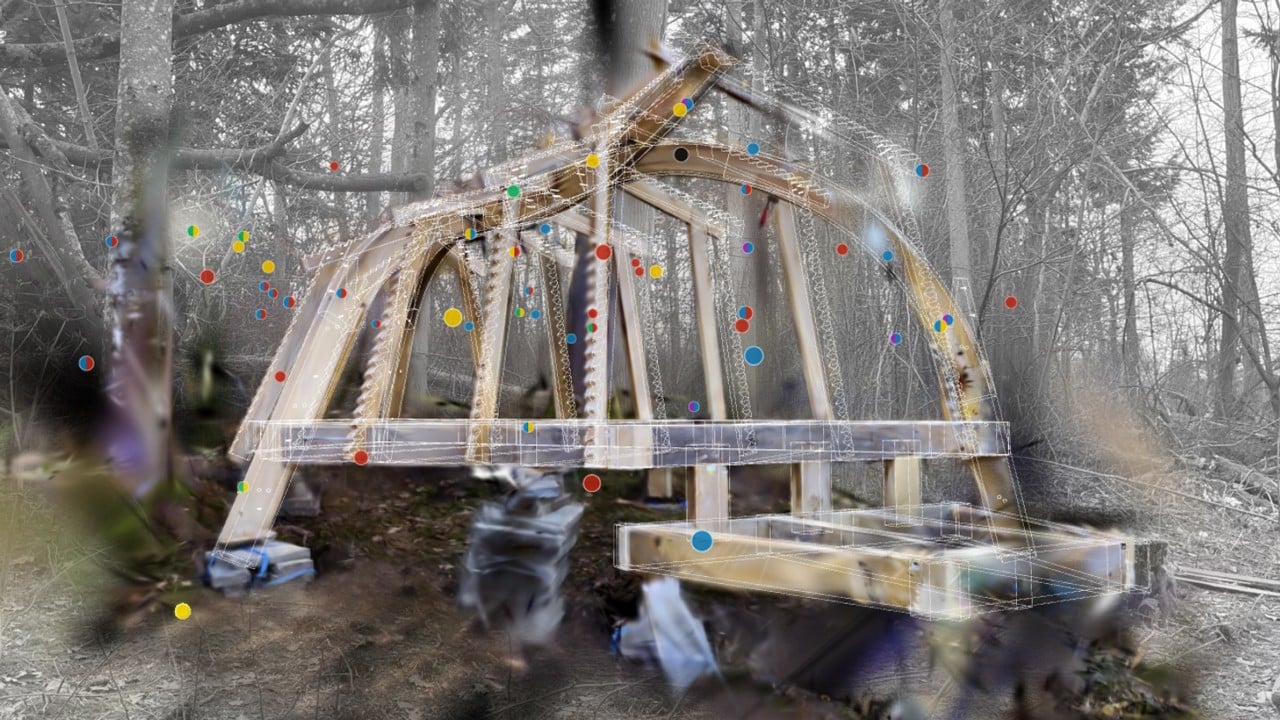
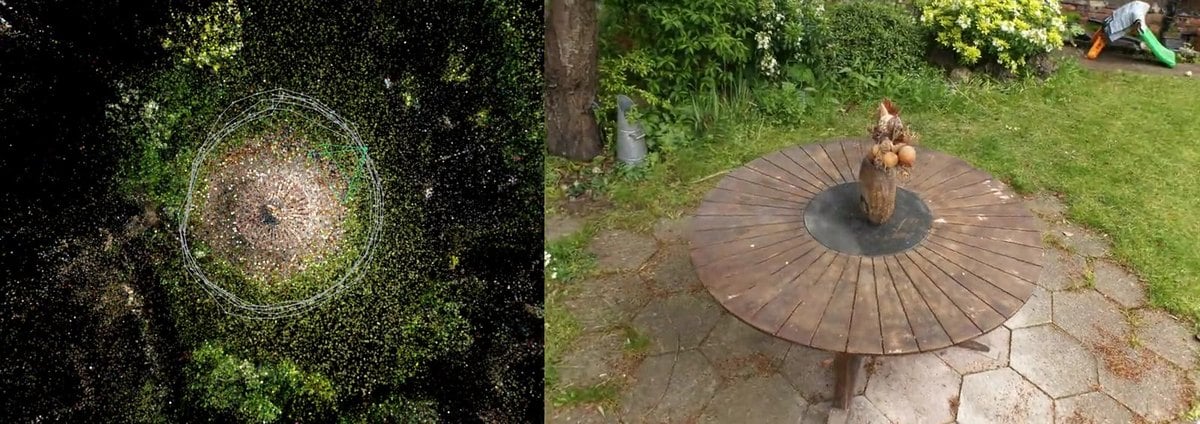
Researchers from Cornell Tech and the Royal Danish Academy’s CITA won the Best Paper Award at ACADIA’26 for Building Drift, which presents Pentimento, a tool that documents how a building made from reclaimed materials drifts away from its design. Builders record video and narration on a phone or smart glasses, and Pentimento estimates camera poses with COLMAP, trains a Gaussian splat and overlays it on the original 3D model, so every stakeholder can see where and why the build changed, as the Cornell Chronicle reports.

The team tested it on ReShelter, a reclaimed timber pavilion in a forest near Hvalsø, Denmark. According to Radiance Fields, ArUco markers register the splat to a glTF export of the CAD model, Whisper transcribes the narration, an AI model sorts each change into five drift categories, and the browser view renders splat and model together with three.js and Spark. The paper does not link to code.

CiGS reads the temperature inside an object from Gaussian splats and thermal images

arXivPapers

Researchers from ETH Zürich, Carnegie Mellon University and Google DeepMind have posted CiGS: Conduction in Gaussian Splats for Interior Temperature Field from Thermal Images on arXiv (15 November 2026). The method infers the temperature distribution inside a solid object from registered multi-view visible-light and thermal images, even when the thermal views cover only part of the surface.

CiGS treats steady-state heat conduction as a Laplace boundary value problem and solves it with a boundary integral equation discretised directly over a point cloud. A Gaussian splat reconstruction from the RGB images supplies the boundary geometry, and the thermal images supply the surface temperatures. No surface or volume mesh is built at any stage: collocation points are sampled from rendered depth, skipping pixels at depth discontinuities, and a density subtraction keeps the interior evaluation accurate right up to the surface.

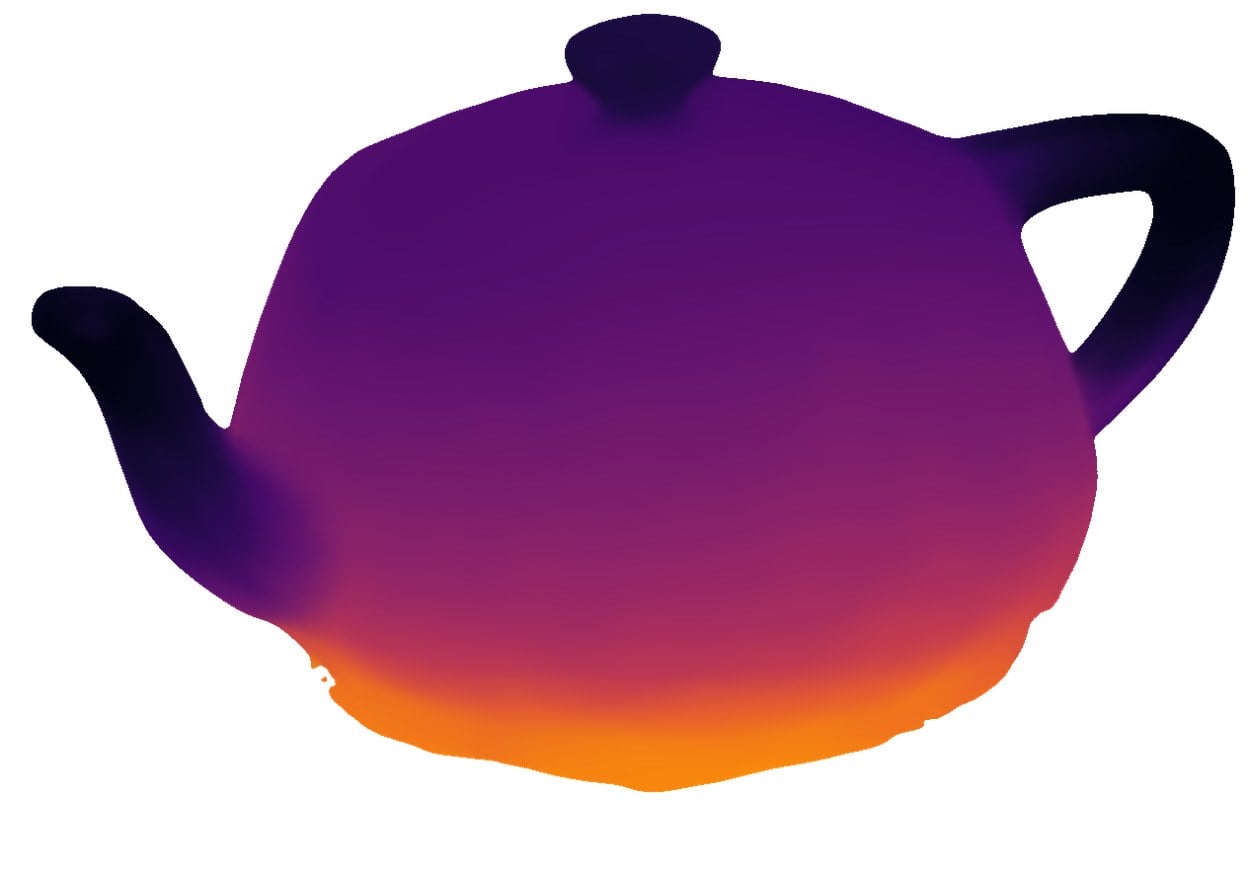
In the headline experiment, 360 RGB and thermal images of a cast plaster teapot on a hot plate were turned into splats carrying surface temperature, and the predicted interior temperature matched three cast-in probes to 1.4 °C on average. Because the whole chain is differentiable, the authors also use it to recover the position and depth of heating pipes, insulation defects and the shape of cracks from thermal images. On synthetic and real data, the paper reports that the method matches analytical solutions and is more accurate than FEM solvers.

Manifold4D re-shoots a monocular video from a new camera path

BlogPapersCode & Tools

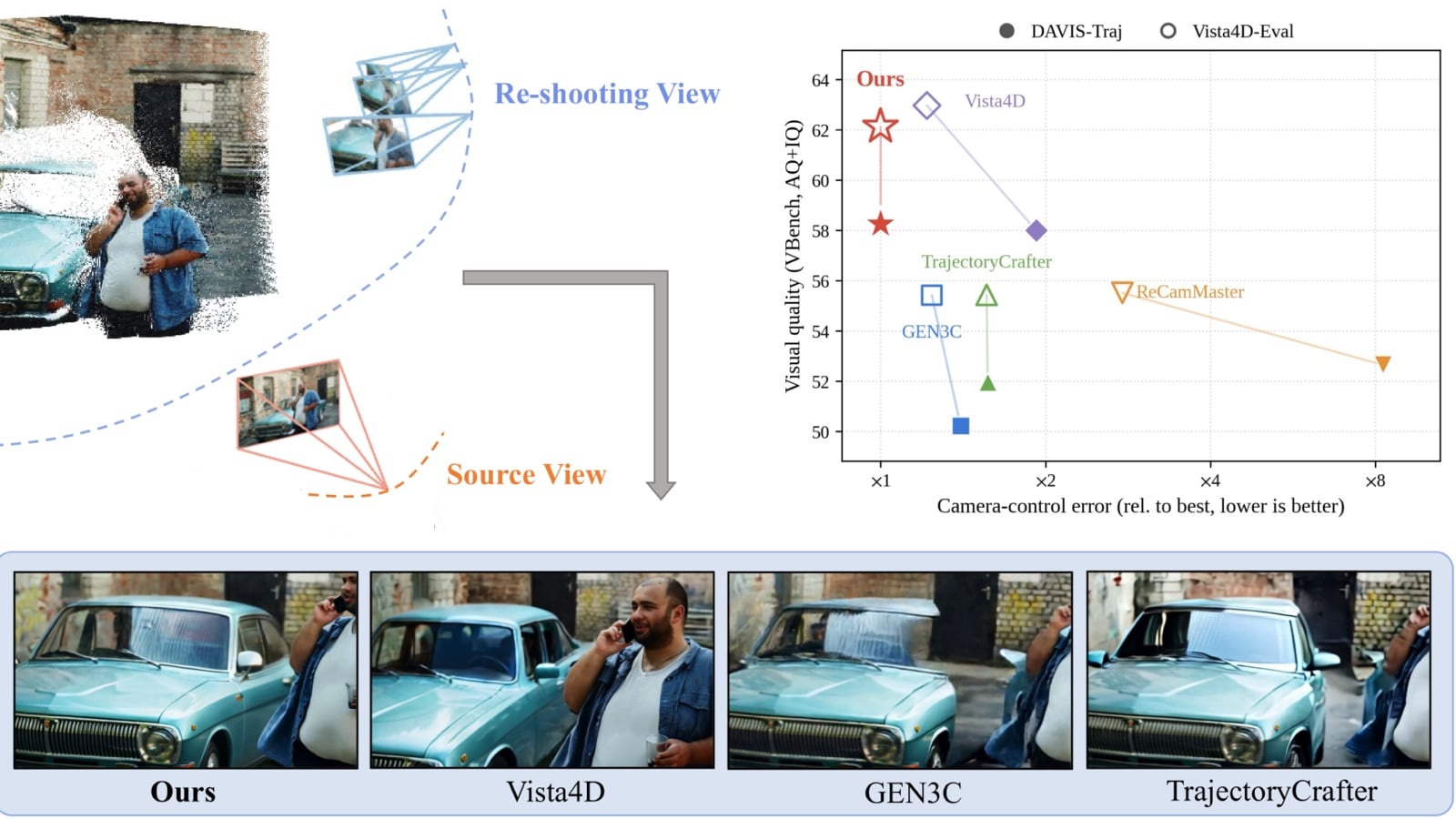
Manifold Tech has published Manifold4D, a video re-shooting method that takes a single monocular video of a dynamic scene and re-renders it along a new camera trajectory. The work is presented on the project page and in a paper on arXiv, with inference code and model weights on GitHub. The company also described the project in a LinkedIn post.

A common approach lifts the source video into a 4D point cloud and, at every denoising step, conditions a generator on both a render of that cloud from the target view and the source video. The authors say those two signals can conflict, a problem they call a trust dilemma, which can weaken camera control, 3D consistency of moving subjects, and visual quality.

Manifold4D instead injects the point-cloud render into the initial noise of a flow-matching video diffusion model, so generation starts from a geometry-bearing noise distribution they call the point cloud rendered manifold. After that first step, the source video is the only visual condition, and the network can spend the remaining denoising steps refining appearance. The model fine-tunes a Wan2.1-T2V transformer. The authors report the best camera-control accuracy on every metric in their tests, lowering rotation error by 25 to 27 percent and translation error by up to 32 percent over the strongest baseline, while matching it in video fidelity and scoring best on overall photometric quality and 3D consistency of dynamic content. Inference code and weights were released in September 2026, with bundled demo scenes added in October.

MatrixSplat maps Gaussian splat feature rendering onto GPU Tensor Cores

arXivPapers

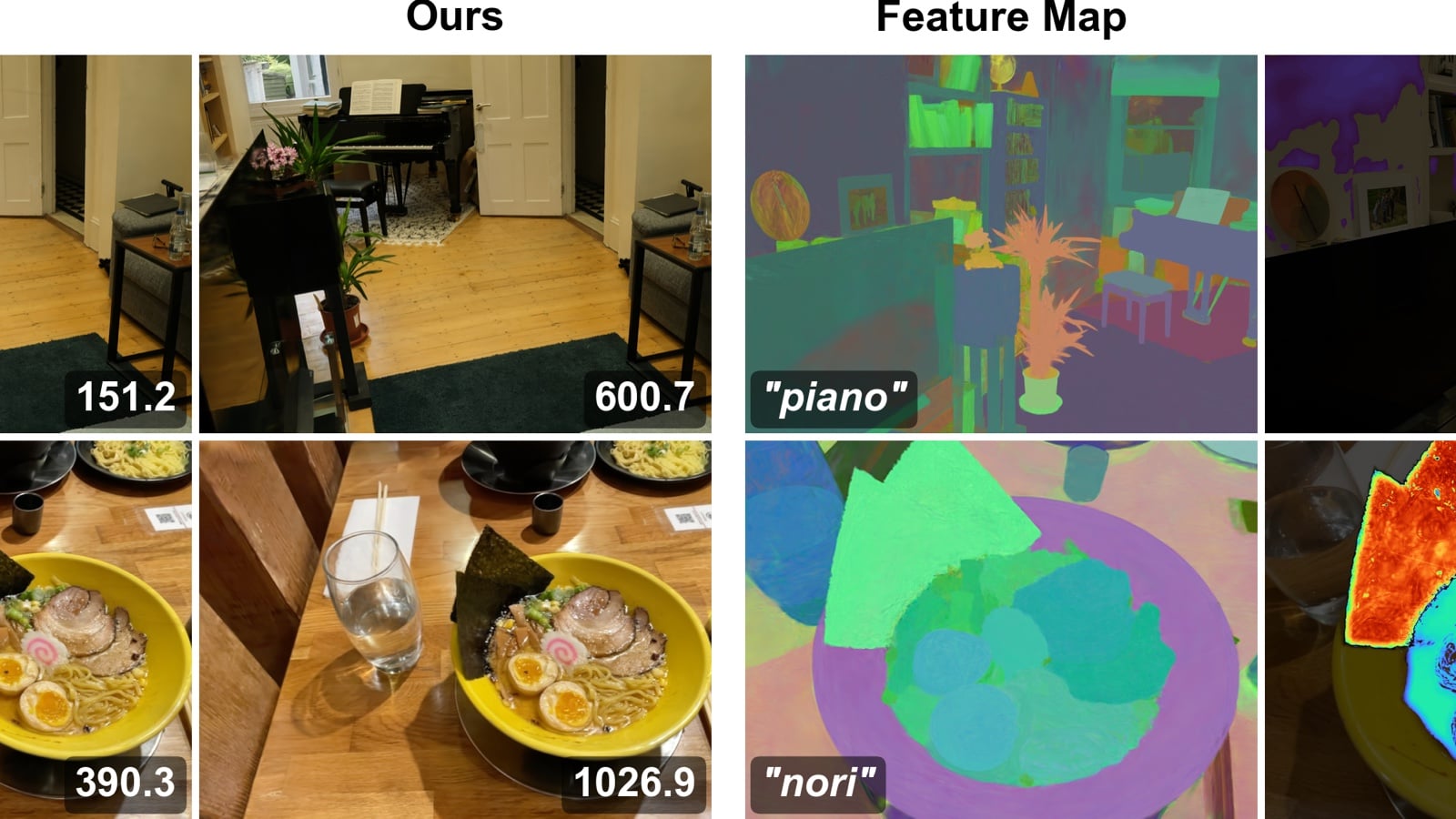
Yangming Zhang and colleagues at the University of Texas at Arlington, with co-authors at Snap, the University of Texas at Dallas, the University of Georgia and Argonne National Laboratory, present MatrixSplat, a paper submitted to arXiv on 11 November 2026, for rendering 3D Gaussian splats, including high-dimensional semantic features, on modern GPUs.

They argue that standard 3DGS pipelines are a poor fit for current hardware: depth-sorted alpha compositing creates strong per-pixel dependencies, so execution stays on scalar fused-multiply-add units and leaves high-throughput matrix units such as Tensor Cores unused. That cost grows quickly when each splat also carries a wide feature vector.

MatrixSplat switches feature rendering to an order-independent weighted accumulation, so the work can be expressed as matrix operations. A tile-based splatting pipeline maps feature accumulation to warp-level matrix-multiply-accumulate on Tensor Cores. A warp-granularity packing step groups Gaussians to improve feature reuse, and a lazy, channel-batched fetch keeps shared-memory use down and overlaps memory access with matrix work.

On Mip-NeRF 360, LERF and 3D-OVS, the authors report up to a 3.8 times speedup over 3DGS and a 2 times speedup over TC-GS, with rendering quality and semantic accuracy held. For high-dimensional features they report render-kernel time reductions of up to 36.7 times. When the method is added to existing fast renderers, they measure a further 1.69 to 2.84 times speedup, including about 2.3 times over FlashGS on an RTX 4090, an RTX 6000 Ada and an H100.

Déjà View, a NeurIPS 2026 oral, loops one transformer block for multi-view 3D reconstruction

arXivPapers

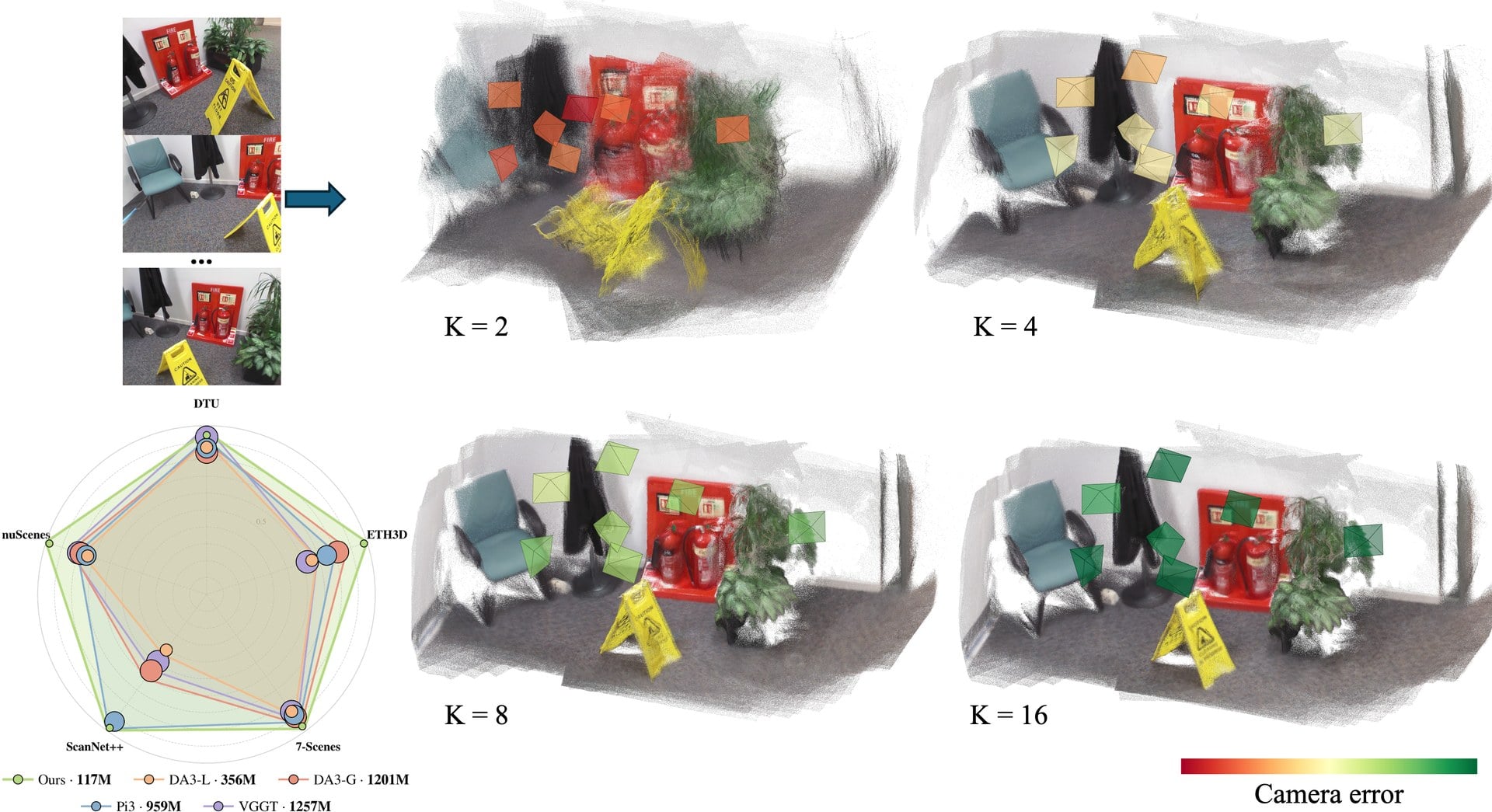
NVIDIA AI posted on 11 November about Déjà View, a NeurIPS 2026 oral paper that reconstructs camera poses and dense geometry from unposed multi-view photographs by applying a single transformer block recurrently. The method, on arXiv since 28 May 2026, is not a Gaussian Splatting pipeline: two lightweight heads decode the looped state into per-view depth and ray maps. A project page and code on GitHub accompany the paper. Alessandro Burzio and Tobias Fischer are listed as equal first authors, with colleagues at NVIDIA, the University of Modena and Reggio Emilia, the University of Toronto and ETH Zürich.
The authors describe a 117-million-parameter model that, once trained, exposes the loop count K as an inference-time compute knob. They report that it matches or outperforms much larger feed-forward baselines across five reconstruction benchmarks spanning indoor, outdoor, object-centric and driving scenes, using 8–10× fewer parameters and 1.9–2.3× less compute than π³ and Depth Anything 3. Per-view features are initialized from a pretrained DINOv2 encoder.

GEMOR-GS refines LiDAR–camera extrinsics and relocalizes inside a Gaussian SLAM map

arXivPapers

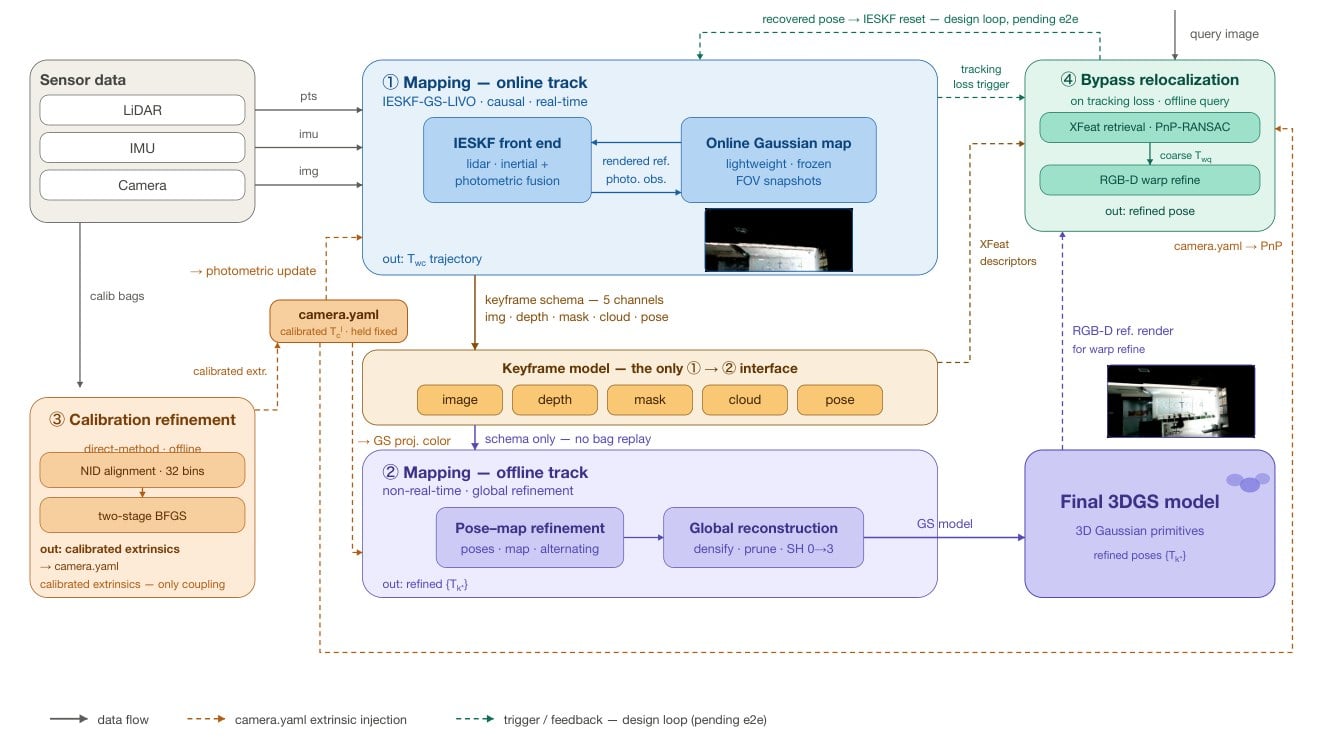
Yuchen Yang, Ming Ding, Xinyu Wu and Hesheng Wang present GEMOR-GS, submitted to arXiv on 10 November 2026, a LiDAR–inertial–visual SLAM method that aims to make a 3D Gaussian map geometrically accurate, globally refined and re-enterable after tracking loss. Before mapping, the LiDAR–camera extrinsic is estimated offline by direct-method alignment over dedicated calibration segments and then reused. Under that calibrated geometry, keyframe poses and Gaussian parameters are refined alternately under a gated differentiable-rendering and LiDAR-projection objective, after which a final global reconstruction is rebuilt from the refined keyframes.

For relocalization, the method recovers pose from the Gaussian map through an XFeat bypass map, RANSAC-PnP coarse localization and Gaussian RGB-D warp refinement. On one self-collected and five public sequences, the authors report that the offline reconstruction improves on the online map by 14.3–19.9 dB on all paired keyframes, improves PSNR by approximately 9 dB over Gaussian-LIC2, and achieves 86–100% held-out relocalization success on most estimated sequences, with reliability tied to extrinsic quality. The paper lists a public repository at github.com/Vector-4D/gemor-gs; that URL returned 404 when checked on 12 November 2026.

DepthGS uses depth-guided adaptive regularization for Gaussian surface reconstruction

arXivPapers

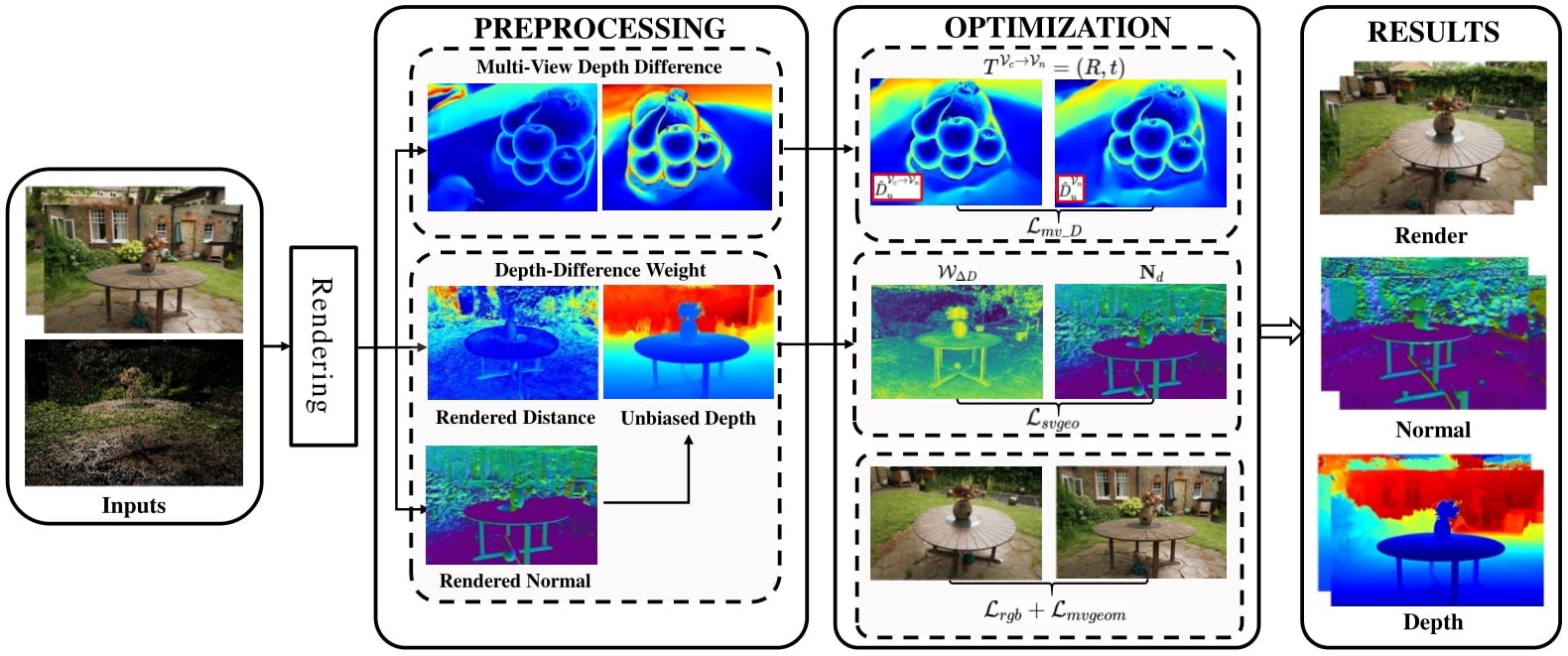
Xiao Ren, Yu Liu, Ning An, Jian Cheng, Xin Qiao, You-Fu Li and He Kong introduce DepthGS, submitted to arXiv on 10 November 2026, a depth-guided Gaussian Splatting method aimed at surface reconstruction. The authors derive relationships, and upper bounds, between depth discrepancies and reconstruction error in single-view and multi-view settings, then use that analysis to design two regularizers. A single-view term weights a normal constraint by a reliability score from local depth differences, applying a stronger constraint where the depth difference is small and a weaker one where it is large. A multi-view term encourages consistency between neighbouring-view depth maps and depths obtained by transforming the current view into those neighbours.

On DTU, DepthGS reports a mean Chamfer distance of 0.51 mm in 17.6 minutes, compared with 0.53 mm for PGSR under a similar setting, ranking second among the methods in their table. On Tanks and Temples it reports a mean F1-score of 0.503, close to GSPrior’s 0.507. On Mip-NeRF 360 it reports the lowest LPIPS of the compared methods for outdoor, indoor and overall averages, with competitive PSNR and SSIM.

FastWild-GS trains in-the-wild Gaussian Splatting scenes in minutes

arXivPapers

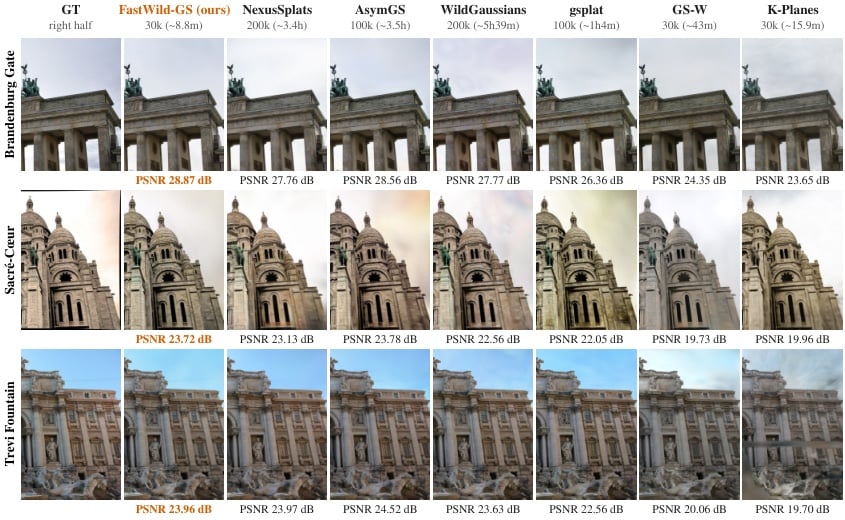
Donghun Ryu, Seokhyun Kim and Minhyeok Lee of Chung-Ang University present FastWild-GS, submitted to arXiv on 10 November 2026, for reconstructing scenes from unconstrained internet photo collections whose exposure, lighting and transient objects vary from image to image. Each photo is described by a 128-dimensional Photo Appearance Token and a six-parameter per-channel scale-and-offset transform. A small MLP predicts each Gaussian’s colour from that token and a per-Gaussian feature, replacing spherical-harmonic colour. The same transform is applied to the renders used for densification and pruning, so appearance differences are not treated as reconstruction error.

On PhotoTourism, the authors report 8.8 minutes of training per scene on one RTX 5090, the lowest LPIPS among the compared methods, and a 23× speed-up against AsymGS, the next-best method on LPIPS. On NeRF-OSR they report the best average PSNR, SSIM and LPIPS among the compared methods, in 9.7 minutes per scene.

RetinexGS reconstructs low-light scenes from noisy RAW images with factorized Gaussian colour

arXivPapers

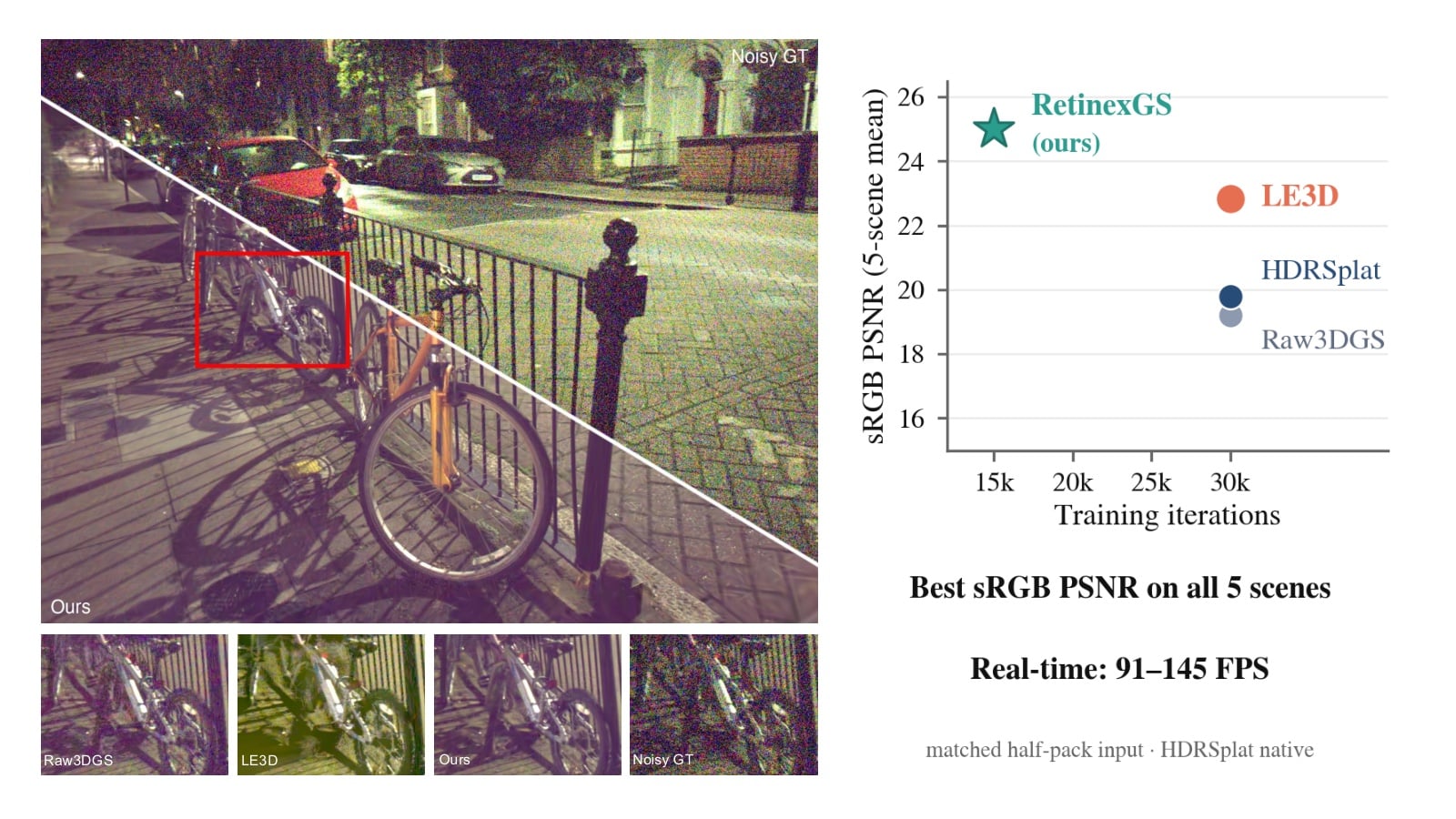
Yulang Fei, Huaiyuan Weng and Chul Min Yeum of the University of Waterloo present RetinexGS, submitted to arXiv on 9 November 2026, a RAW-domain 3D Gaussian Splatting method for novel-view synthesis from severely underexposed photographs. Standard 3DGS pipelines often produce unstable colours, floating artifacts and missing geometry in the dark. RetinexGS works on linear RAW measurements and, inspired by Retinex theory, factors each Gaussian’s colour into a view-independent base colour and a shared, position- and view-dependent modulation field, regularizing the two parts separately.

The reconstruction loss is weighted with DNG noise metadata so that signal-dependent noise is taken into account, and lens distortion is handled in the rasterizer so RAW targets are not spatially resampled. Depth-guided initialization adds points in dark regions where structure-from-motion is sparse. Across three public RawNeRF scenes and two custom low-light captures, and with all methods trained on the same RAW inputs per scene, the authors report that RetinexGS outperforms LE3D and RawNeRF in mean sRGB PSNR by 2.18 dB and 2.71 dB respectively, while rendering in real time (91–145 FPS at 2016×1512 on one RTX 4090).

DPGS-SLAM uses diffusion priors for monocular Gaussian SLAM in dynamic scenes

arXivPapers

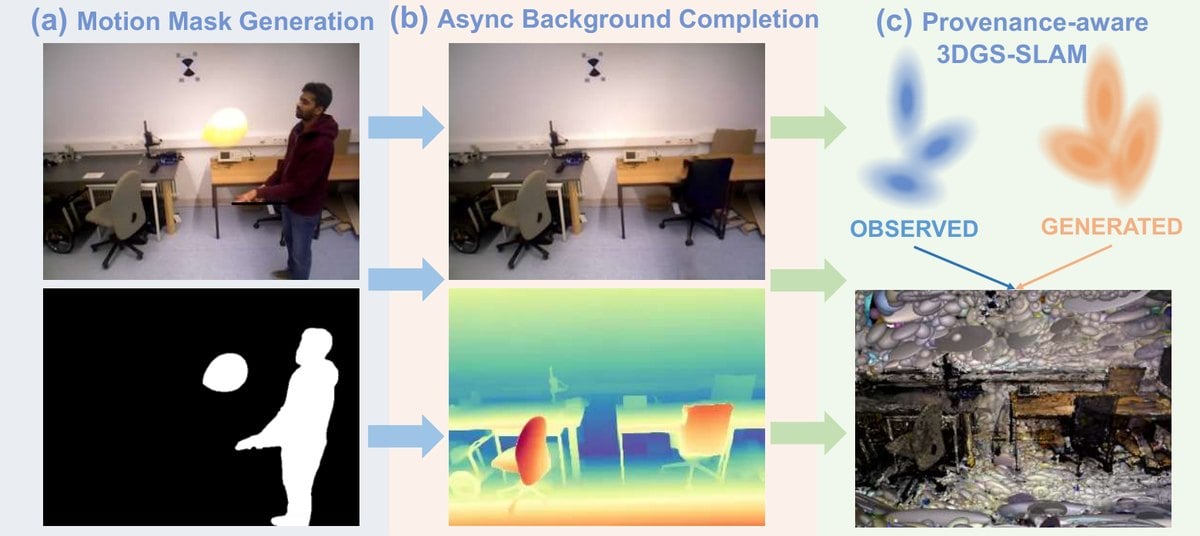
Yifan Luo et al. present DPGS-SLAM, a monocular RGB Gaussian Splatting SLAM system for environments that contain dynamic objects. Dynamic observations can contaminate tracking and mapping, but simply dropping them can leave occluded static backgrounds missing or weakly constrained.

The system completes those backgrounds asynchronously with a diffusion model and initializes provisional Gaussians from the completed images. Provenance labels keep generated primitives out of pose estimation and observed-map optimization, and they are removed when the real background becomes visible. The authors report average ATE RMSE of 1.2 cm on TUM RGB-D and 2.7 cm on BONN RGB-D, and a 4.60 dB average PSNR gain over WildGS-SLAM on StaDy4D using only monocular RGB.

Plant Orbiter generates 3D Gaussian plant models from a single image

arXivPapers

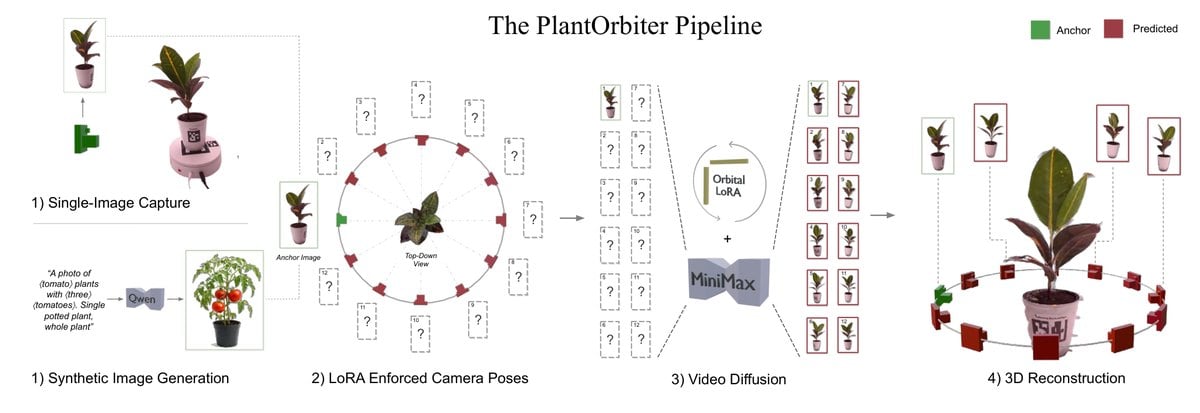
Zane K. J. Hartley et al. present Plant Orbiter, a method that uses video diffusion to produce 3D Gaussian Splats of plants from a single image, submitted to Plant Phenomics. They argue that high-throughput 3D plant phenotyping is still hard because of complex morphology, thin structures and occlusions.

The authors report the highest 3D F-score against the compared baselines and say the approach is more practical for high-throughput pipelines because camera placement is cheaper and alignment is easier. Combined with a 2D diffusion model, they also report state-of-the-art results for generating 3D plant models from a text prompt.

A software scheduler cuts SM-level load imbalance in 3D Gaussian Splatting on GPUs

arXivPapers

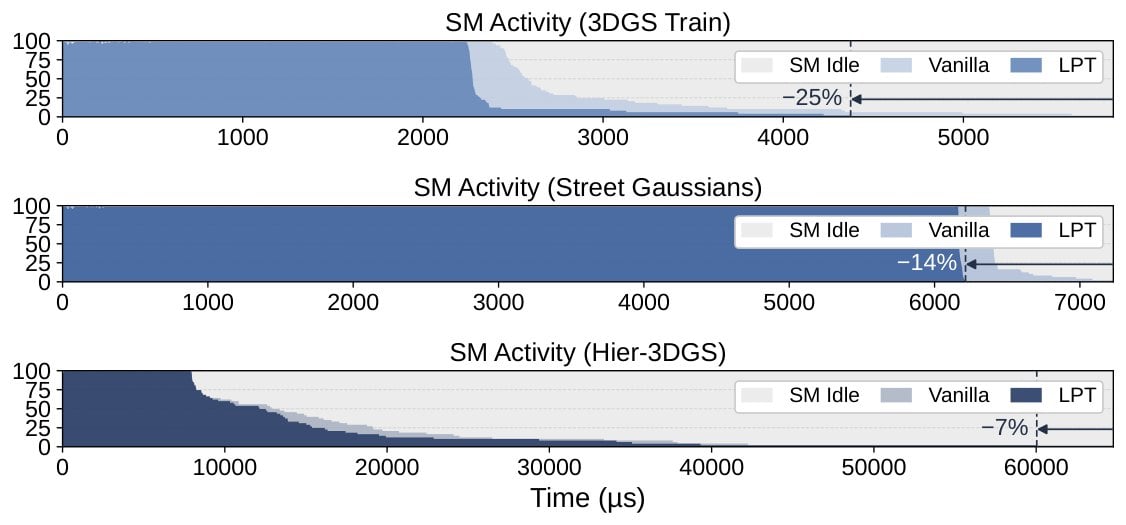
Junha Ryu and Hoi-Jun Yoo identify severe SM-level load imbalance in GPU 3D Gaussian Splatting, caused by uneven work across screen tiles, which leaves most SMs idle while a few process heavy tiles, especially in large urban scenes. Their software-defined scheduler uses a persistent kernel to schedule heavy tiles first and optionally chunks outlier tiles across multiple CTAs, with a lightweight per-frame policy based on tile statistics already in the pipeline.

The approach needs neither retraining nor specialized hardware and is described as orthogonal to existing optimizations. Averaged per scene, the authors report that it accelerates alpha blending by up to 2.93× on a large-scale urban scene, and by up to 5.6× on its most imbalanced frames, while retaining the original alpha-blending formulation.

Spaghetti Splatting differentiates curvilinear primitives by convolution

arXivPapers

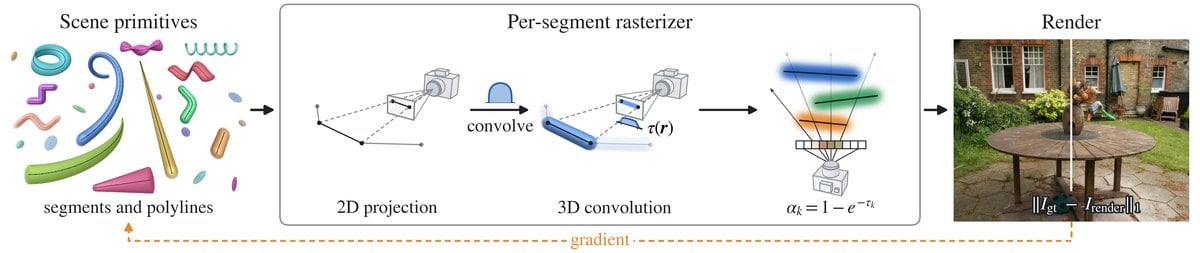
George Shramko et al. introduce Spaghetti Splatting, a method for learning curvilinear 3D primitives from images by volume rendering. Points, lines and triangles are Dirac masses, so the authors follow the same convolution recipe used by EWA splatting and 3D Gaussian Splatting, approximating curves with polylines whose convolution converges to that of the continuous curve and rendering segments so joints are not overcounted.

Linearizing the camera projection per segment also allows kernels beyond Gaussians, such as beta kernels. Because a point is a curve of zero length, the representation is a strict superset of 3D Gaussian Splatting. The authors say it stays competitive on general scenes, outperforms methods specialized to line-like geometry, supports anti-aliasing, and produces long connected strands that can be used in physics simulation.

UltraVoxelGS predicts ultrasound Gaussian scenes in seconds from posed slices

arXivPapersHardware

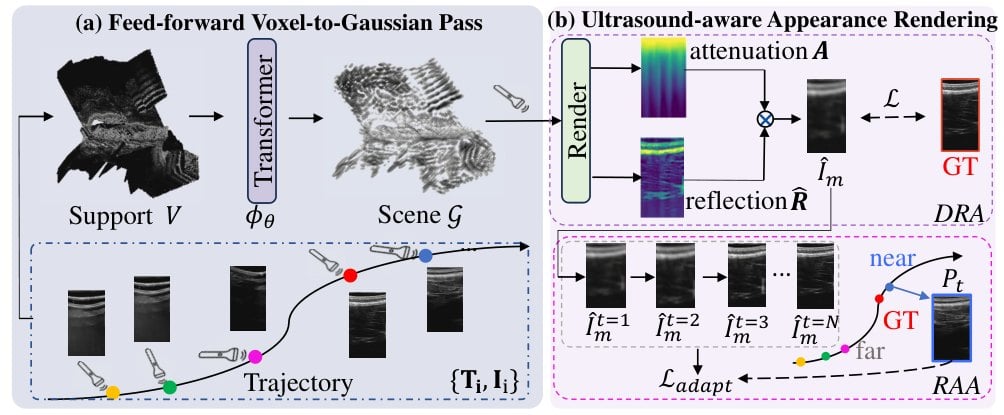
Yue Wang, Haoxin Chen and Xiaoqing Guo present UltraVoxelGS, a feed-forward 3D ultrasound reconstruction method that predicts a complete Gaussian scene from posed ultrasound images, avoiding per-scene optimization. Ultrasound slices share at most one-dimensional intersections and have view-dependent appearance from acoustic propagation, which breaks assumptions used by feed-forward Gaussian methods designed for natural images.

The system packs slices into a fixed-size voxel support and predicts Gaussian parameters directly, with an ultrasound-aware appearance model that factorizes reflection from cumulative attenuation. On real and simulated data, the authors report the best PSNR and SSIM among the compared per-scene baselines while cutting inference from 10–20 minutes to about 10 seconds, and they say it scales to sequences of more than 1,000 frames.

FastGRT speeds up 3D Gaussian ray-tracing training in Vulkan

arXivPapers

Meet Banthia et al. present FastGRT, a set of training-time optimizations for Gaussian-based ray tracing, which they say is much more expensive to train than rasterized 3D Gaussian Splatting. After studying how Gaussian ray tracing runs on GPUs, they decouple ray traversal from blending and reuse work from the forward pass in the backward pass, with further changes including faster gradient accumulation and a hybrid BVH update strategy.

The authors implement FastGRT in Vulkan and describe it as the first Vulkan-based Gaussian ray-tracing system they know of that supports both training and rendering. Compared with 3DGRT, they report 1.9× to 4.97× shorter training time while preserving the original rendering formulation, and they say the code is open source.

ClearForm reconstructs transparent and opaque surfaces with shared planar Gaussians

arXivPapers

Hajeong Lee and Jong-Il Park present ClearForm, a shared-planar-Gaussian method for jointly reconstructing transparent interfaces and the appearance seen through them. They analyze a Geometry-Appearance Compositing Dilemma: when the same transparency-dependent alpha controls both color and geometry, revealing the background can weaken a transparent surface’s contribution to geometric reconstruction.

Geometry-preserving dual-opacity reconstruction keeps interface contributions in the geometry compositor while modeling appearance separately, and a Dual-Evidence Lifecycle retains Gaussians supported by multi-view geometry or RGB evidence. On 3D-FRONT-T they report 27.05 mm Chamfer distance and 0.928 F1, compared with 59.18 mm for their PGSR reproduction; on TransLab they report 1.65 mm Chamfer distance, 0.963 F1 and 40.14 dB PSNR.

PLS-GS builds a compact, surface-aligned Gaussian scene from camera and LiDAR

arXivPapersHardware

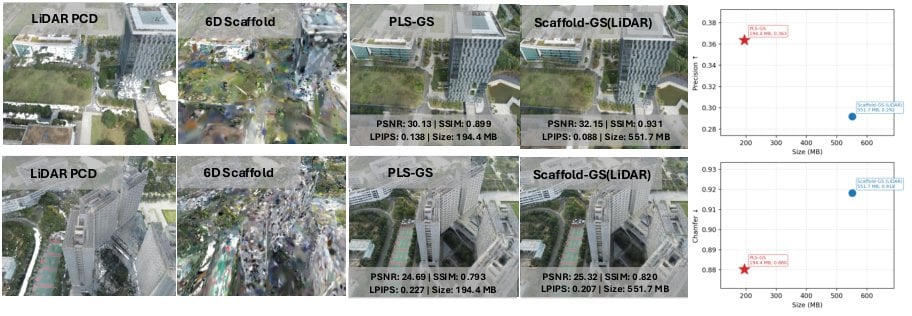
Krishnan Harikumar et al. introduce PLS-GS, accepted to WACV 2027, a probabilistic LiDAR scaffold for Gaussian Splatting when both camera images and high-definition LiDAR are available. A hierarchical Gaussian mixture is fitted jointly over position and color, giving a continuous adaptive scaffold that does not need voxel grids or octrees.

Each renderable 3DGS Gaussian is then tied to a mixture component and constrained in the local surface frame induced by that component’s covariance, with a Mahalanobis support loss limiting how far it may drift. The authors present this as a compact representation aligned to the measured surface.

RefineSplat reconstructs each object with its own Gaussians for open-vocabulary queries

arXivPapers

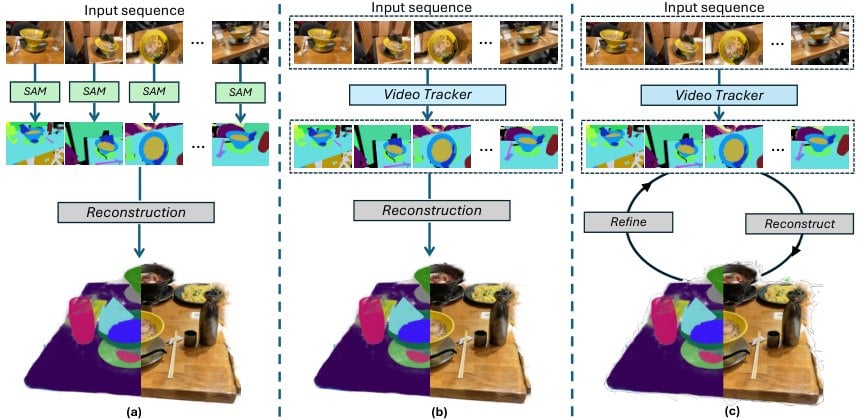
Yiren Lu et al. present RefineSplat, a reconstruction-guided extension of their earlier Segment-then-Splat framework for open-vocabulary 3D scene understanding. Methods that splat a scene first and add labels afterwards, they argue, often suffer from view inconsistency, ambiguous object boundaries and weak object-level correspondence.

RefineSplat tracks objects in 2D and then reconstructs each one with a dedicated set of 3D Gaussians, keeping an explicit object-to-Gaussian correspondence for unified open-vocabulary segmentation and retrieval. The paper describes further robustness work on top of that object-centric reconstruction.

SHIN adds a reusable quality hierarchy to incremental 3D Gaussian Splatting

arXivPapers

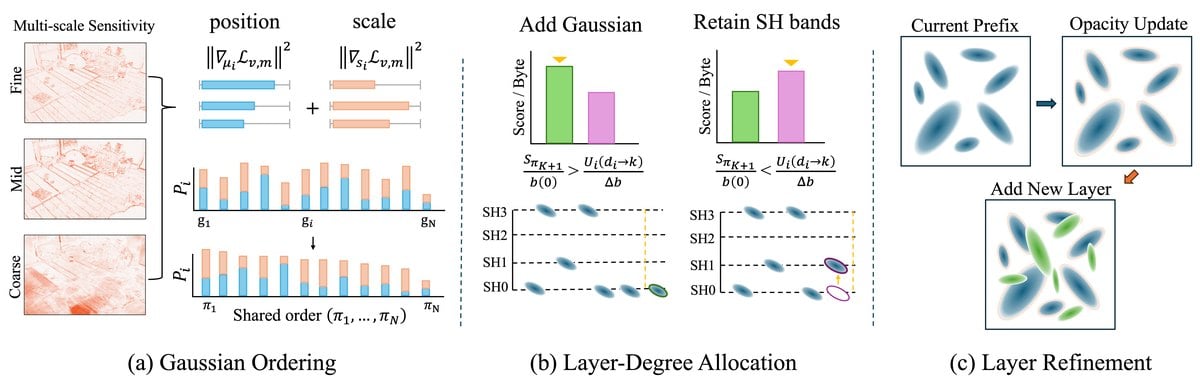
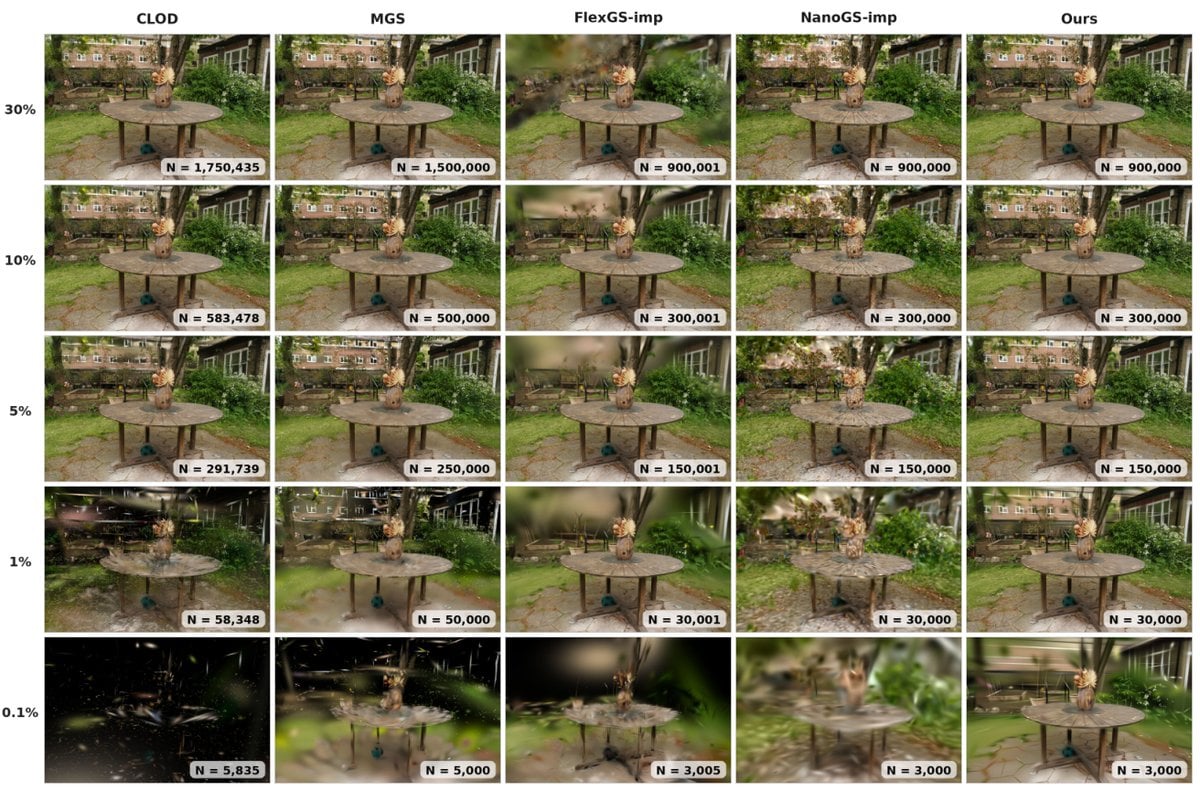
Reagan Koo et al. present SHIN, a scalable 3D Gaussian Splatting hierarchy with a reusable Base and additive enhancement layers, so a higher-quality operating point extends the already decoded representation rather than replacing it. Most compact methods, they note, target a single budget and need a separate representation for any other one.

The hierarchy is built by deriving one shared Gaussian order from multi-scale position-scale sensitivity and splitting each stage’s budget between adding Gaussians and retaining spherical-harmonic bands, using calibrated gradient-based scores per byte. Lightweight opacity updates adjust compositing while the stream is in progress, so the same asset can serve different device and network budgets.

RigidGS decouples object identity from geometry for interactive Gaussian scenes

arXivPapers

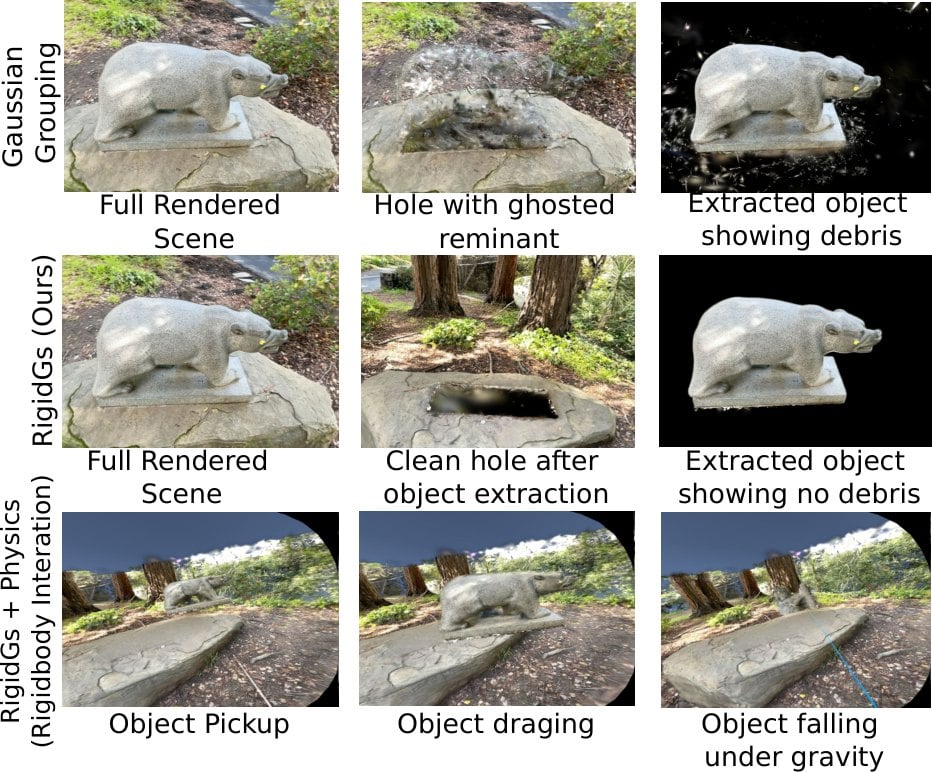
Paul Sansah Gyreyiri and Diksha Shukla present RigidGS, accepted to WACV 2027 (Applications Track), for object-level manipulation in 3D Gaussian Splatting scenes aimed at interactive VR and MR. They argue that methods which jointly optimize geometry and semantic identity suffer from noisy foundation-model masks and from label-geometry coupling that mislabels boundary Gaussians.

RigidGS determines object identities upstream via COLMAP projections and uses a depth- and temporally-aware mask refinement module to address two SAM2 failure modes: over-inclusion on thin structures and under-inclusion on objects with multimodal depth. Geometric learning is then kept separate from those identities.

AffineGS rectifies monocular depth region by region for more accurate 3DGS geometry

arXivPapers

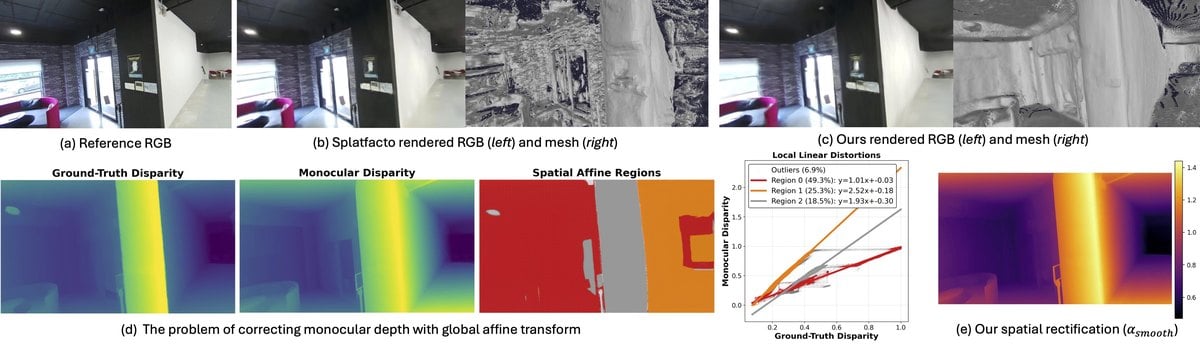
Tze Ho Elden Tse et al. present AffineGS, accepted to NeurIPS 2026, which targets the geometric accuracy of 3D Gaussian Splatting when monocular depth is used as a prior. They report that modern monocular depth networks show region-dependent, piecewise-linear distortions, so a single global scale-and-shift alignment can warp the scene.

The method applies a spatially varying affine rectification that uses regionally smooth, edge-aware fields to turn monocular disparity into more consistent metric depth, plus a normal-aware regularizer that couples the rectified disparity with 3DGS depth and normals.

EDGAR uses a diffusion model to refine artifact-prone Gaussian head avatars

arXivPapers

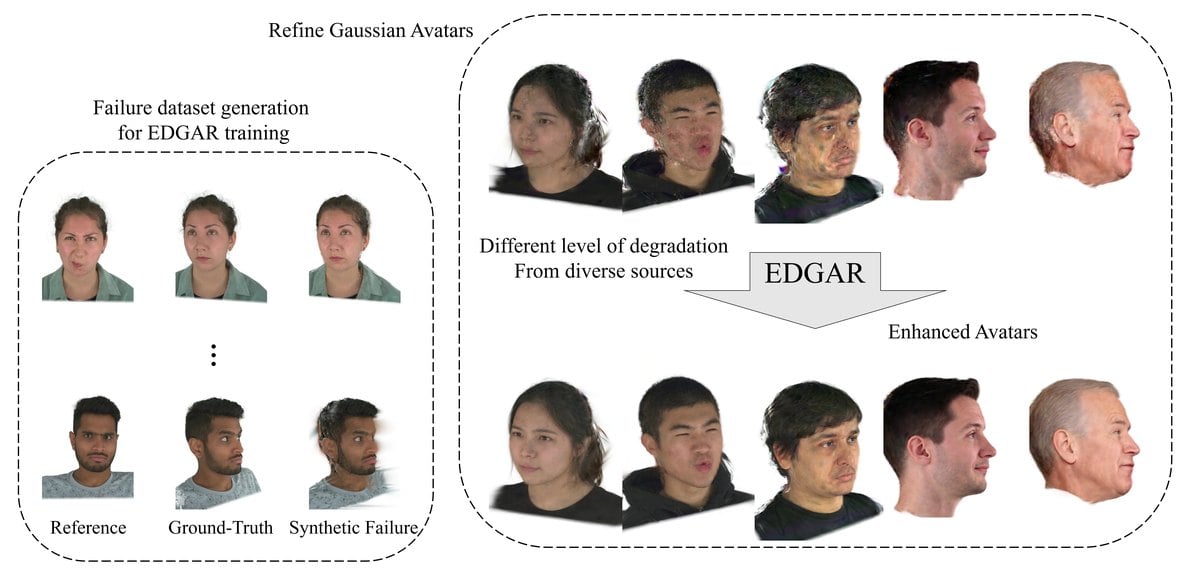
Kwan Yun et al. present EDGAR, a conditional diffusion framework accepted to ACM Transactions on Graphics that refines Gaussian head avatars while trying to preserve identity. Monocular video or image reconstruction can leave under-constrained geometry and texture, showing up as blur, stretching or temporal instability.

The authors train on EDGAR-SET, a hybrid triplet dataset of real and synthetic samples that pairs degraded Gaussian renderings with ground-truth and reference images. Identity features from the self-supervised Sapiens model are injected into the diffusion process, and a single underlying Gaussian avatar can then be rendered without running EDGAR on every output frame. Experiments on three avatar methods report gains in perceptual and reconstruction metrics, including under large yaw and open-mouth expressions.

HIBS brings beta kernels to incremental online Gaussian reconstruction

arXivPapers

Linus Franke presents Hierarchical Incremental Beta Splatting (HIBS), accepted to WACV 2027, for online reconstruction in which each keyframe can spawn primitives only once and refine them for a few dozen iterations. The shape parameter of beta kernels interpolates between a soft, Gaussian-like profile and a flat-topped, near-opaque surfel, which the paper treats as a confidence dial for geometry.

Confidence-aware spawning uses geometric observability and multi-view depth agreement to initialize opacity and shape, putting solid primitives where geometry is verifiable and softer, correctable ones where it is not. Error-driven relocation recycles stale primitives into photometric-error regions as a form of online densification.

InstantHand builds an animatable Gaussian hand avatar from a single image

arXivPapers

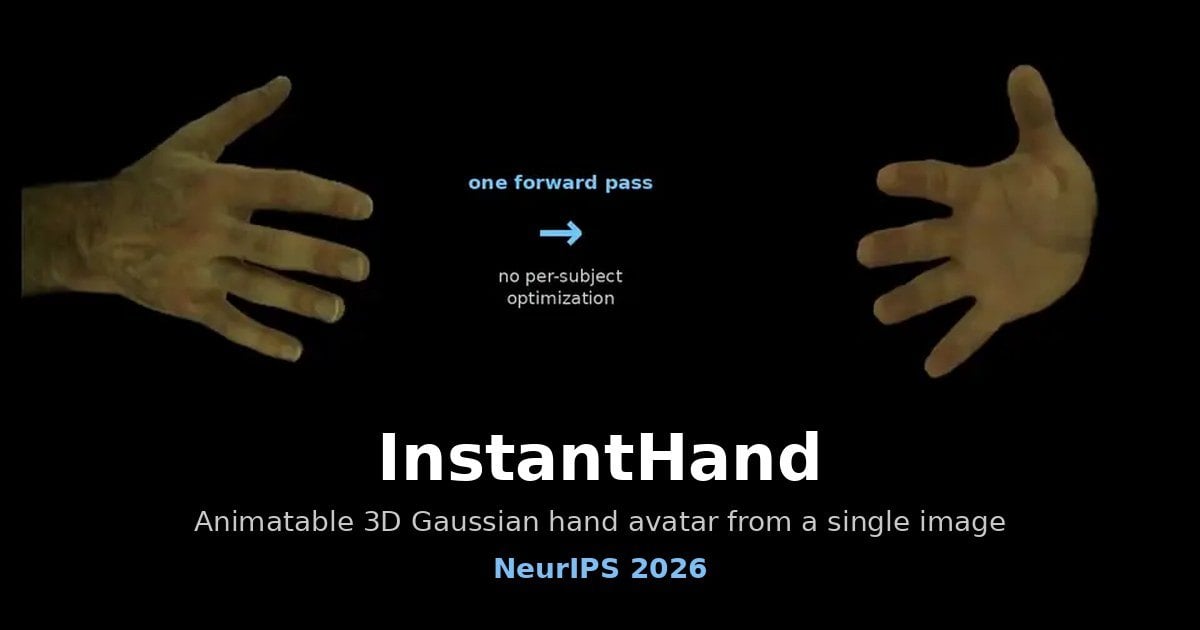
Chanho Kim et al. introduce InstantHand, a feed-forward method accepted to NeurIPS 2026 that constructs an animatable 3D Gaussian hand avatar from a single image, using off-the-shelf MANO, camera and mask estimates and no test-time optimization. A Soft Alpha Band regularizer concentrates supervision on silhouette boundaries to limit alpha leakage that would otherwise thicken thin finger contours.

Reliability-gated Appearance Transfer keeps observed colors where a Gaussian contributes to the rendering, and fills unobserved regions from a learned prior. The authors position the work against typical multi-view capture or per-subject optimization pipelines for hand avatars.

MOMASPLAT augments mobile-manipulation demos with dynamic novel-view splats

arXivPapers

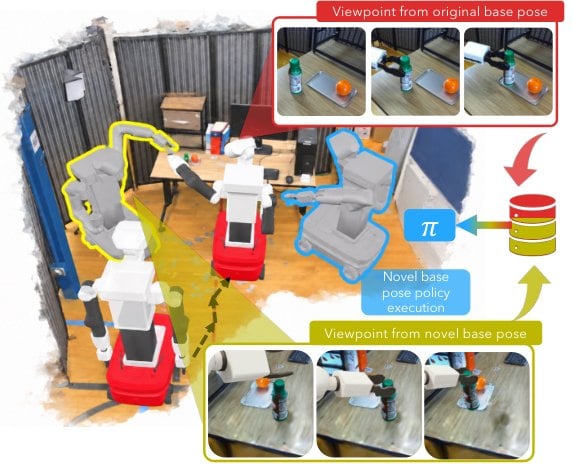
Sateesh Kumar et al. present MOMASPLAT, a novel-view demonstration augmentation method for mobile manipulation. Visuomotor policies are sensitive to camera viewpoint, and mobile robots rarely repeat the exact base pose used while collecting demonstrations; prior novel-view synthesis tools assume static scenes and therefore fail to re-render the object once contact begins.

MOMASPLAT synthesizes full manipulation trajectories from unseen robot base poses, including the dynamic object interaction after contact. The authors say that is the portion of a demonstration that most needs augmentation and is usually left unaugmented.

P-MGS allocates mesh-based Gaussians by appearance complexity, not face count

arXivPapers

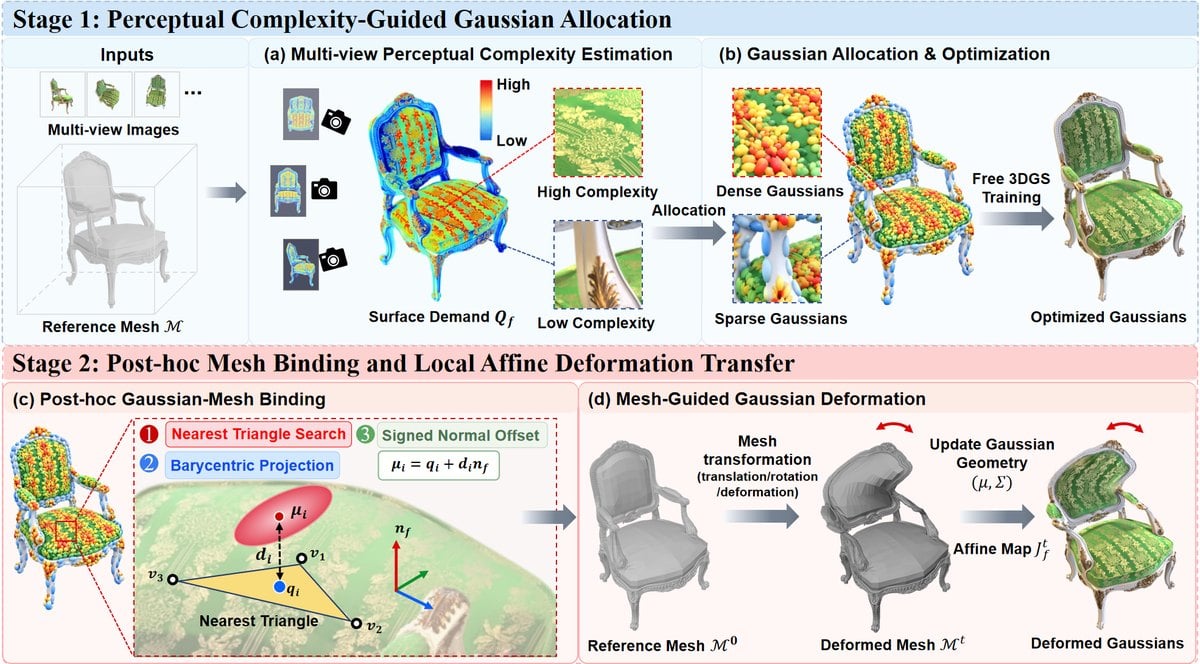
Yuting Wang et al. propose P-MGS, a mesh-based 3D Gaussian Splatting framework that separates appearance modeling from geometric control. Existing methods that pin a fixed number of Gaussians to each mesh face, the authors argue, ignore that reconstruction capacity should follow local appearance complexity rather than tessellation density.

A perceptual-complexity-guided allocation distributes Gaussians according to surface appearance estimated from multi-view observations, while still leaving the Gaussians free enough to reconstruct well and keeping the mesh available for geometric editing. The paper presents this as a route to high-quality rendering, a more compact representation, and flexible mesh edits.

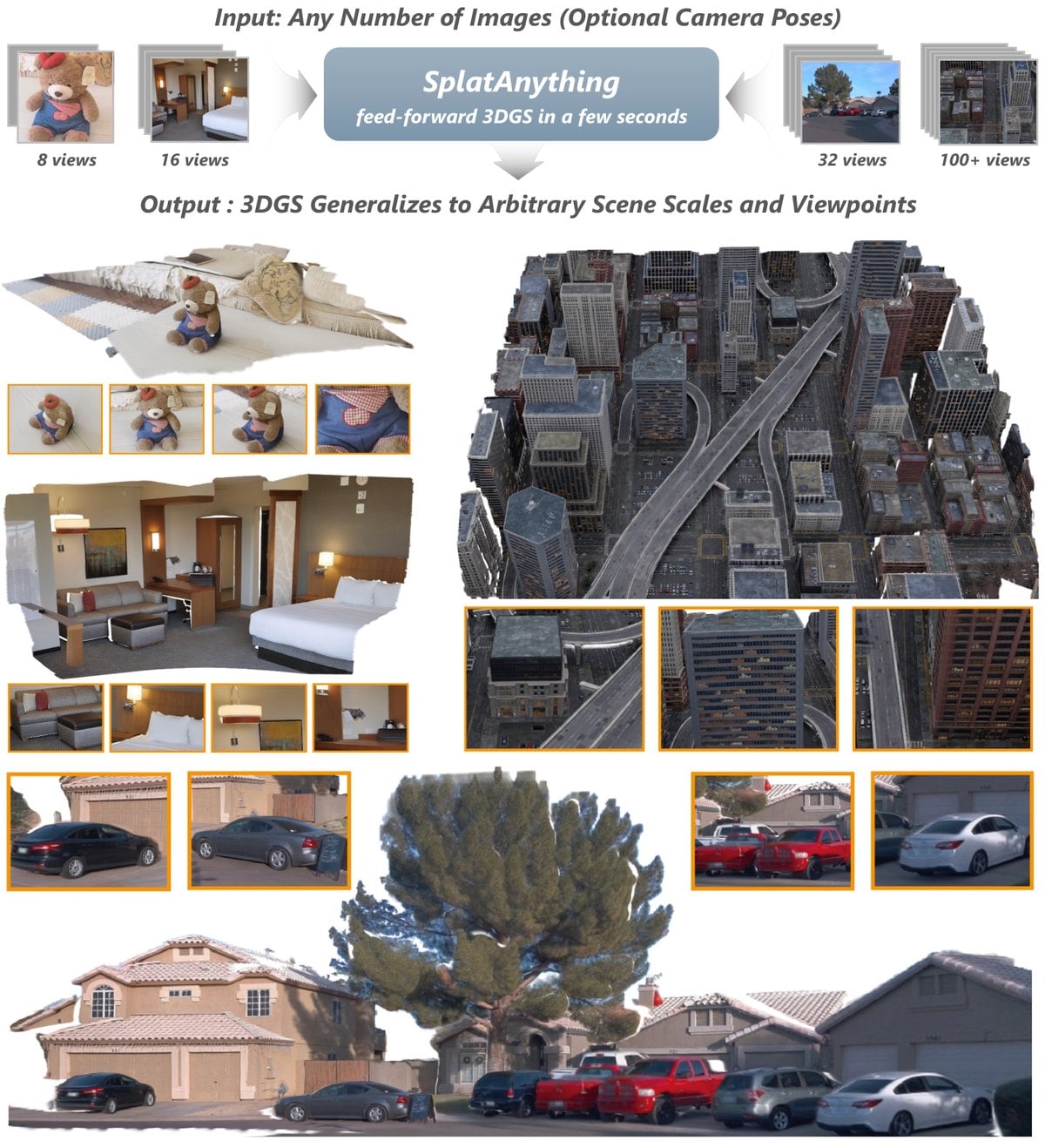
SplatAnything normalizes Gaussian spacing for feed-forward 3DGS

arXivPapers

Hao Yu et al. present SplatAnything, a feed-forward 3D Gaussian Splatting method that addresses a mismatch they identify in existing pipelines: attributes are often predicted in a space normalized by a global radial statistic, while the spacing between neighboring Gaussian centers can still vary widely across scene scales and camera setups. That shift, they argue, makes Gaussian-scale supervision ambiguous.

Gaussian Spacing Normalization (GSNorm) canonicalizes a robust scene-level spacing statistic as a more consistent spatial reference. The authors also introduce a benchmark covering diverse datasets, input sparsity and extrapolated viewpoints, and report state-of-the-art results with the largest gains when scene scale and viewpoint vary substantially.

BudgetSplat lets a single feed-forward model meet a chosen Gaussian budget

arXivPapers

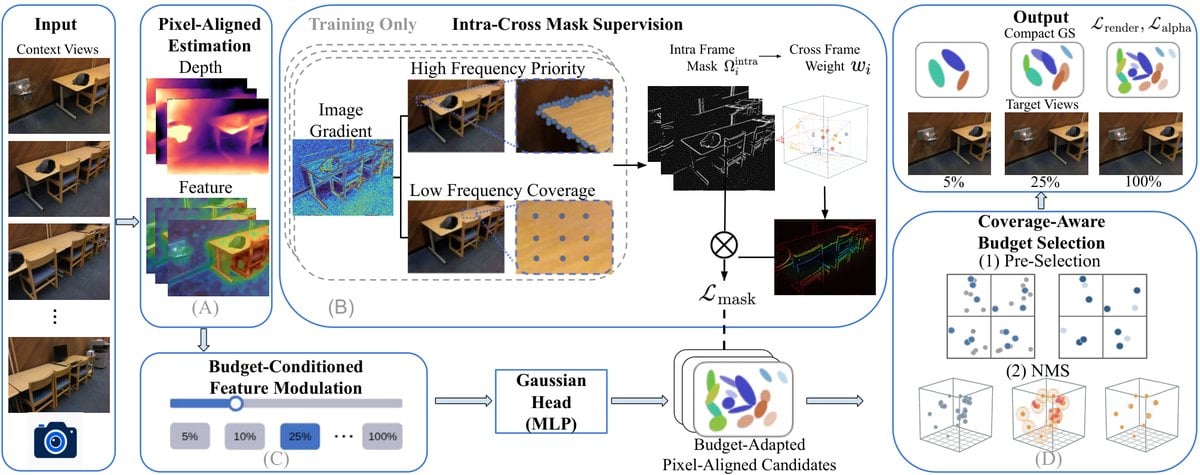
Yuxi Hu et al. introduce BudgetSplat, a feed-forward 3D Gaussian Splatting framework that adapts the final representation to a user-specified preservation ratio. Instead of treating compaction as simple importance ranking, the method jointly considers importance, spatial coverage and cross-view redundancy, and a single trained model can handle different numbers of context views and test-time budgets without retraining or per-scene compression.

Intra-Cross Mask Supervision and budget-conditioned feature modulation guide opacity and attributes, while Coverage-Aware Budget Selection combines patch pre-selection, opacity ranking and 3D redundancy suppression. Experiments on indoor reconstruction and cross-dataset generalization are reported to keep rendering quality while cutting storage and rendering cost across view counts and budgets.

CrossPressor scales feed-forward Gaussian fusion across long camera sequences

arXivPapers

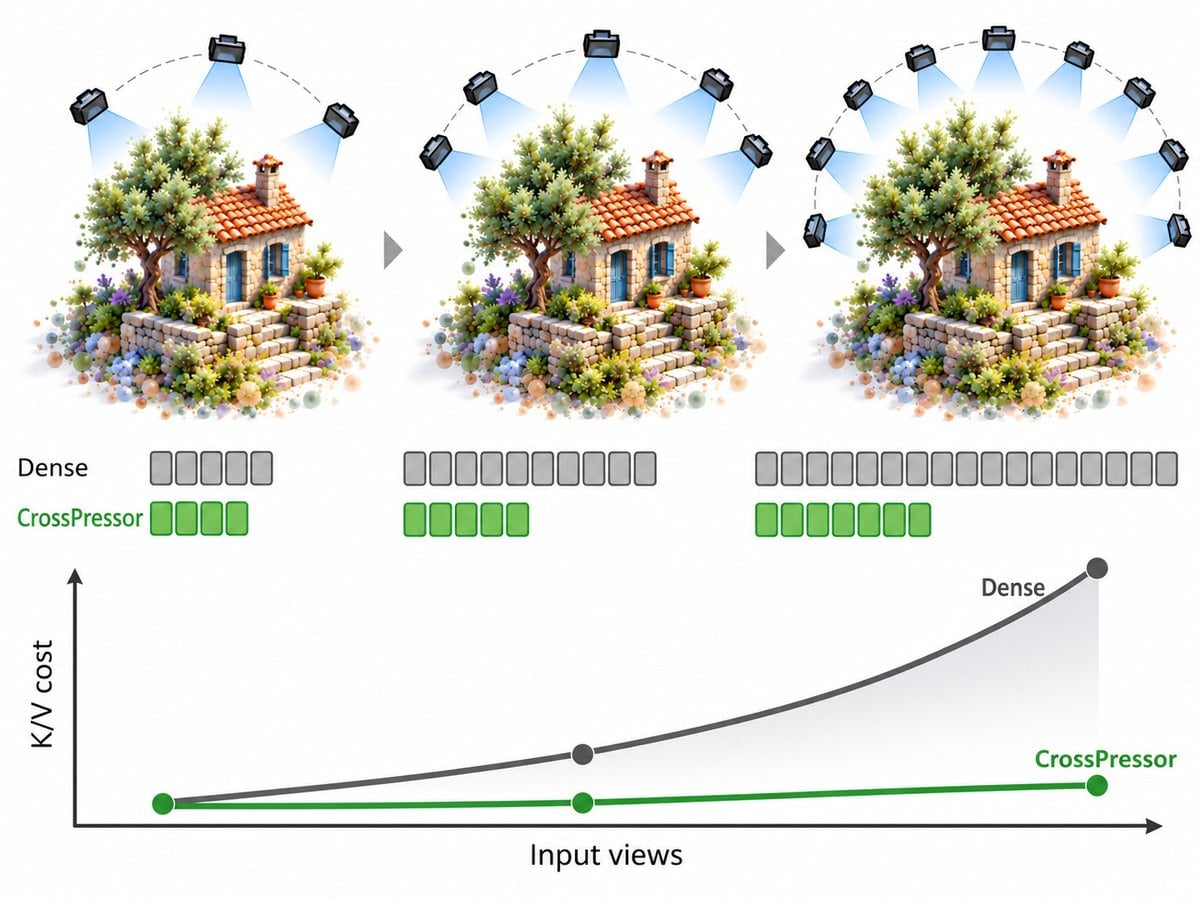
Yuxi Hu et al. present CrossPressor, a training-free method for scalable cross-view fusion in feed-forward 3D Gaussian Splatting, accepted to WACV 2027. Anchor-based compressors such as ZPressor keep a compact set of anchors, but as more support views arrive each anchor has to fuse a longer sequence; CrossPressor keeps the decoder-facing anchor queries and routes evidence across support views and fusion layers instead.

Routing before key/value projection and joint context packing cut support-side fusion cost without retraining. The authors report reconstruction quality close to dense fusion, with up to 26.12× faster cross-view fusion and 1.43× end-to-end acceleration on long input sequences.

METRIC-GS estimates metric scale for indoor Gaussian reconstructions, or refuses

arXivPapers

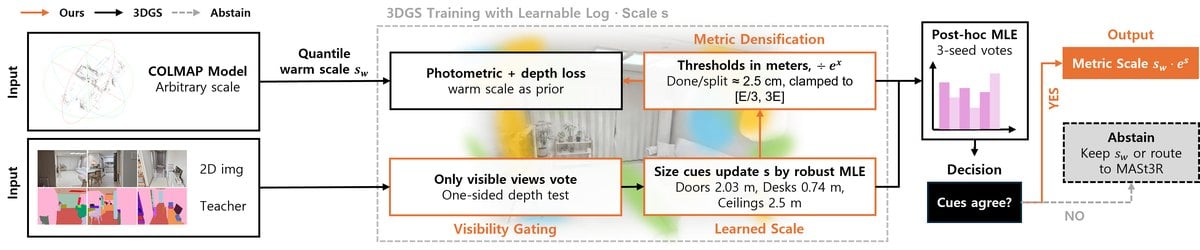
Sooyeun Yang and Jongseong Brad Choi present METRIC-GS, a selective metric-scale estimator for 3D Gaussian Splatting reconstructions of real indoor photographs. Structure-from-motion leaves scenes in arbitrary units; the authors report that a quantile floor-to-ceiling heuristic erred by 27% and metric-depth alignment by 35–71% on five indoor scenes with tape-measured ceilings.

METRIC-GS reads scale from semantic content in the reconstruction, fusing instance-level size priors for doors, tables and floor-to-ceiling gaps, and abstains when the evidence is thin. A hybrid that routes only those refusals to a standalone estimator is the configuration they advocate, and they also report results on 13 of their own phone and drone captures.

OccSplat densifies feed-forward Gaussian driving scenes in occluded regions

arXivPapers

Dung Do Tien et al. introduce OccSplat, a feed-forward 3D Gaussian Splatting framework for driving-scene reconstruction that targets missing geometry rather than missing pixels. The paper, accepted to the ACCV 2026 CV4DC workshop, argues that single-observation feed-forward methods leave Gaussians under-constrained where input cameras cannot see, so novel viewpoints expose incomplete scenes.

Gaussian Occlusion Mapping finds regions without support, Gaussian Occlusion Completion predicts new primitives for those regions, and the added primitives are merged back into the representation without per-scene optimization. On nuScenes, the authors report particular gains in occluded regions and more coherent novel-view driving reconstructions than the compared methods.

An exploratory study turns in-the-wild video into a Gaussian splat digital twin

arXivPapers

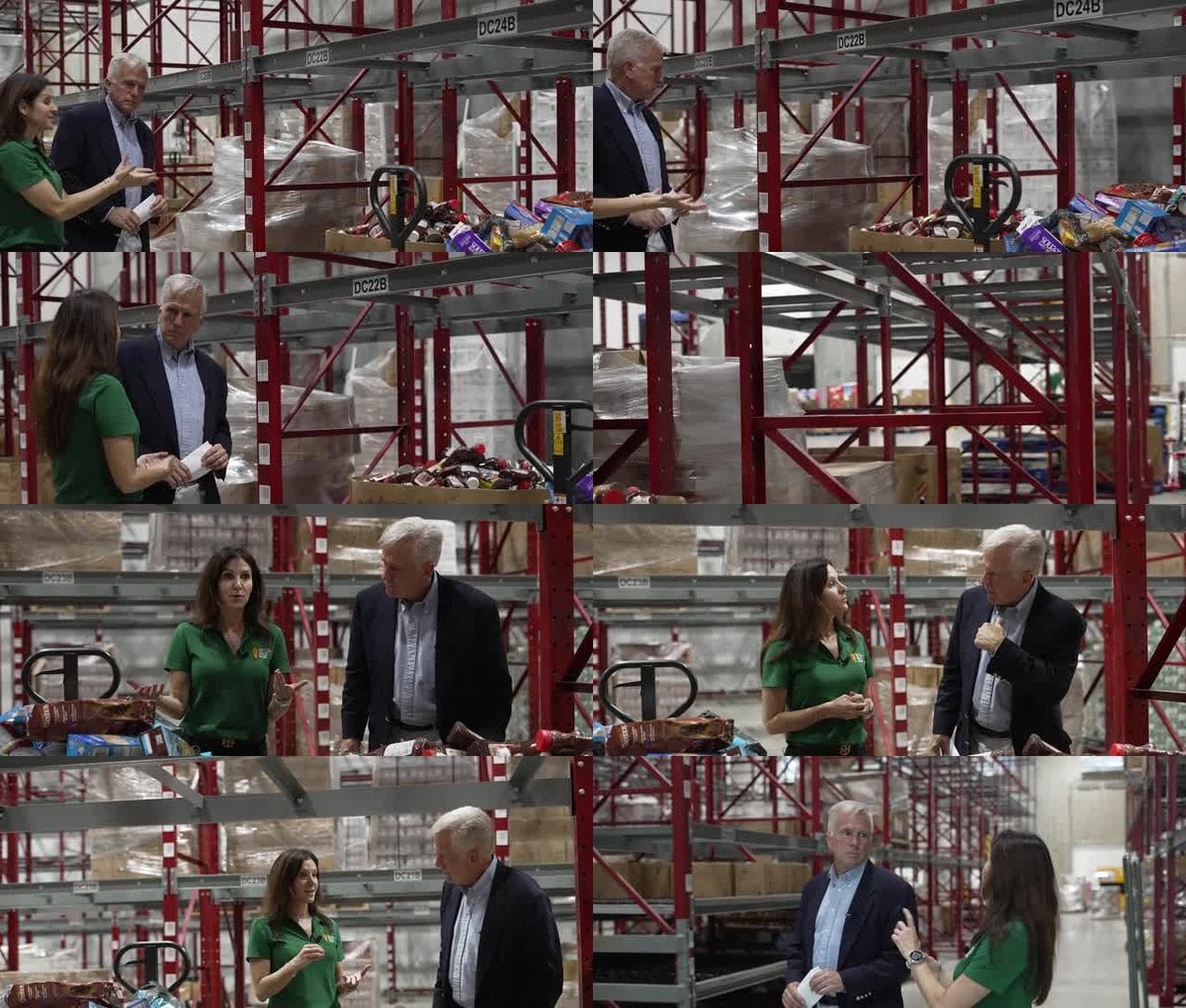
Somesh Mohapatra reports an exploratory study of generative world models and 3D Gaussian Splatting on an uncurated news walkthrough of a food bank warehouse, with no scans or site visit. A commercial world model given 20 frames recovered camera poses and metric depth for three areas, which were fused into about 747,000 Gaussian splats; locally optimized splat models looked photorealistic near the filmed path but degraded quickly away from it.

On held-out frames, scored only in pixels not covered by people, those local models reached 21.2 and 23.1 dB PSNR from 64 and 43 training frames. Attempts to generate views of unseen areas failed on the provider’s side twice, and the author describes the corrections needed to turn the output into a metric OpenUSD asset with its native splat schema. The work is presented as an exploration, not a deployed product.

WV-GS synthesizes a wide driving view from overlapping perspective cameras

arXivPapers

Kaixuan Zhang et al. formulate wide view synthesis: building a geometrically consistent wide image at a virtual viewpoint from multiple spatially separated perspective cameras, a setting they say is common in autonomous driving. Unlike image stitching, the task has to reason about 3D geometry, depth-dependent parallax and occlusions; the authors propose WV-GS, a feed-forward Gaussian-splatting method that avoids per-scene optimization.

Piecewise Perspective Rendering is used to reduce peripheral stretching, and Spatial Affine Photometric Modeling accounts for camera-dependent photometric variation. They also introduce WideDrive, a synthetic benchmark with dense ground-truth wide views, and say the dataset and code will be released.

3DGS-VBench+ and 3DGSV-Assessor score compressed Gaussian splat video quality

arXivPapers

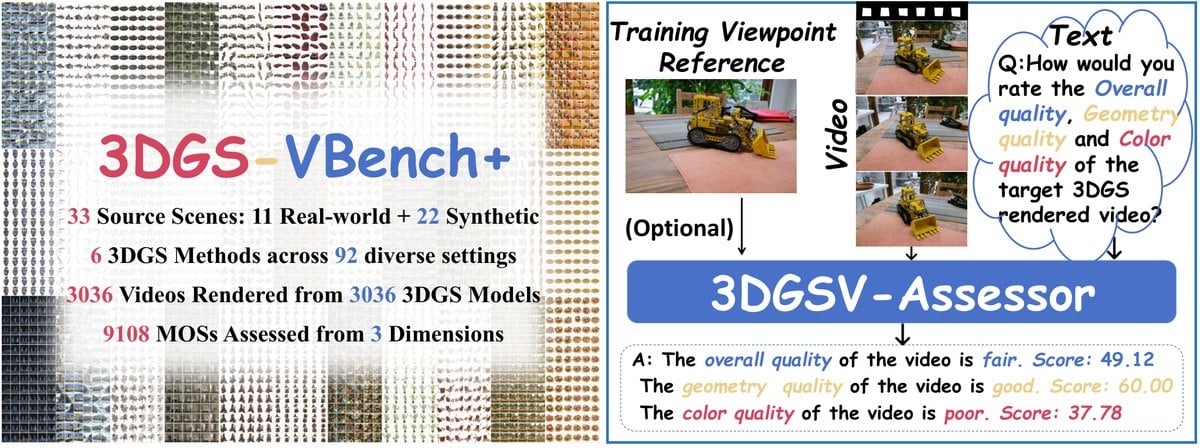
Yuke Xing et al. release 3DGS-VBench+, a subjective quality benchmark for 3D Gaussian Splatting videos, together with 3DGSV-Assessor, a reference-flexible model that scores overall, geometry and color quality in one pass. The benchmark comprises 3,036 reconstructions across 11 real-world and 22 synthetic scenes, each with a rendered video, and 9,108 mean opinion scores covering those three dimensions.

The assessor can run in reduced-reference or no-reference mode by gating a ranking-based reference cue into a frozen regressor. The authors report state-of-the-art correlation with human judgments on their benchmark and strong zero-shot generalization to other novel-view-synthesis test sets, and say the dataset and code will be released on GitHub.

EndoS3 is a Gaussian Splatting semantic SLAM system for endoscopy

arXivPapers

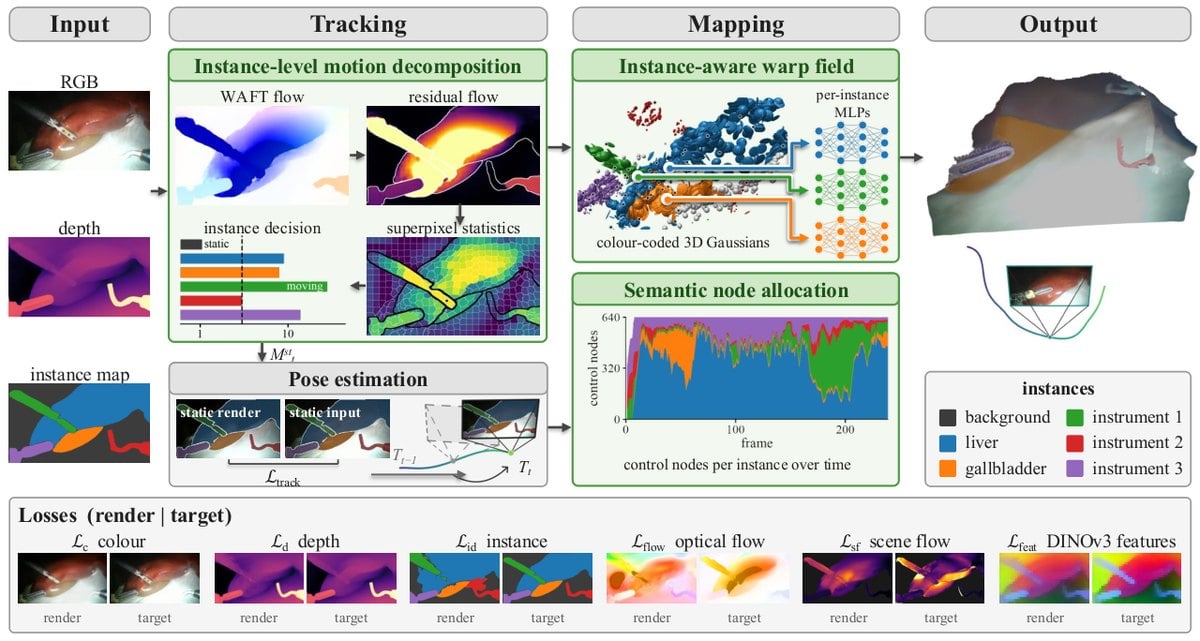
Mona Sheikh Zeinoddin et al. introduce EndoS3, a Gaussian Splatting-based semantic SLAM framework that uses instance masks to drive camera tracking, deformable reconstruction and semantic mapping in surgical scenes. An instance-level motion module separates static and dynamic tissue after compensating for camera motion, and a semantic node allocator spreads a fixed deformation-node budget by instance size and non-rigidity.

The paper also presents CRCD++, an ex-vivo cholecystectomy dataset with RGB-D frames, poses and instance labels for full semantic SLAM evaluation. The authors report that EndoS3 surpasses the compared general-purpose and surgical semantic SLAM methods on tracking, reconstruction and semantic mapping on CRCD++ and SemSup.

GaussianRenderFormer renders 3D Gaussian splats with a transformer, not a rasterizer

arXivPapers

Shahaf Valencia Levy and Sagie Benaim present GaussianRenderFormer, a transformer that takes a set of 3D Gaussians and a camera and outputs an image without a rasterizer in the renderer. Each Gaussian is a token in a view-independent encoder, and a view-dependent decoder turns patches of camera rays into pixels by attending to those tokens.

Trained on 26,820 Objaverse objects pruned to 20,000 Gaussians each, the model reaches 38.08 dB PSNR on 300 unseen objects against the full unpruned splats, while rasterizing the same pruned input reaches 44.02 dB. The authors say the gap is consistent with a bottleneck in the view decoder rather than a failure to generalize, and they have submitted the work to TMLR.

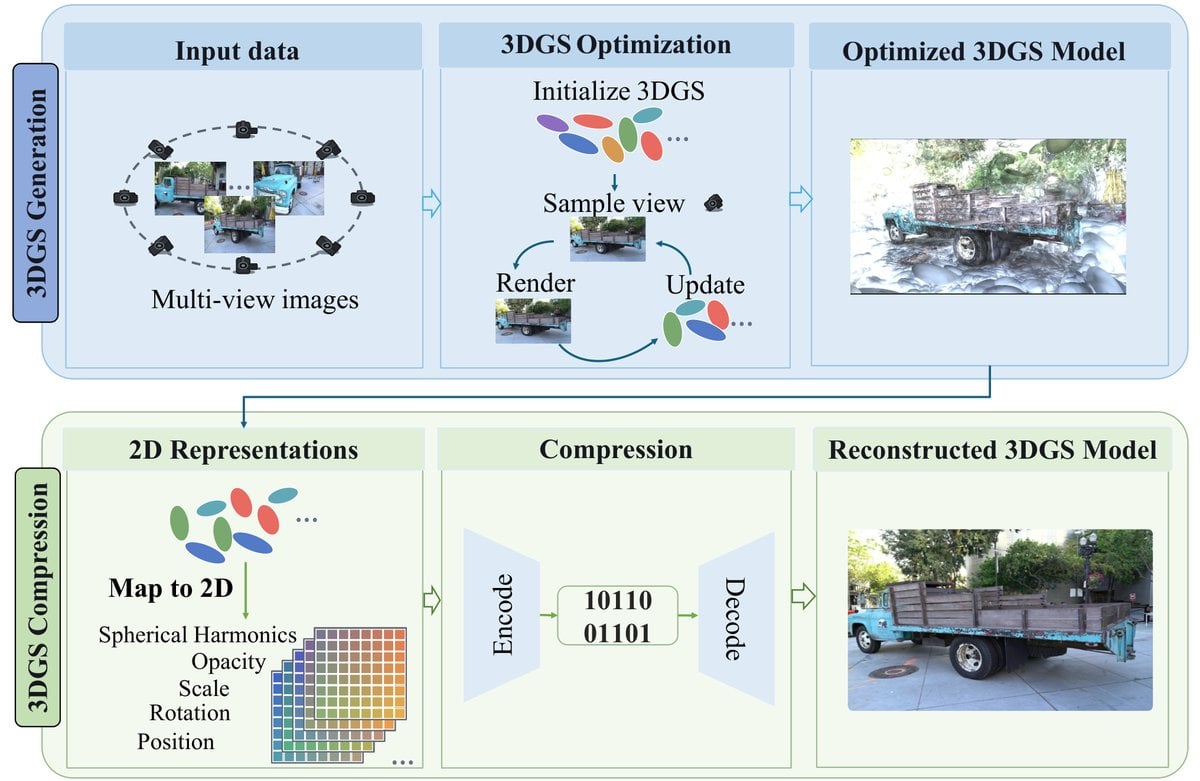
GSCV++ compresses 3D Gaussian splat sequences with standard video codecs

arXivPapers

Qi Yang et al. introduce GSCV++, a lightweight pipeline that compresses 3D Gaussian Splatting sequences with standard video codecs, aiming at low complexity and hardware compatibility. The method combines energy-adaptive inter-frame spherical-harmonic dimensionality reduction, a prior-based Inter-MiniPLAS mapping to smooth 2D feature maps, and codec configuration changes that do not alter the video standards themselves.

Experiments reported in the paper show more than 20% intra-prediction and 60% inter-prediction rate-distortion gains against the compared state-of-the-art methods, along with faster 2D map generation, encoding and decoding when the same class of video codecs is used.

GSPIM accelerates 4D Gaussian splatting on PIM-enabled edge devices

arXivPapersHardware

Zirui Ma et al. present GSPIM, a temporal-locality-aware accelerator for 4D Gaussian Splatting on processing-in-memory edge devices, accepted to HPCA 2027. The authors argue that explicit 4D, keyframe and anchor-based methods waste memory bandwidth on inactive data and reload shared attributes across adjacent frames when working sets exceed on-chip cache.

Polymorphic PIM filters and packs valid data before transfer, multi-frame rendering reuses active attributes and depth relationships, and hybrid scheduling overlaps near-memory preparation with GPU rendering. Across three 4DGS methods and six dynamic scenes, they report a 4.15× geometric-mean speedup and a 4.99× energy-efficiency gain over an optimized frame-by-frame GPU baseline, with a maximum scene-level PSNR difference of 0.011 dB.

IGSW edits weather in 4D urban Gaussian scenes without breaking structure

arXivPapers

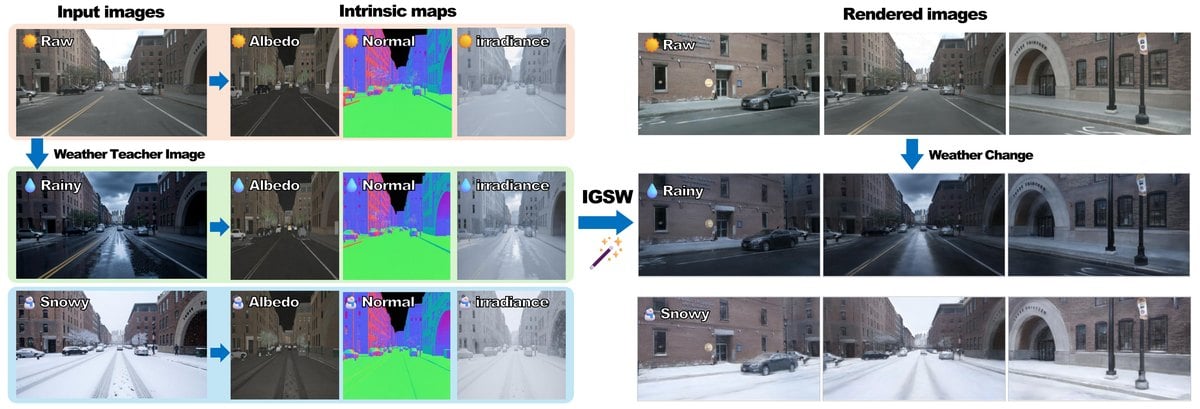
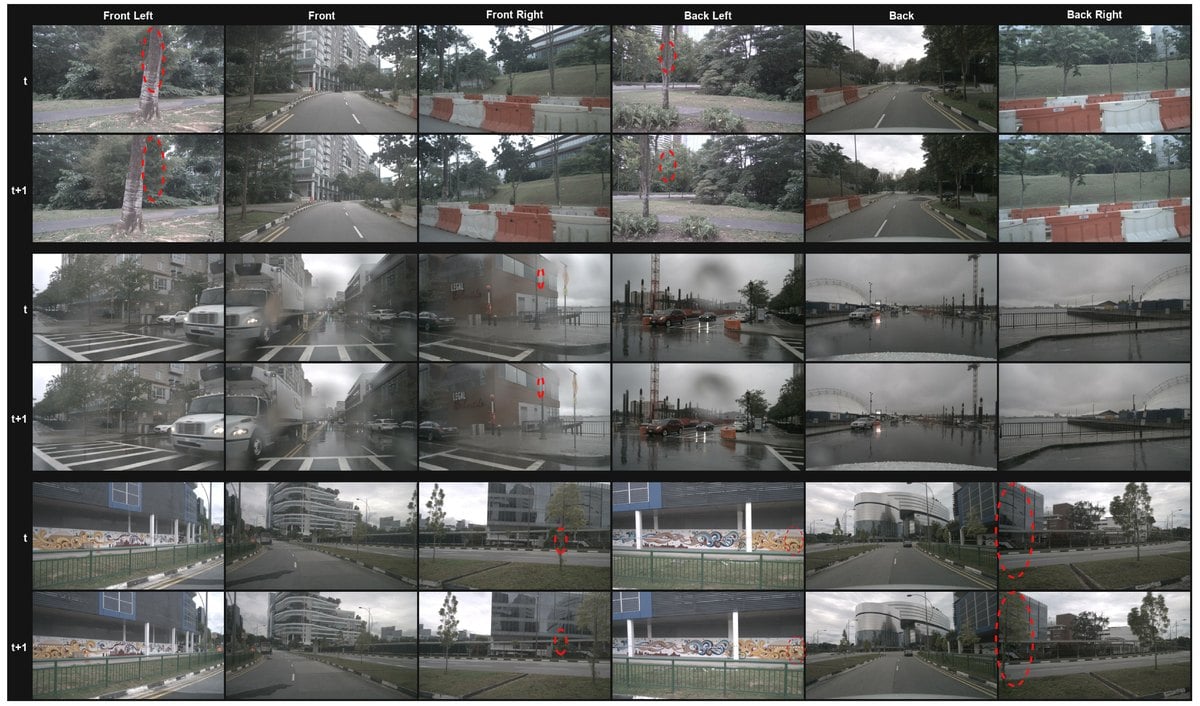
Zhongquan Wang et al. present IGSW, a two-stage method for multi-weather reconstruction of 4D urban scenes with Gaussian splatting. Stage I decomposes background appearance into weather-shared albedo and normals and weather-specific irradiance and residuals, using diffusion-edited teacher images; Stage II applies a structure-preservation gate so unreliable edited regions do not distort the original geometry and temporal continuity.

On nuScenes and Waymo, the authors report the highest content similarity and semantic consistency and the lowest temporal error among the compared methods, while still keeping weather-dependent illumination and atmosphere.

Phase-DGS reconstructs dynamic Gaussian scenes from unsynchronized cameras

arXivPapers

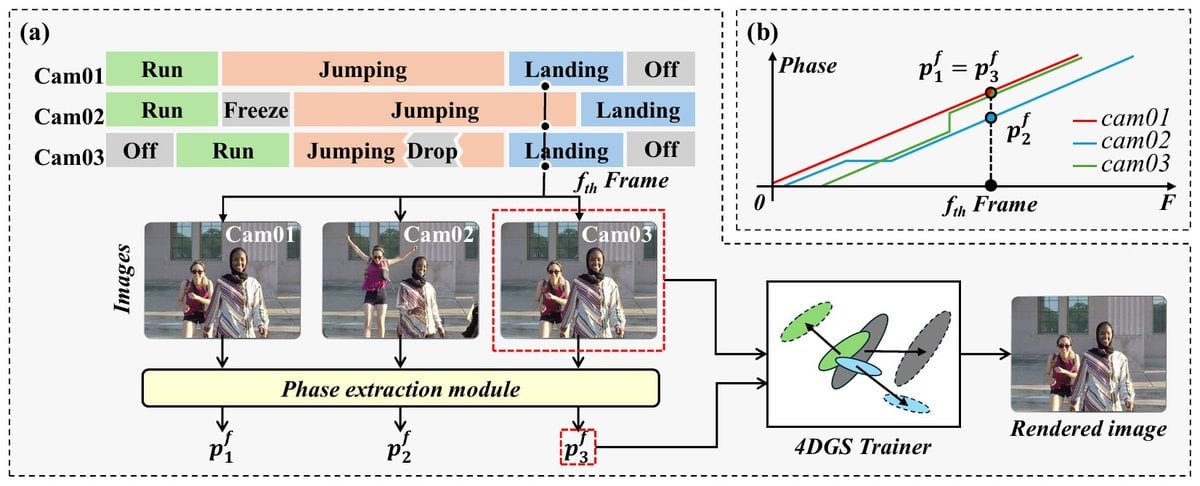
Hosung Jeon et al. propose Phase-DGS, a Dynamic Gaussian Splatting framework accepted to NeurIPS 2026 that drops the usual assumption of perfect multi-camera time sync. Instead of timestamps, each frame is assigned a semantic phase for its state in the underlying motion cycle, so frames that capture the same motion share a phase regardless of which camera recorded them or when.

The authors validate the approach under temporal offsets, frame drops and camera freezes, reporting up to +8.5 dB PSNR over baselines, and say the method can be used with existing dynamic Gaussian backbones including RealTime-4DGS and FreeTimeGS.

GaussFlaw-80K and GeoCritic diagnose where 3DGS renderings go wrong, and of what type

arXivPapers

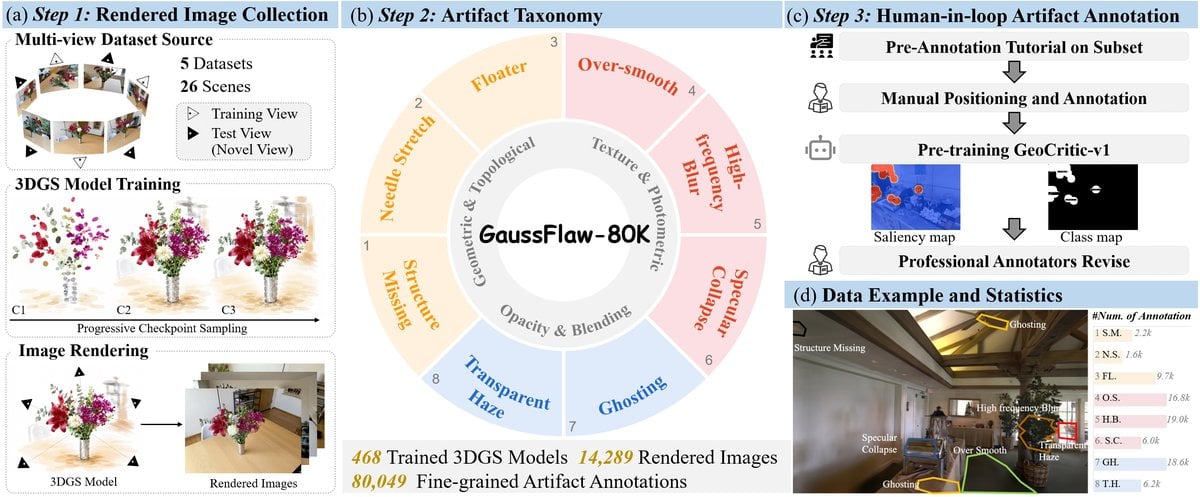
Shaocheng Shen, Zihan Zheng, Kejin Li, Lu Liu, Xiaoyun Zhang, Qiang Hu and Wenjun Zhang introduce GaussFlaw-80K, a dataset for fine-grained perceptual diagnosis of 3D Gaussian Splatting artifacts, with 80,049 artifact regions across 14,289 rendered images, each annotated with a pixel-level mask and one of eight flaw labels spanning geometric, blending and photometric degradations.

Building on the dataset, they propose GeoCritic, a geometry-guided multi-task model that integrates RGB appearance with depth-derived cues to localize artifacts and classify their types. GeoCritic achieves an AUC-J of 0.9507 and Acc@1 of 80.08%, and diagnosis-guided refinement through densification, attribute correction and outlier pruning improves reported global and crop-level metrics across diverse datasets and 3DGS backbones.

Self-learned neural color fields give 3DGS smoother geometry and fewer floaters

arXivPapers

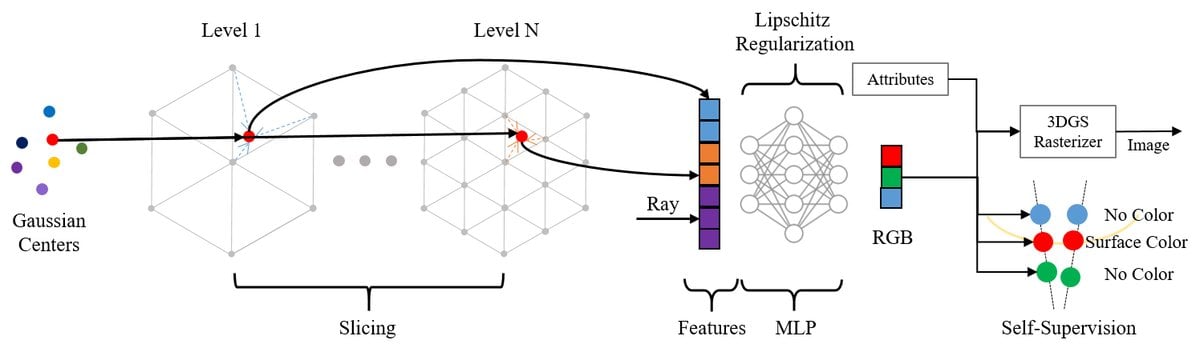
Yixiao Yang, Yu-Shen Liu and Zhizhong Han, in a NeurIPS 2026 paper, learn a 3D Gaussian Splatting radiance field inside a continuous, view-dependent color field parameterized by neural networks. They argue that discrete 3D Gaussians usually produce poor depth with few geometry details and many floaters; continuous color constraints encourage the geometry to explain high-frequency color variations on images, rather than relying on the color attribute alone.

A Lipschitz constraint makes large changes of each Gaussian’s color also match large changes of its position, and self-learning strategies improve the neural color field without external knowledge or priors. Numerical and visual comparisons on widely used benchmarks show better high-fidelity geometry recovery in 3DGS.

OctreeSplat allocates feed-forward Gaussians according to local scene complexity

arXivPapers

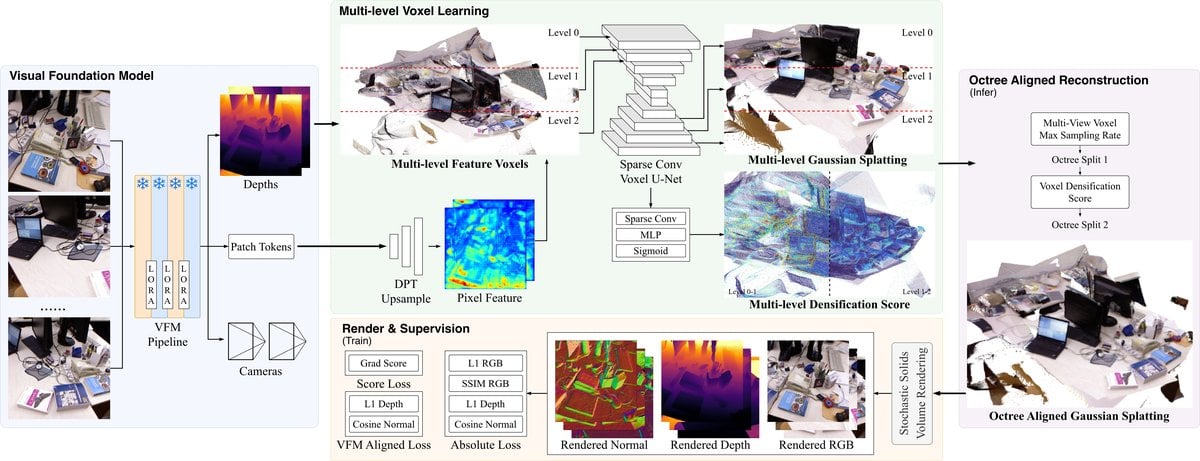
Yibin Zhao, Yihan Pan, Wenli Yang, Jun Nan and Jianjun Yi present OctreeSplat, a hierarchical octree-guided feed-forward Gaussian splatting method. Feed-forward 3DGS often uses a fixed image or spatial resolution, which limits the ability to allocate primitives according to local complexity; OctreeSplat extracts multi-view features and geometric priors from a frozen visual foundation model, constructs a hierarchical octree, and predicts densification scores so Gaussians are placed at spatially varying densities.

Stochastic solids volume rendering is used to improve depth rendering and support surface reconstruction, and an optional test-time optimization module can improve agreement between predicted and ground-truth camera parameters. Training updates only 76 million additional parameters and requires 35 GPU-hours. The authors report competitive RGB view synthesis, depth synthesis and surface reconstruction on Replica, TUM, Tanks and Temples, and DTU.

SCARF is a MICRO 2026 accelerator for depth-guided generalizable 3DGS encoders

arXivPapers

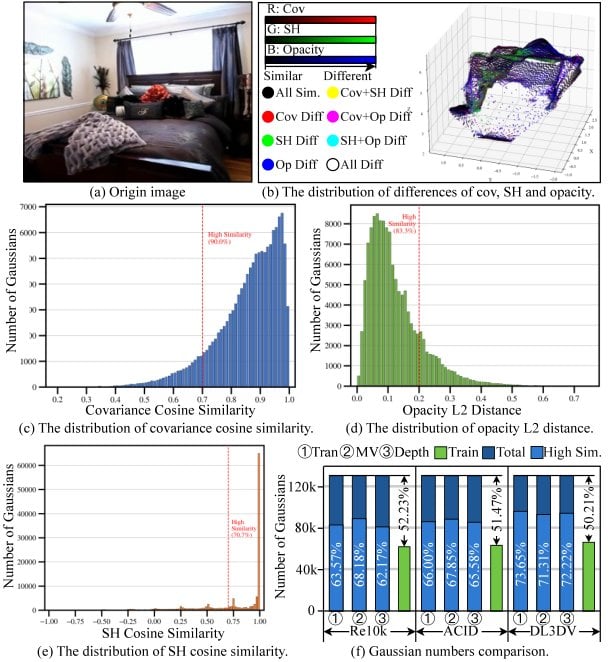
Zirui Ma, Zhihua Fan, Haibin Wu and colleagues present SCARF, a dataflow-co-designed accelerator for depth-guided, cost-volume-based generalizable 3D Gaussian Splatting encoders, accepted at MICRO 2026 with all three artifact-evaluation badges. They report that per-pixel depth search accounts for over 65% of memory traffic because of redundant candidate scans, and that more than 52% of generated Gaussians are redundant before instantiation because the pipeline ignores local 3D geometric continuity.

Feature Similarity Depth Reuse turns exhaustive per-pixel depth searches into anchor-centered local searches based on feature-space affinity, and Scene-Adaptive Early Sparsification probes each tile and activates only the minimally sufficient generation pathway. On a 27.8 mm² 28 nm post-layout design, SCARF delivers a 2.94× geometric-mean end-to-end speedup with maximum PSNR degradation below 0.072%, at 2.23 inferences per joule.

AbacusGS stores splat blending order in an octree, so viewers need not sort every splat

arXivPapers

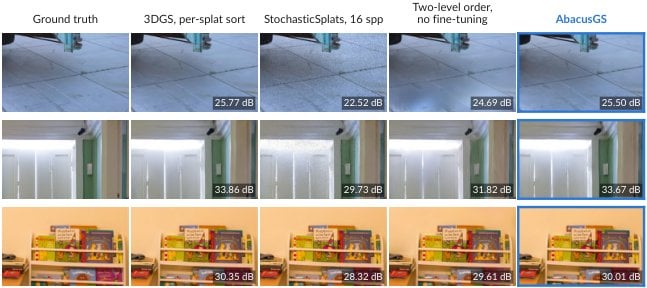
Jiacheng Ding, Yanliang Qi, Cong Guo and Peihua Mai present AbacusGS, which stores the blending order of a 3DGS scene in the scene layout instead of sorting every splat by depth in every frame. Splats are grouped into octree boxes of at most 128, each stored in order along an axis chosen at write time; each frame sorts only the visible boxes, and one dot product per box decides whether the box is read forward or backward.

A short order-aware fine-tuning converts an existing 3DGS model, and the over operator stays unchanged. On 13 standard scenes, AbacusGS loses 0.13 dB PSNR on average against an equally fine-tuned 3DGS model, and in an OpenGL viewer that orders splats on the CPU it renders frames 4.5 times faster than per-splat sorting. A compact format of 17 bytes per splat is also presented.

Loss-aware density control predicts how much a split, clone or opacity change will help

arXivPapers

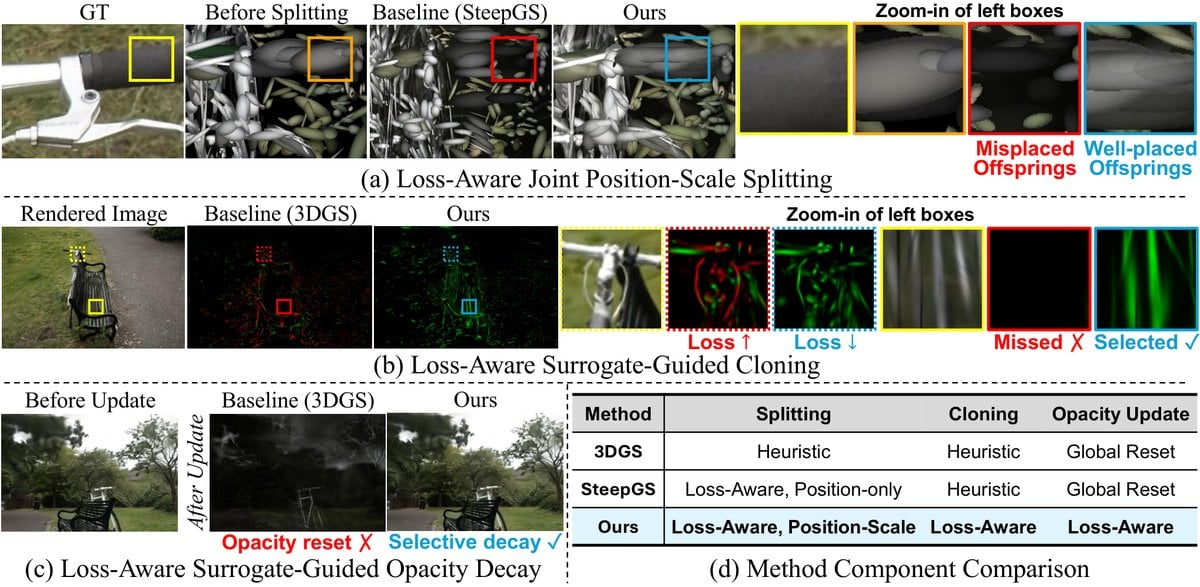
Tae-Young Kim, Jiwoo Chung and Jae-Pil Heo recast 3DGS adaptive density control as a collection of local loss-reduction decisions, in a NeurIPS 2026 paper. Instead of heuristic view-space gradients, scale thresholds and global opacity resets, they derive efficient Taylor-based per-Gaussian surrogates that predict the objective change caused by splitting, cloning and opacity decay.
Second-order splitting is extended to a normalized joint position-scale space, duplicate cloning selects only Gaussians whose duplicated contribution is predicted to help, and global opacity reset is replaced with selective soft opacity decay. Across standard 3DGS benchmarks, the method produces more targeted primitive allocation and improved rendering quality with comparable or smaller Gaussian budgets.

VLSplat lifts object-centric language semantics onto 3DGS with a scene graph

arXivPapers

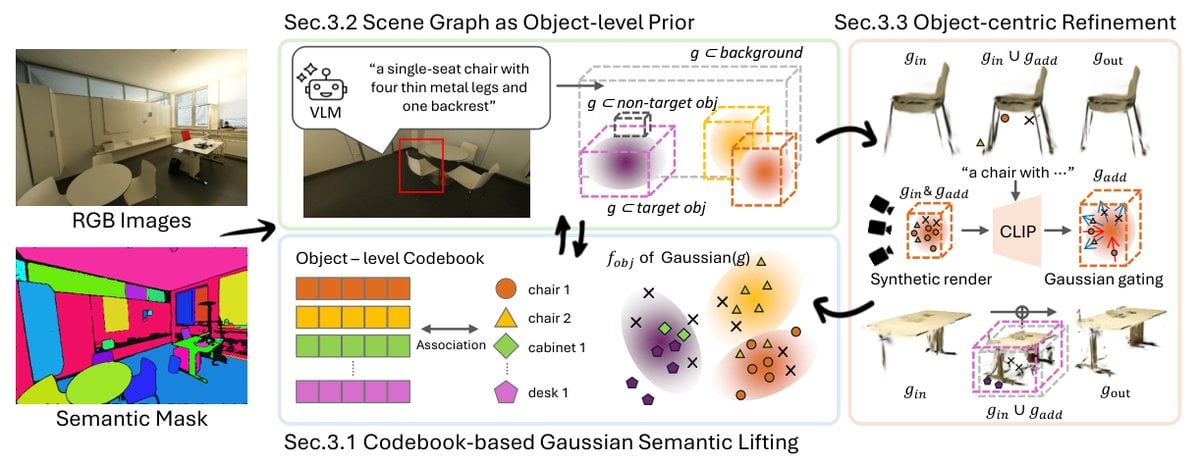
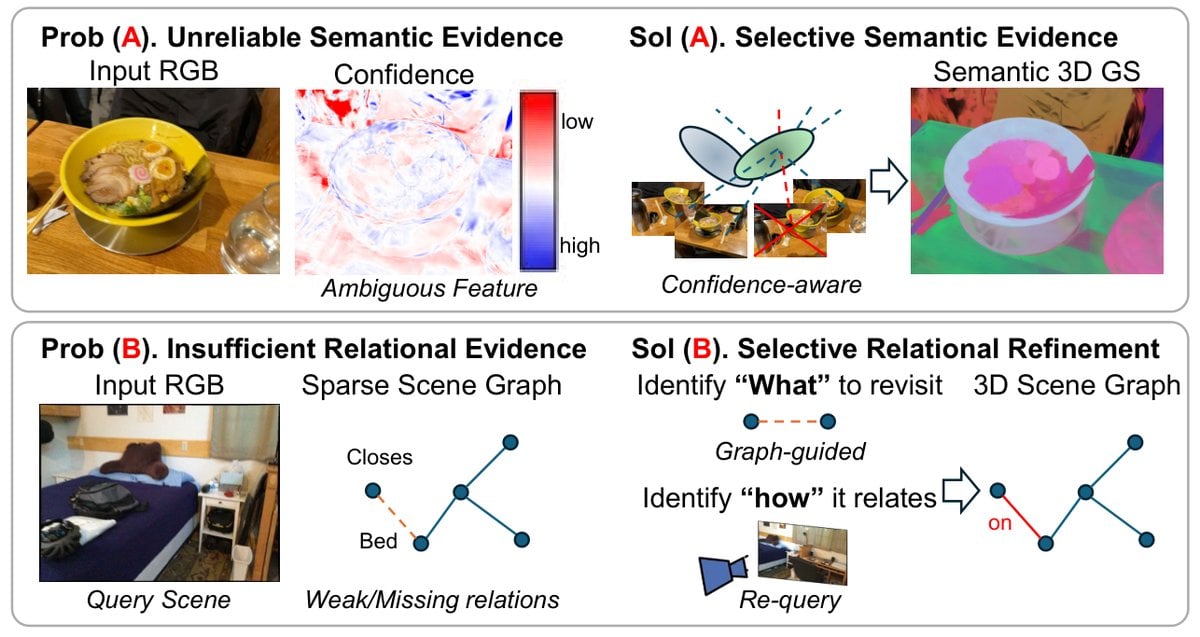
Yuntae Jeon, Younho Jeon, Sujin Jin, Sungho Jo and Seunghee Park present VLSplat, a vision-language-guided approach for object-centric semantic lifting in 3D Gaussian Splatting, accepted at NeurIPS 2026. They argue that existing 2D-to-3D semantic lifting relies primarily on 2D segmentation supervision and lacks object-level priors, so the learned representation is driven by local mask evidence rather than holistic object structure.

VLSplat augments mask-based lifting with object-level semantic priors from vision-language models and refines Gaussian representations using an object-group scene graph. Intra-group refinement suppresses semantic noise within object groups, and inter-group acquisition expands object support regions from neighboring groups. On indoor scene datasets, the authors report improved semantic consistency and structural completeness of object-level categories.

A survey frames 3DGS as a new paradigm for representing wireless environments

arXivPapers

Jinya Zhang, Jiajia Guo, Chao-Kai Wen and Shi Jin survey 3D Gaussian Splatting as a paradigm for wireless environment representation, combining explicit environment modeling with learnable radio-frequency characteristics. The article clarifies why 3DGS might extend from visual scene modeling to wireless communications, formulates a unified framework for wireless environment representation, and discusses applicability to communication and sensing tasks as well as practical deployment considerations.

Emerging directions highlighted include cross-scene generalization, near-field channel modeling, real-world data collection and lifecycle management. A collection of related papers is linked from a GitHub repository, AI4Wireless/3DGS_for_Wireless.

A lunar-analog study finds 3DGS training metrics are poor predictors of digital-twin fidelity

arXivPapers

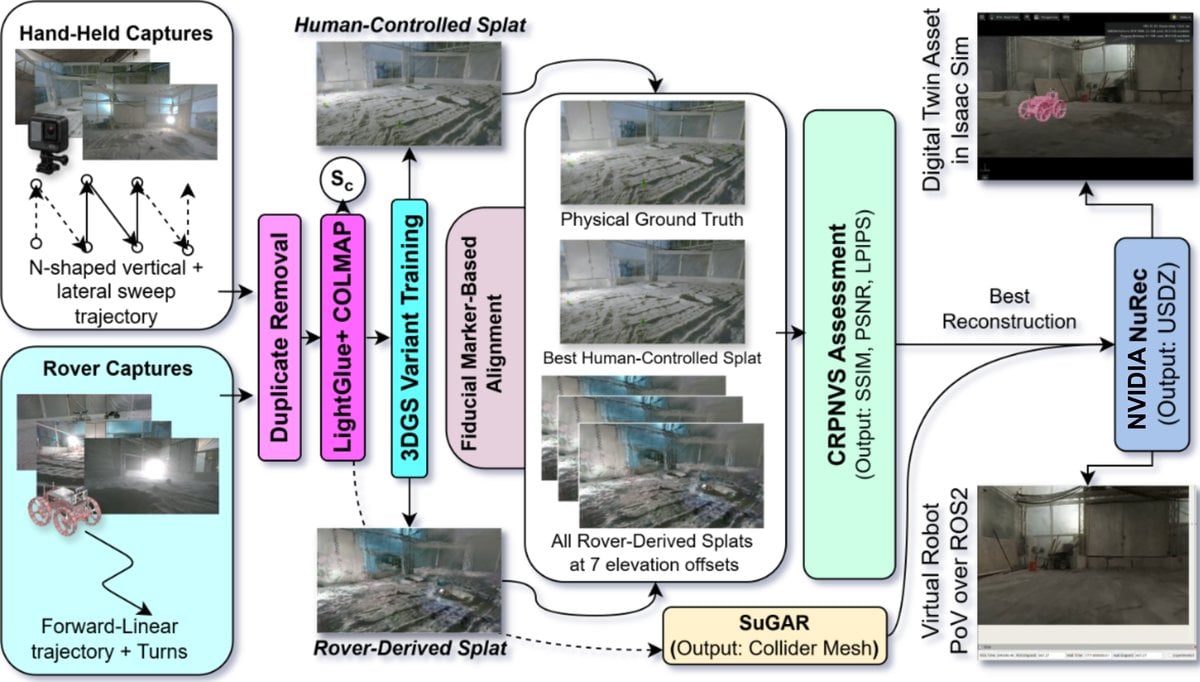
Antar Mazumder, Ryan Hartzell, Luke Boyd and colleagues present a reproducible reconstruction and evaluation pipeline for photorealistic lunar-analog digital twins. They quantify reconstruction accuracy from human-controlled and rover mast-camera monocular feeds against physical ground truth, as a function of traversal effects such as motion blur, lofted-regolith haze, trajectory bias and sparse views, and first benchmark six 3DGS variants across three analog scenes.

They then show that test-set novel-view synthesis performance does not proportionally scale to the same photometric metrics in the reconstructed digital twins, so splat training metrics alone are insufficient predictors of cross-reconstruction photorealistic fidelity. A pilot Coverage Score derived from COLMAP poses and point-cloud structure is offered as a geometry-based diagnostic of the highest achievable structural fidelity.

SHield watermarks a 4DGS file by perturbing spherical-harmonic coefficients

arXivPapers

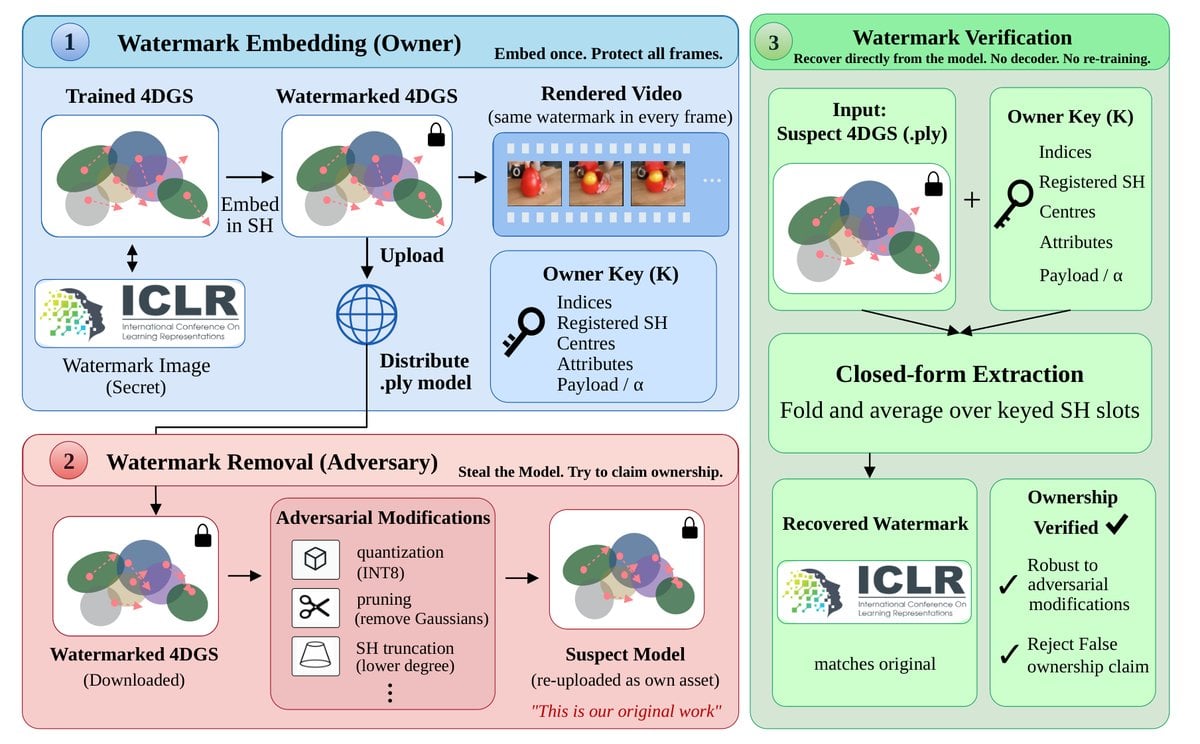
Kunal Bhosikar, Prajas Wadekar, Venkata Sai Pranav Bachina and colleagues present SHield, a non-blind, decoder-free watermark for 4D Gaussian Splatting parameter files. Existing watermarks fine-tune a scene against a neural decoder to extract bits from rendered video, which the authors call heavy and vulnerable to temporal dynamics; SHield instead tiles a zero-mean payload across the time- and view-invariant canonical spherical-harmonic coefficients of a key-selected Gaussian subset, and recovers the payload in closed form after geometrically re-associating the key.

Across 30 scenes and 150 tested models, SHield reports near-perfect payload recovery (Pearson r ≥ 0.991) with a mean rendering penalty of ≤ 0.13 dB, perfect detection on 400 true trials and zero false positives across 1,600 wrong-subset null trials. It survives INT8 quantization and 30% opacity pruning for the image payload.

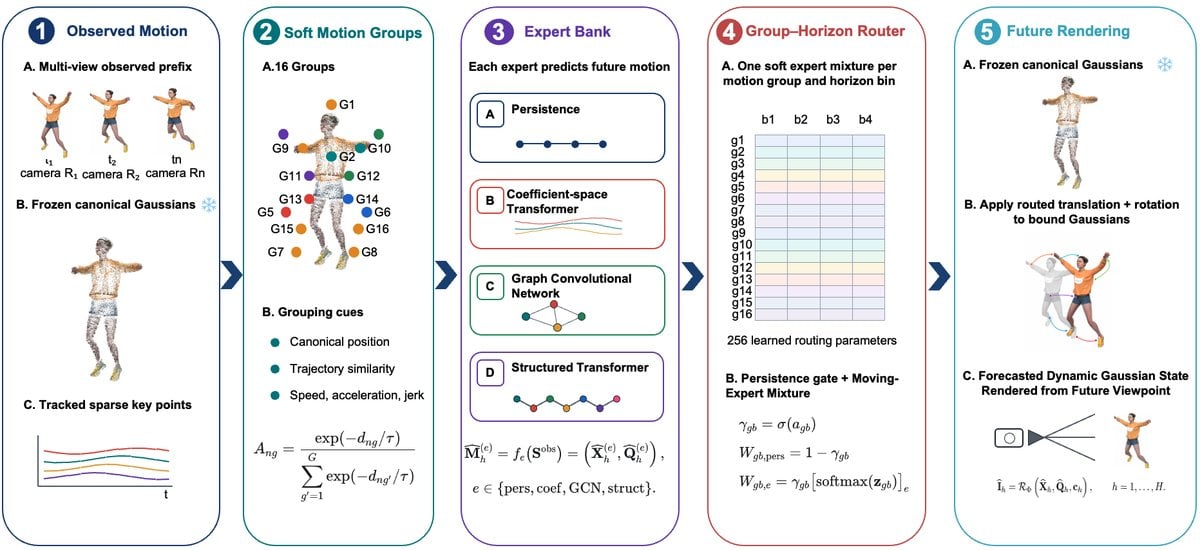
MoRE-GS forecasts a dynamic 3DGS scene with four motion-regime experts

arXivPapers

Shima Salehi and Joshua Peeples present MoRE-GS, a causal, render-aware framework for forecasting dynamic 3D Gaussian scenes, accepted at WACV 2027. A Gaussian representation reconstructed only from the observed temporal prefix is frozen, and its control-keypoint motion is forecast by four complementary experts: persistence, a coefficient-space Transformer, a graph convolutional network, and a structured Transformer with rigid and non-rigid constraints.

A compact routing table assigns expert mixtures across soft motion groups and forecast-horizon bins, and a persistence gate suppresses unreliable extrapolation. Across D-NeRF and HyperNeRF scenes, the authors report improved performance and argue that renderer-calibrated composition of complementary predictors helps across heterogeneous motion regimes.

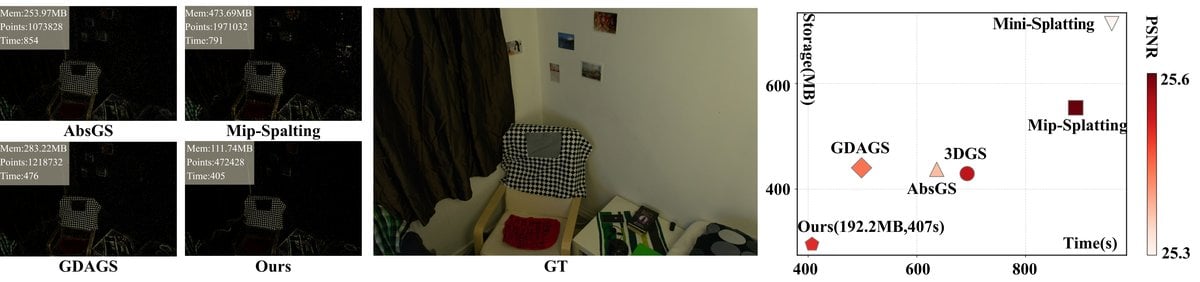
ACD-GS uses second-order depth curvature to decide where 3DGS should densify

arXivPapers

Houqiang Zhong, Tianchi Zhu, Qiang Hu, Xiaoyun Zhang, Li Song and Wenjun Zhang present ACD-GS, an asymmetric curvature-aware densification framework for 3D Gaussian Splatting. They argue that first-order screen-space gradients fail to distinguish true geometric discontinuities from high-frequency textures or noisy residuals.

Second-order depth responses provide a structural prior for density control, enabling asymmetric regulation of cloning and splitting. A multi-view photometric consistency constraint suppresses transient single-view errors, and a capacity-aware adaptive regulation balances densification and pruning. The authors report that the method reduces nearly 60% of the Gaussian count and storage while maintaining competitive rendering fidelity, without post-hoc compression.

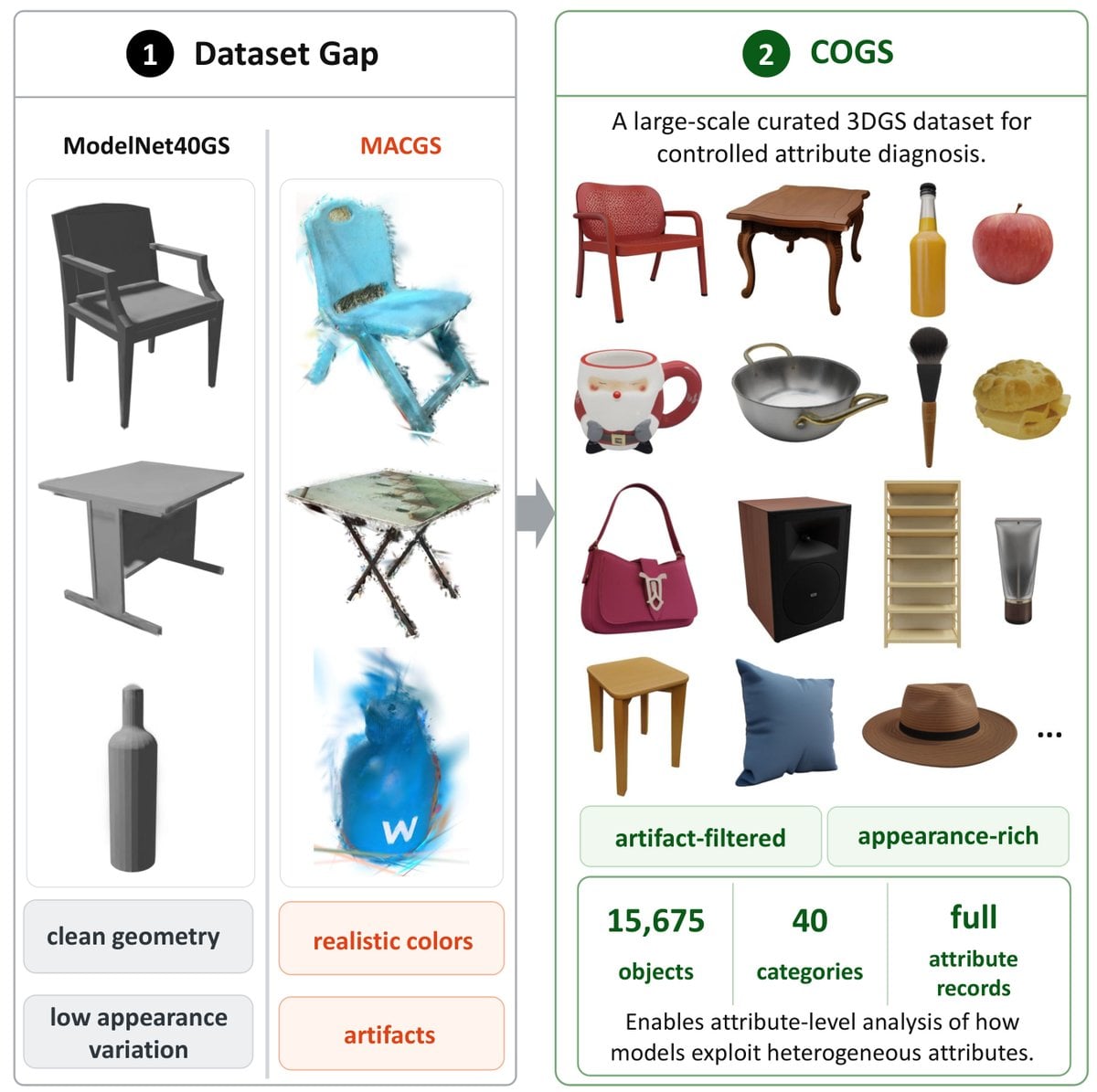
COGS is a 15,675-object benchmark for how 3D networks use Gaussian attributes

arXivPapers

Zheng Xiao, Yifan Liu, Weijian Deng, Jiashu Li, Ziqin Liu, Zhenjun Han and Jianbin Jiao introduce COGS, a large-scale 3D Gaussian Splatting dataset with 15,675 artifact-filtered, appearance-rich objects across 40 categories, accepted at WACV 2027. They argue that existing object-level 3DGS datasets lack the appearance variation or artifact control needed to tell how current 3D architectures exploit heterogeneous Gaussian attributes.

On the accompanying COGS-Bench, Gaussian attributes are not uniformly beneficial: selected subsets can outperform the full attribute set, and the effects of appearance, opacity and covariance-related combinations vary substantially across architectures. A reference model, HALO, that preserves attribute-specific evidence before hierarchical aggregation is used to illustrate the value of role-preserving attribute organization.

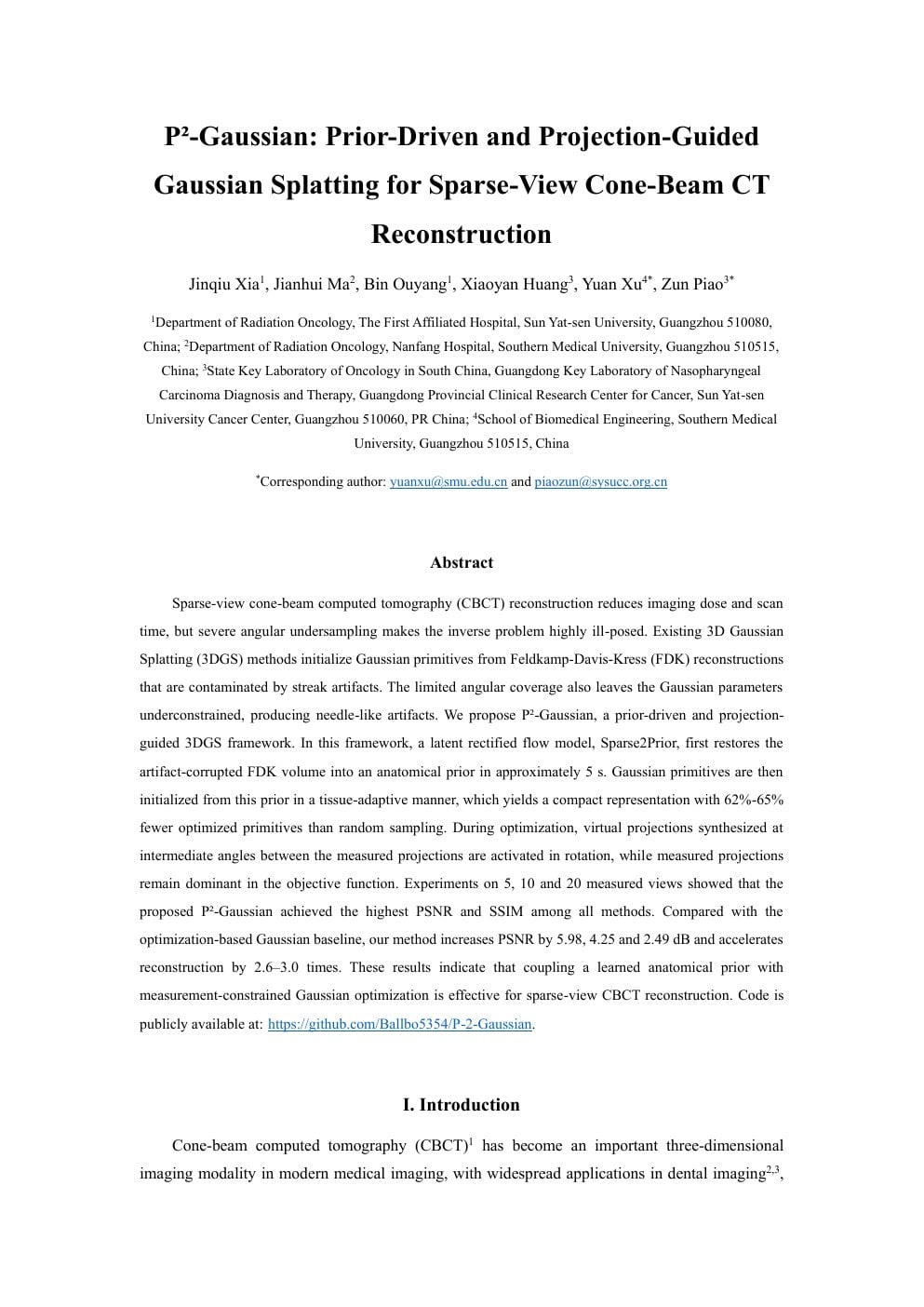
P²-Gaussian initializes sparse-view CBCT splats from a learned anatomical prior

arXivPapers

Jinqiu Xia, Jianhui Ma, Bin Ouyang, Xiaoyan Huang, Yuan Xu and Zun Piao present P²-Gaussian, a prior-driven and projection-guided 3DGS framework for sparse-view cone-beam CT. Existing 3DGS methods initialize primitives from FDK reconstructions contaminated by streak artifacts, and limited angular coverage leaves parameters underconstrained.

A latent rectified-flow model, Sparse2Prior, first restores the artifact-corrupted FDK volume into an anatomical prior in approximately 5 seconds, and Gaussians are then initialized from this prior in a tissue-adaptive manner, using 62–65% fewer optimized primitives than random sampling. During optimization, virtual projections at intermediate angles are activated in rotation while measured projections remain dominant. Compared with an optimization-based Gaussian baseline, the method increases PSNR by 5.98, 4.25 and 2.49 dB at 5, 10 and 20 views and accelerates reconstruction by 2.6–3.0 times.

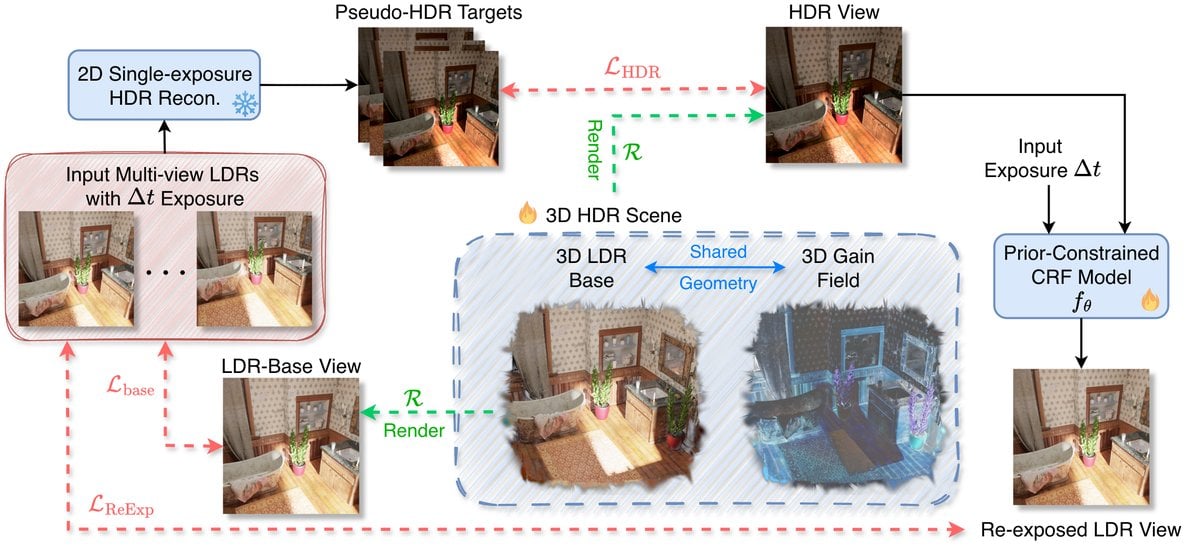
PriorGS recovers HDR novel views from single-exposure LDR images with a 3D base-gain field

arXivPapers

Armin Shafiee Sarvestani, Sheyang Tang, Jialu Xu and Zhou Wang present PriorGS, a 3D Gaussian Splatting framework for single-exposure HDR novel-view synthesis. Without HDR ground truth, single-exposure LDR views underconstrain HDR reconstruction, so PriorGS guides recovery with pseudo-HDR supervision from 2D single-exposure HDR methods, anchors it to input LDR views through a closed reconstruction loop, and regularizes camera-response modeling with a learnable monotonic prior.

Because independently generated pseudo-HDR targets are inconsistent across views, a 3D base-gain representation factors HDR radiance into an LDR base and an overlaid 3D gain field, which also enables 3D HDR appearance editing. The authors report substantial superiority over baselines.

BudSplat keeps the most valuable feed-forward Gaussians under a primitive budget

arXivPapers

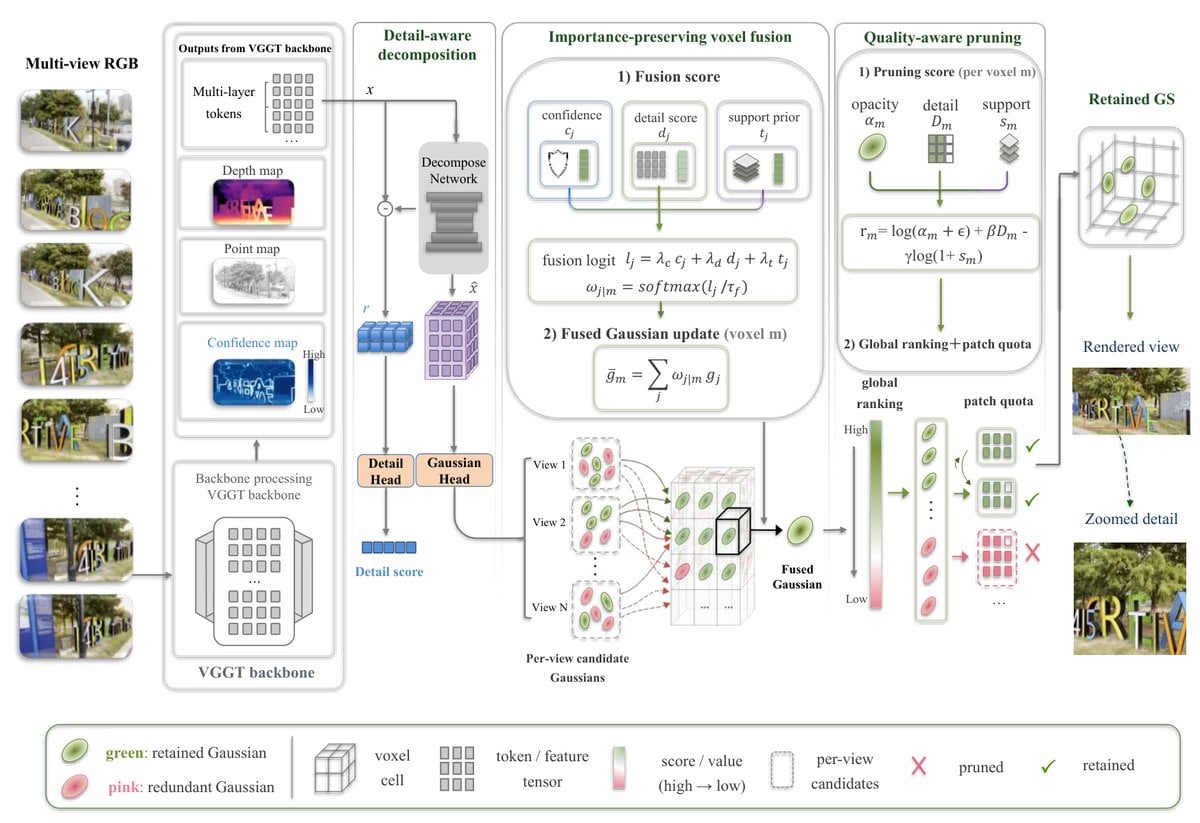
Muyu Xu, Fangneng Zhan, Yu Wei, Ling Shao and Shijian Lu present BudSplat, a compact feed-forward 3D Gaussian Splatting framework that learns to keep the most valuable Gaussians under a limited primitive count. As feed-forward methods scale from sparse to dense multi-view inputs, candidate Gaussians grow rapidly and many become redundant in repeatedly observed regions.

A detail-aware importance score extracted from multi-level visual tokens is injected into voxel fusion to preserve high-value local contributors, and quality-aware pruning then selects a compact set by jointly considering rendering contribution and detail importance, with local quota redistribution to avoid over-allocating large redundant regions. On RE10K, DL3DV and ACID, the authors report a favorable trade-off among rendering quality and efficiency.

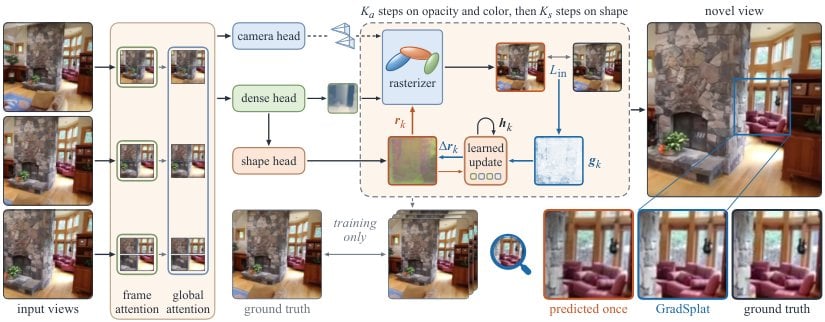
GradSplat refines feed-forward Gaussian shapes with gradient steps inside the forward pass

arXivPapers

Jingong Chen, Linlian Jiang, Guangyuan Li and colleagues present GradSplat, a feed-forward 3D Gaussian Splatting model that refines its own Gaussians by learned gradient steps inside the forward pass, with no target view. They argue that the gap between a feed-forward predictor and per-scene optimized Gaussians lies mostly in scale and rotation, and that gradient steps on the input views can correct that shape.

Log-anisotropy correction changes the axis ratios of each Gaussian in log space at constant volume, and in-forward gradient refinement renders the Gaussians into the input views and applies the photometric-loss gradient with a learned recurrent update, first to opacity and color and then to shape. On both complete six-view RealEstate10K protocols it has the best PSNR and SSIM among nine methods, and without fine-tuning it is the most accurate on DL3DV.

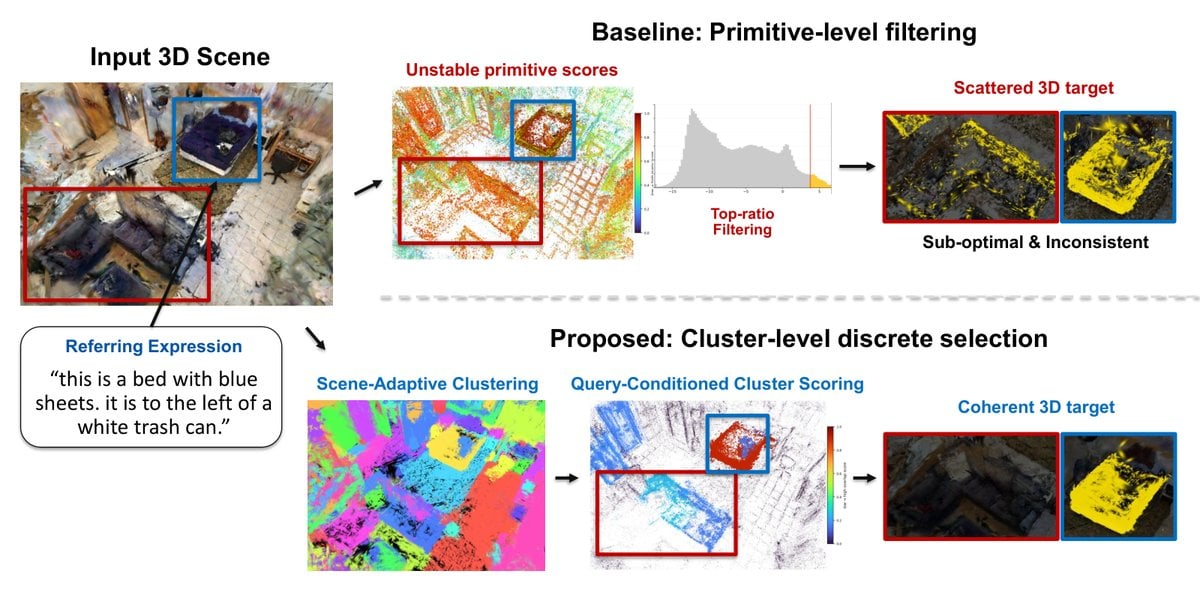
ClusterSplat selects scene-adaptive Gaussian clusters for 3D visual grounding

arXivPapers

Jaesung Lee, Hyeontaek Hwang, Gabriel Manalu and Daeyoung Kim present ClusterSplat, a NeurIPS 2026 Spotlight paper on 3D visual grounding in 3D Gaussian Splatting, where a referring expression should identify a target both as a rendered 2D mask and as a set of explicit 3D Gaussians. Instead of heuristic thresholding of dense primitive-level scores, the method learns instance-aware Gaussian features, forms feature-aware seed voxels, and merges neighboring seeds when a description-length criterion decreases, producing scene-specific cluster candidates.

A query-conditioned scorer ranks those clusters, and the selected cluster defines the explicit 3D target while its score is rendered for the 2D mask. On ScanRefer, ClusterSplat achieves the best rendered 2D segmentation and explicit 3D target metrics among the compared 3DGS baselines.

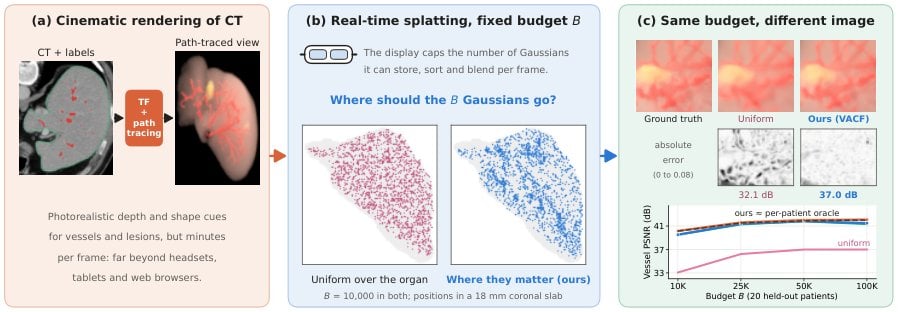
CTBakeGS bakes a photorealistic CT volume rendering into 3DGS without training

arXivPapers

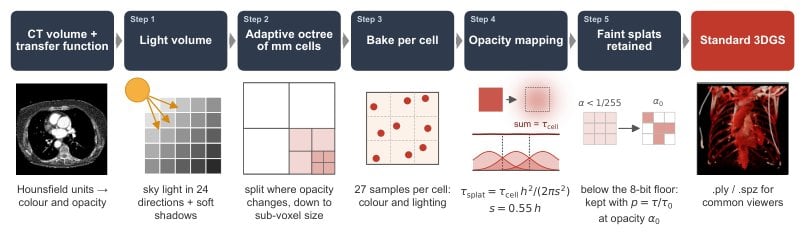
Haruki Fukuda, Constantin Lux, Wolf Schweitzer, Tadashi Hosoya and Lars Ebert present CTBakeGS, which converts a photorealistic CT volume rendering directly into a 3D Gaussian Splatting model without per-scene training. Splats are placed on an adaptive octree of millimetre-sized cells; colour and opacity are computed on the GPU with the renderer’s lighting, cell opacity is converted analytically into splat opacity, and faint splats are retained stochastically above the 1/255 opacity floor of standard 3DGS rasterisers.

Six public CT scans with 1.5 mm voxels were converted with three transfer functions. Two-million-splat models reached a PSNR of 32.6 ± 0.9 dB for bone, 30.1 ± 1.0 dB for contrast-enhanced vessels and 32.3 ± 1.5 dB for skin and bone. A conversion pass took 4–30 seconds on a current laptop, where the models rendered at 68 frames per second at 800×800 pixels.

DomeGS builds the VR sky into the 3DGS scene instead of hanging a flat skydome behind it

arXivPapers

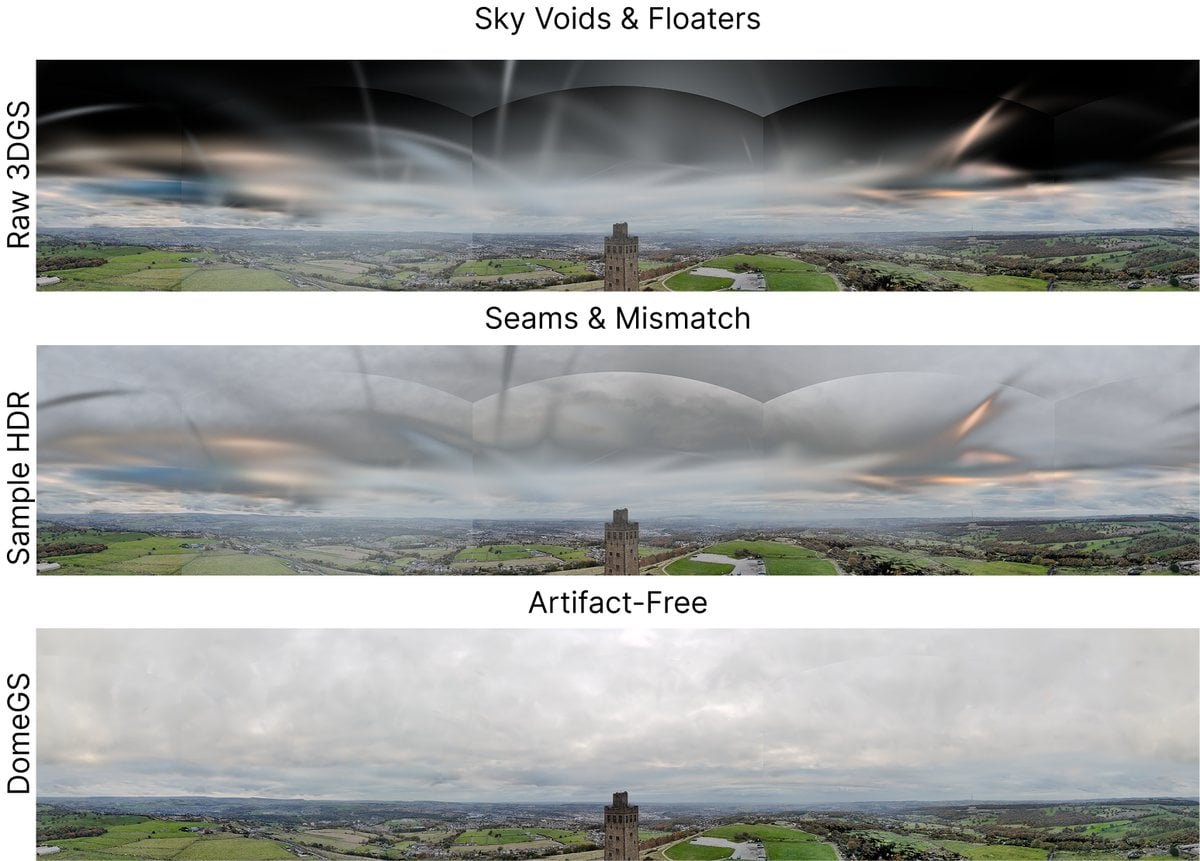
Anastasiya Pechko, Agata Szymańska, Piotr Borycki and colleagues present DomeGS, which incorporates a skydome not as a flat background shell but as part of the reconstructed 3D Gaussian Splatting scene, so incomplete outdoor horizons do not break immersion in VR. By integrating the horizon and sky into the 3DGS representation, the method aims for a unified, scene-consistent environment that bridges foreground and background.

In an experimental evaluation with 36 users, DomeGS significantly increased spatial presence (p=0.042) and realism (p=0.042) compared with a skybox baseline.

GeoGSplat grounds non-pixel-aligned feed-forward Gaussians with geometric priors

arXivPapers

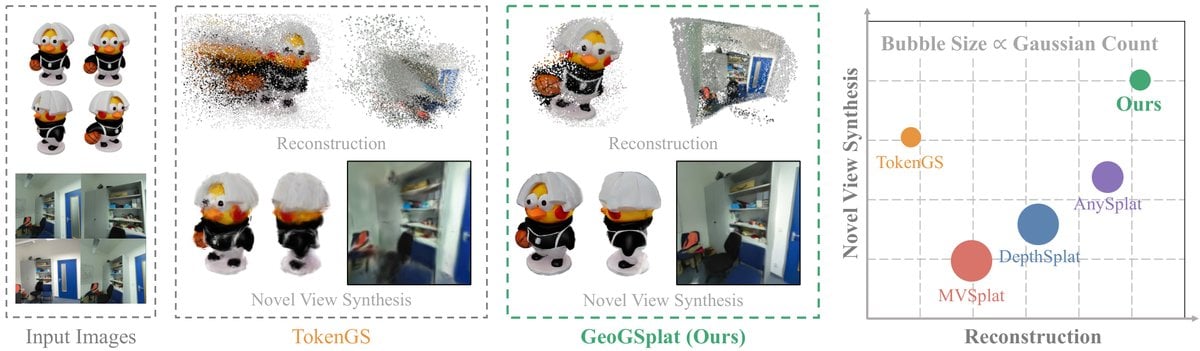
Jiale Wang, Chen Zhao, Haoyang Zhang and colleagues present GeoGSplat, a geometry-grounded feed-forward model that predicts a fixed number of Gaussians rather than one per pixel. They argue that without explicit ray and depth constraints, non-pixel-aligned methods misplace Gaussian centres and produce artifacts under large viewpoint changes.

A dual-branch encoder constructs Anchors and a Triplane to capture coarse 3D structure and fine scene features, and a hierarchical decoder progressively decodes dense 3D points and Gaussian primitives. On DTU and NRGBD, GeoGSplat surpasses both pixel-aligned and non-pixel-aligned Gaussian Splatting methods in novel-view synthesis and reconstruction, with a larger advantage as target viewpoints move farther from the input cameras.

GOFish trains 3DGS on fisheye images, rasterizes past 180° and extracts an aligned mesh

arXivPapers

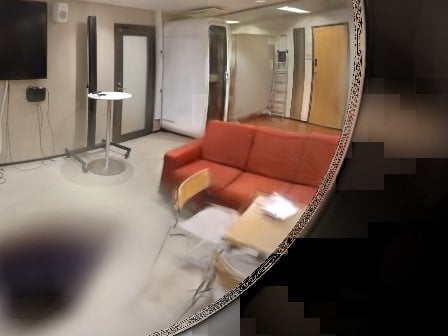
Allen Tu, Meher Gitika Karumuri, Shifan Zhu and colleagues present GOFish, which they describe as the first 3D Gaussian Splatting surface-reconstruction method to train directly on fisheye images, rasterize fields of view beyond 180°, and extract an aligned mesh from the same scene. Calibrated densification recovers the surface across the entire field of view, while Calibrated Mip Filtering and Wide-Angle Appearance Modeling keep pixel blur and lens falloff out of the scene and mesh.

Across the 200° FIORD and 205° FullCircle benchmarks, GOFish improves PSNR over the best prior method by 2.28 and 1.97 dB, respectively, and achieves the highest mesh F-score on FIORD and the main ScanNet++ set. The Gaussian scene and mesh together form a LiDAR-free, simulation-ready digital twin.

GraftRay path-traces mesh objects into indoor Gaussian splat scenes

arXivPapers

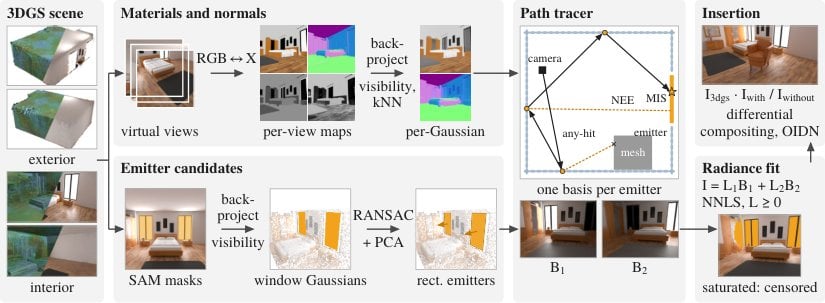
Jinxin Ai and Matthias Niessner present GraftRay, a method for physically consistent insertion of mesh objects into indoor scenes represented by 2D or 3D Gaussians. Existing approaches either harmonize appearance in image space, losing multi-view consistency, or approximate illumination with an environment map that cannot represent near-field area lights such as windows and lamps.

GraftRay recovers scene materials and surface normals with diffusion-based priors, models spatially extended emitters and solves their radiance in closed form, then jointly path-traces the scene Gaussians and inserted meshes. On FIPT it sets a new state of the art, outperforming recent baselines such as ComGS and EAG-PT in rendering fidelity and shadow accuracy.

LingGS decouples feed-forward geometry from explicit camera tracking in Gaussian SLAM

arXivPapers

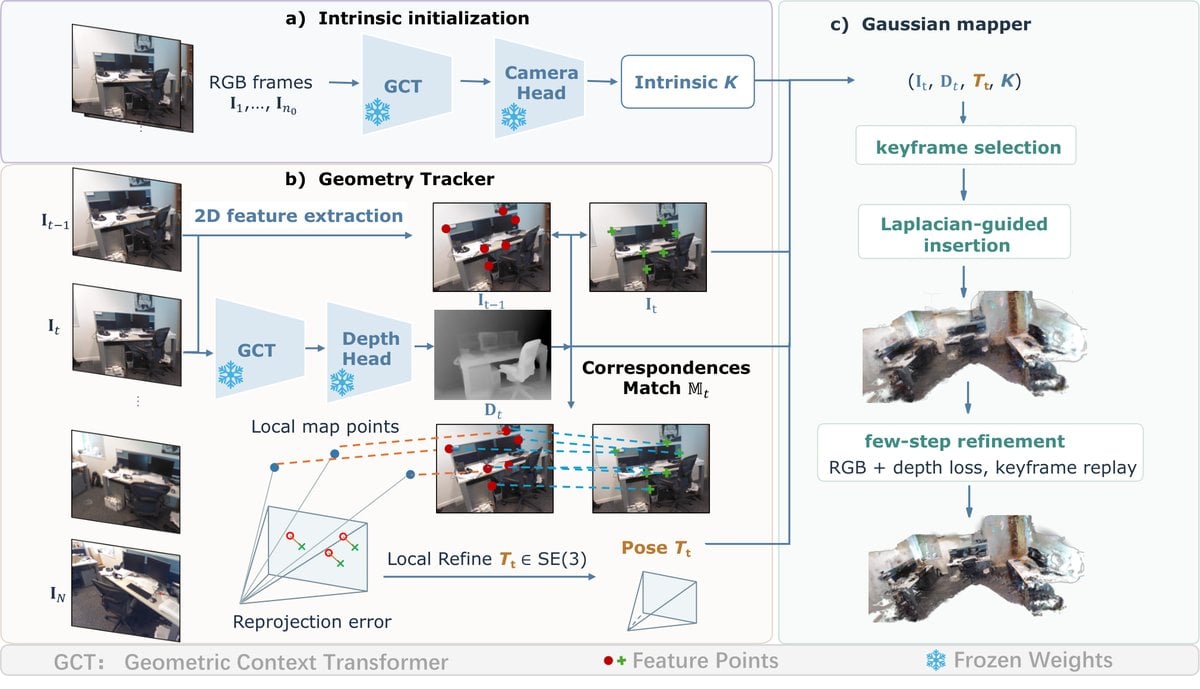
Da Li, Yihan Zang, Ivan Viola, Zeyu Wang and Dominik Engel present LingGS, an online monocular RGB Gaussian-splatting SLAM system. A frozen streaming 3D foundation model acts as a virtual RGB-D sensor, providing depth from monocular video; an explicit geometric solver then estimates camera motion through feature reprojection, and a streaming Gaussian mapper integrates the observations into a dense scene.

The authors show that geometric tracking improves camera-pose accuracy across representative streaming geometry backbones. On indoor and outdoor datasets the method significantly improves reconstruction quality over existing approaches, achieving about 7 frames per second on a single RTX 4090 and 2–3 times the throughput of the evaluated prior SLAM systems.

MIMO-GS renders wireless beam-pair power maps with a 3D Gaussian splatting scene

arXivPapers

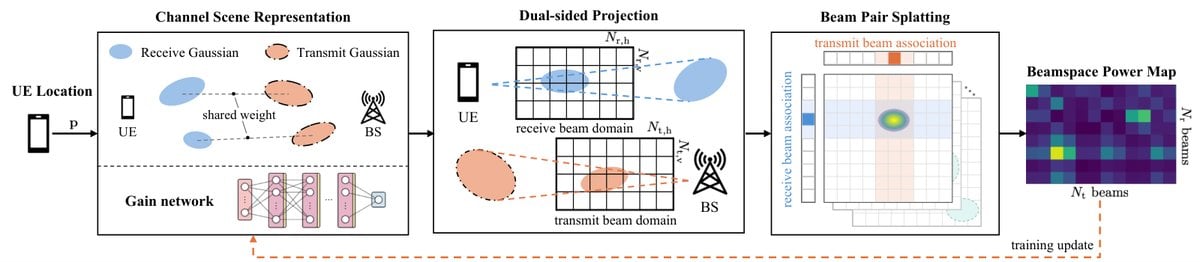
Juntaek Han, Geonha Kim, Chaozheng Wen, Ahmed Alkhateeb, Jun Zhang and Jeonghun Park present MIMO Gaussian splatting (MIMO-GS) for spatial MIMO channel rendering. The method learns a latent beamspace channel scene from sparse observations and renders the long-term transmit and receive beam-pair power map at unobserved user locations, representing the scene with pairs of receive and transmit 3D Gaussians that are projected onto the corresponding beam domains.

On a simulated urban scenario and measured indoor channels, MIMO-GS renders 5.5 times faster than ray tracing without a calibrated replica. Applied to multiuser beam management, the rendered maps allow users and transmit beams to be scheduled without sounding, and the net sum rate reaches 98% of a genie-aided benchmark, 19% above a position-based predictor.

Complexity-guided regularization keeps Gaussians dense on intricate clothed-human details

arXivPapers

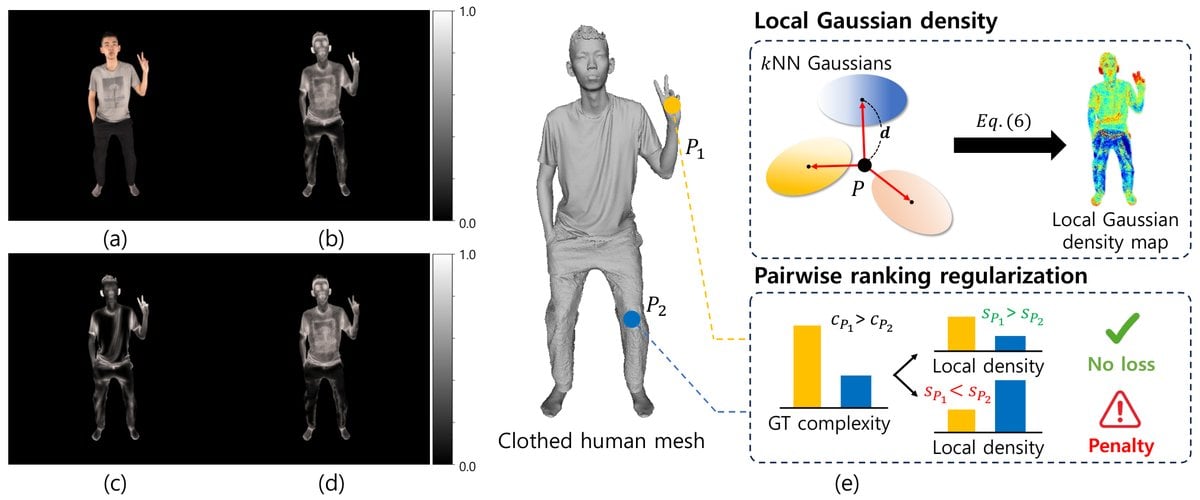
Gun Ryu, Gi-Mun Um, Won-Sik Cheong and Wonjun Kim present a complexity-guided regularization scheme for generalizable human Gaussian splatting, accepted at NeurIPS 2026. They argue that existing methods do not constrain how densely Gaussians are placed, which often blurs regions of high geometric and textural complexity.

A complexity prior computed from local entropy in geometric and textural characteristics of a clothed human prevents Gaussians from being placed too coarsely in complex regions, and local patches are sampled predominantly from those regions so the model is supervised by fine details. The authors report state-of-the-art performance on benchmark datasets while maintaining real-time inference.

CVTSplat reconstructs surfaces with adaptive centroidal Voronoi cells, in about 2.5 minutes

arXivPapers

Briac Toussaint, Diego Thomas, Jean-Sébastien Franco, Edmond Boyer and Christian Theobalt present CVTSplat, which uses adaptive centroidal Voronoi tessellations for multi-view shape and appearance reconstruction. Cell size is modulated by the evolving signed distance field, concentrating sites near the zero level set while keeping cells nearly centroidal, and the pipeline is specialized with GPU nearest-neighbor queries, approximate Voronoi construction and a rasterizer tailored to small, nearly isotropic cells.

The authors report that their Voronoi construction is 5 to 10 times faster than general-purpose alternatives in this regime. On DTU and BlendedMVS, CVTSplat reaches geometric accuracy competitive with the best Gaussian-splatting surface methods while training in about 2.5 minutes on a single GPU.

DUET4D lets a 4DGS reconstruction and a generative prior correct each other

arXivPapers

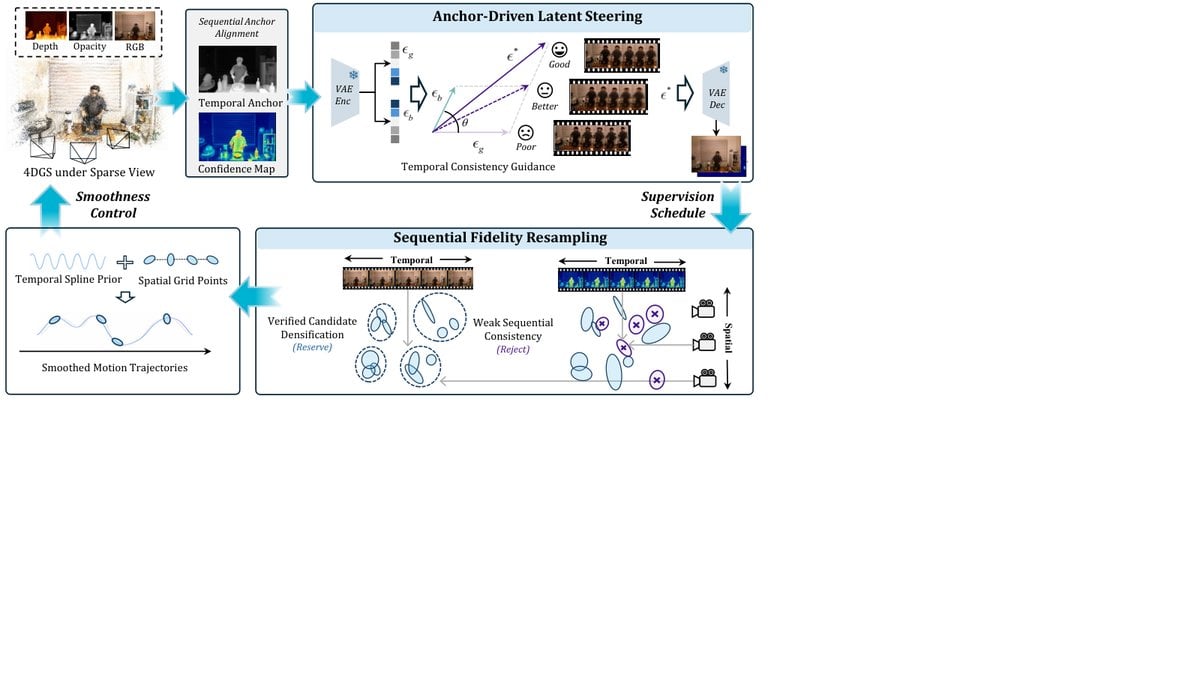
Beizhen Zhao, Nanjie Yao, Boyi Fu, Qingsong Yan, Haofan Ren, Kaiyong Zhao and Hao Wang present DUET4D, a self-corrective coupled-guidance framework for sparse-view 4D Gaussian splatting. They argue that video generative priors are too expensive for iterative reconstruction and that single-view models produce temporally inconsistent pseudo-observations, while absorbing uncertain generative outputs into Gaussian optimization creates redundant primitives and floaters.

DUET4D first builds sequential alignments from current Gaussian evidence to steer latent restoration, then uses Sequential Fidelity Resampling to lift generative supervisions into Gaussian space and keep repeatedly supported primitives. The corrected representation then provides more reliable evidence for the next cycle. The authors report significant improvements in rendering quality and efficiency.

GaussianSpline models 4DGS motion with adaptive, non-uniform Bézier splines

arXivPapers

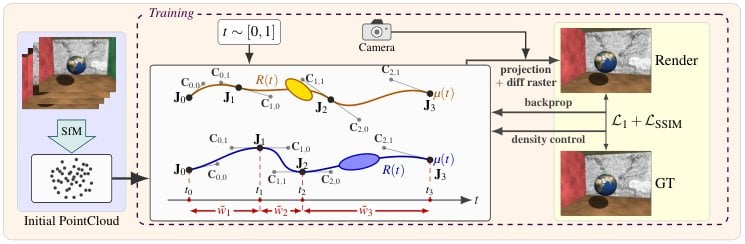
Tom Yachil and Andrei Sharf present GaussianSpline, a dynamic 4D Gaussian Splatting method that models per-Gaussian motion with adaptive, non-uniform piecewise cubic Bézier splines. Unlike global deformations, fixed-order polynomials or uniformly parameterized splines, it jointly learns the Bézier control points and the temporal partition of each Gaussian’s trajectory, allocating more temporal capacity to highly dynamic regions.

G¹ continuity between consecutive segments is enforced with a reflection-based constraint on control points, producing smooth, fully differentiable trajectories. On the Neural 3D Video benchmark, the Google Immersive dataset and synthetic scenes, the authors report substantially better reconstruction of highly non-uniform dynamics, while remaining competitive on general dynamic scenes.

A four-iPhone dataset lets LaGSplat learn 3D dynamics of a robot-held flexible strip

arXivPapers

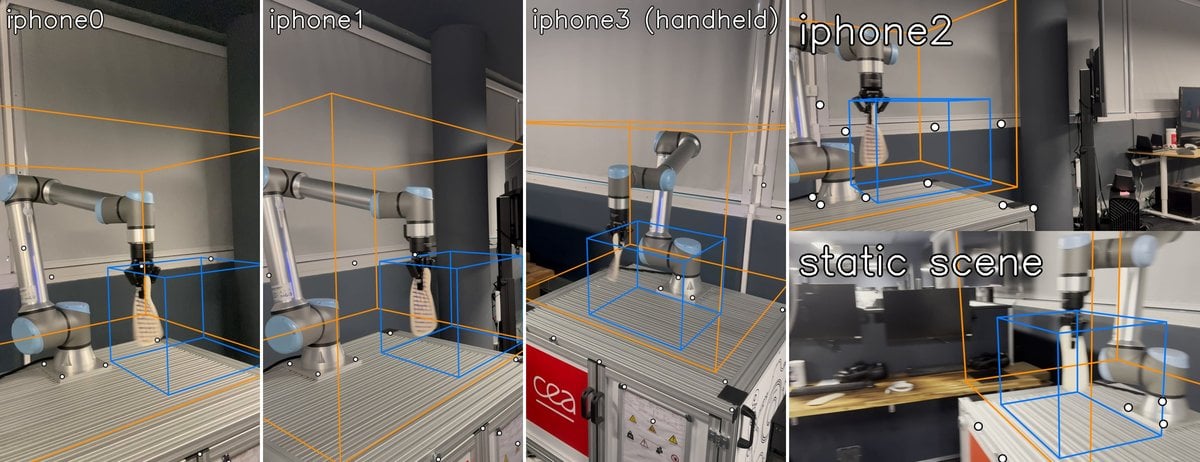
Louen Pottier releases a multi-view video dataset of a deformable object driven by a measured input, with the measured pose of every camera, and a first 3D result obtained with LaGSplat. LaGSplat learns from video a low-dimensional latent state that is both the generalized coordinate of a learned dissipative Lagrangian and the conditioning variable of a Gaussian Splatting decoder; fitting that decoder in 3D needs synchronized multi-view footage, which the original paper only had from synthetic renderings.

A robot arm moves a flexible strip along a one-dimensional path while four iPhones, three fixed and one handheld, film it for ten minutes. LaGSplat fitted on this data with gripper acceleration as a forcing term renders held-out views at 26 to 33 dB PSNR and runs as a real-time interactive demo in a web browser. The dataset, checkpoints and training code are public.

PrinGS anonymizes a trained 3DGS scene in less than a second

arXivPapers

Gaurav Behera, Abhinav Raundhal, Archisha Panda, Saumya Balina, Gargi Shroff and Ponnurangam Kumaraguru present PrinGS, a representation-level anonymization framework for trained 3D Gaussian Splatting scenes, accepted at ICVGIP 2026. Given a trained splat and a user-provided reference view identifying sensitive content such as faces, license plates, documents or screens, the method localizes the corresponding 3D regions and anonymizes them so the information is absent from subsequently rendered novel views, in less than one second, while aiming to preserve scene geometry and visual fidelity.

A privacy-by-design training strategy can also prevent sensitive content from being embedded during optimization. The method achieves a Face Similarity Measure of 9.79% at a retained Face Detection Rate of 39.47%, and makes sensitive text completely unreadable with an OCR character error rate of 1.00.

Robot-aligned 3DGS data helps a wrist-camera VLA reach cluttered e-waste parts

arXivPapers

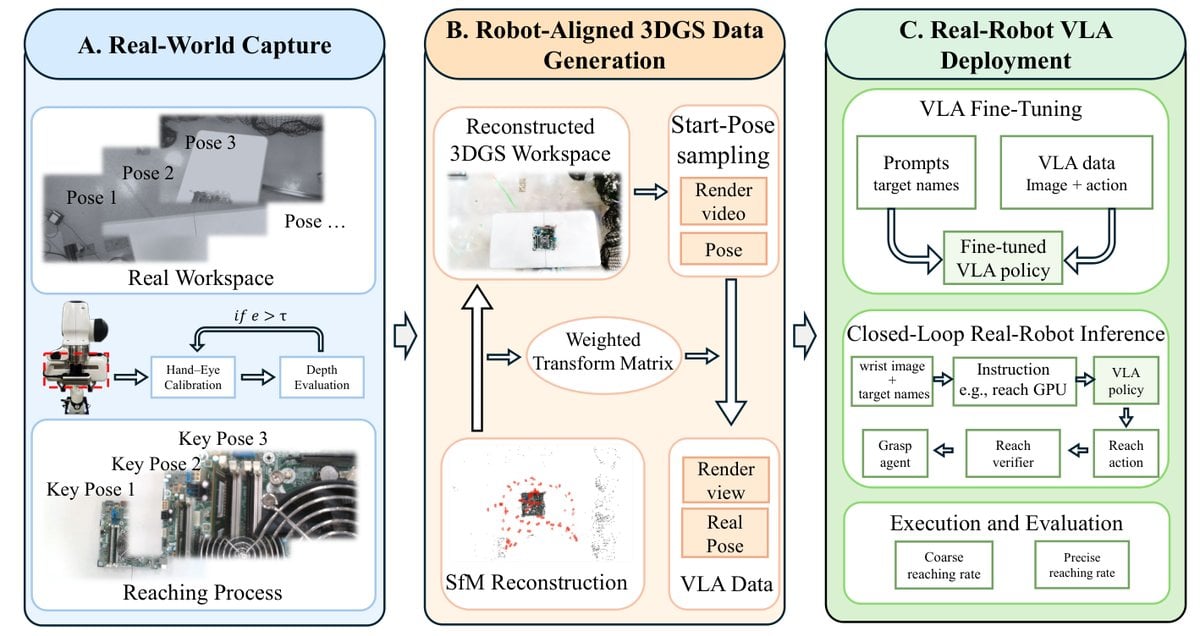
Zuoxu Wang and Xiao Liang present a 3D Gaussian Splatting data-generation pipeline for wrist-camera vision-language-action policies, aimed at pre-contact reaching in cluttered electronic-waste disassembly. The real workspace is reconstructed with 3DGS and diverse wrist-camera observations are rendered from robot-aligned poses, then paired with smooth reaching trajectories for VLA fine-tuning. An instruction-conditioned reach verifier estimates target proximity and provides reliable termination before contact.

In motherboard-disassembly experiments using wrist-camera observations alone, 1,500 generated trajectories with π0.5 achieve 80.0% precise-reaching success across three targets, compared with 58.7% using 150 teleoperated demonstrations, and require less than 10 minutes of active human capture.

SceneAgent turns 3DGS and 4D captures into interactive simulation environments

arXivPapers

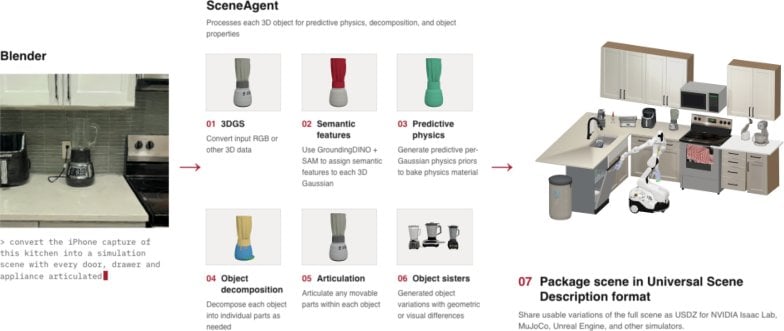
Luke Hollis, Tianxing Fan and Heng Yang present SceneAgent, an agentic pipeline that converts visual captures into interactive simulation environments through simulator-based visual inspection and repair. It processes 3D Gaussian Splatting, photogrammetry, LiDAR, AI-generated 3DGS scenes and 4D videos, combining object segmentation, physical parameter estimation, part decomposition, articulation and deformable simulation, and can generate “digital sisters” and scripted demonstrations for policy learning.

On a cluttered bin scene from GraspClutter6D, all agent configurations exceed SimFoundry’s F1 score, with a best of 60.75% versus 6.9%. On three dynamic scenes from 4DCodeBench, SceneAgent raises the mean dynamic IoU of Gemini 4 Argon from 0.86% to 99.09%.

SG-Splat stabilizes pose-free feed-forward 3DGS under residual pose error

arXivPapers

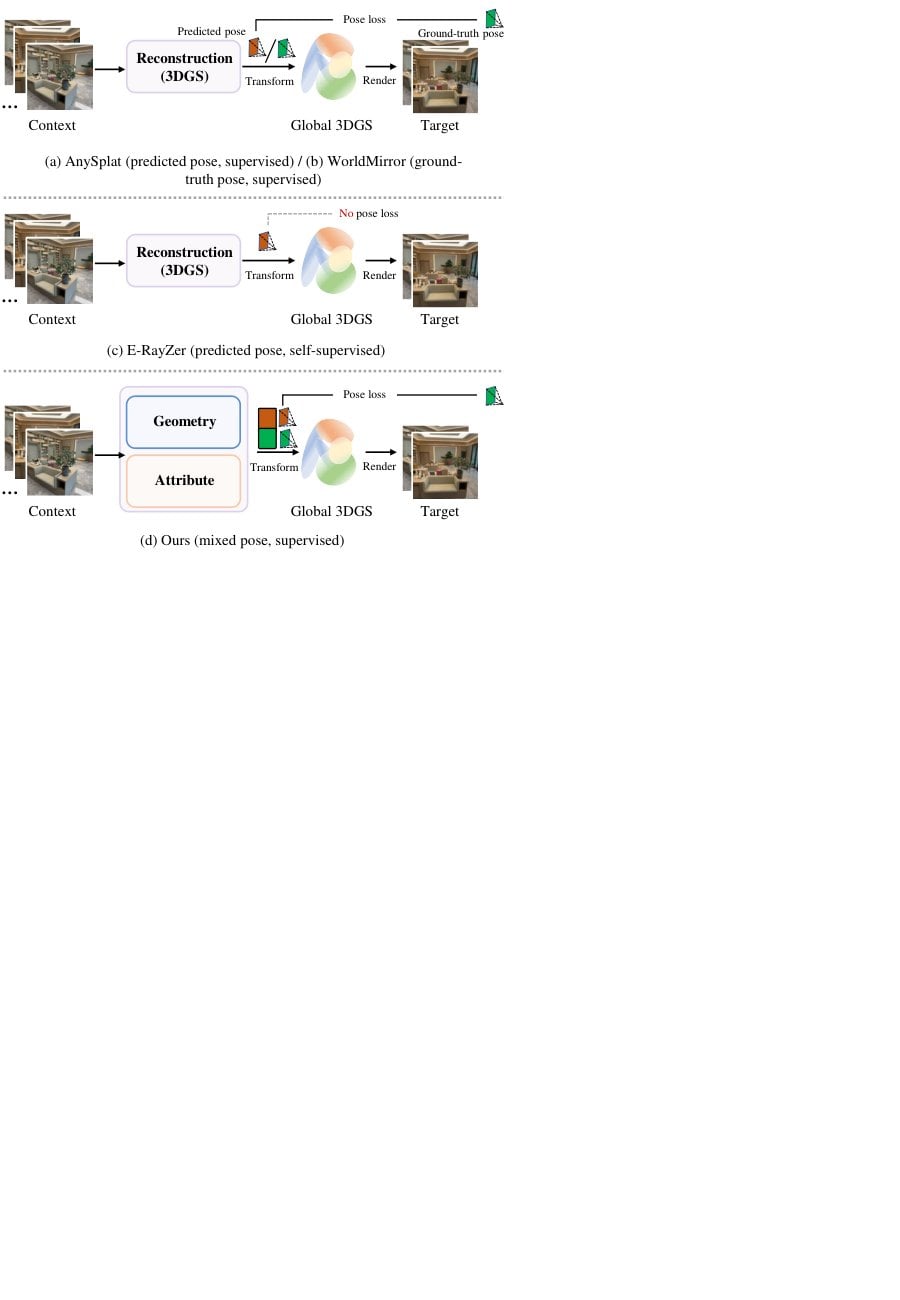
Xiaohan Lu, Jiaqi Zhang, Weijia Jiang and Siwei Ma present SG-Splat, a pose-free feed-forward 3D Gaussian Splatting framework designed to be more robust to residual pose errors. Geometry estimation and Gaussian attribute prediction are decoupled into two branches, and a coarse-to-fine pipeline first refines camera poses with flow-based correlation and differentiable bundle adjustment, then corrects initial point maps with depth residuals before attribute reconstruction.

A dual-path training strategy mixes ground-truth and predicted poses for canonical transformation. On DL3DV and RealEstate10K, the authors report state-of-the-art performance in both novel-view synthesis and pose estimation.

SG²SLAM couples streaming spatial geometry with a ray-conditioned 3DGS kernel

arXivPapers

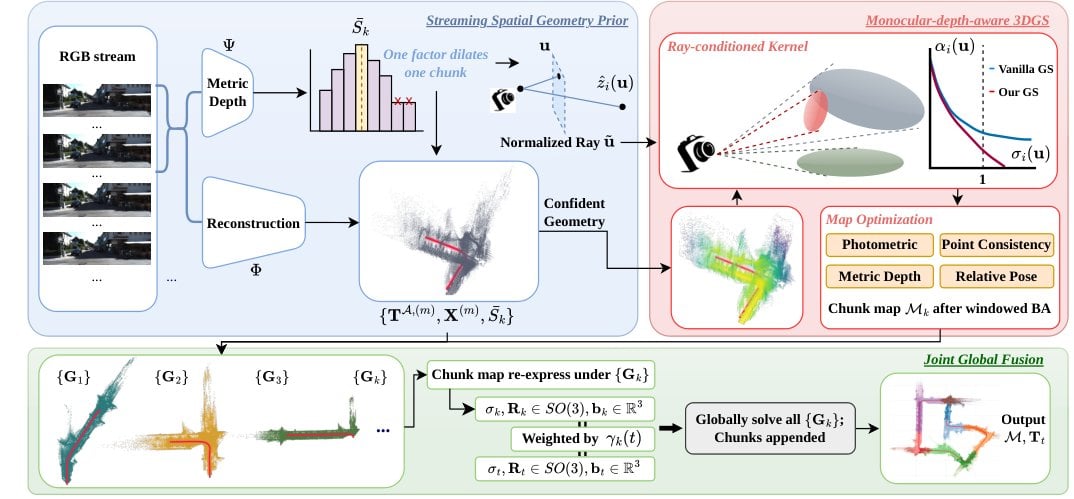
Ziang Guo, Didar Seyidov, Yixiao Zhou and colleagues present SG²SLAM, a monocular outdoor 3D Gaussian Splatting SLAM system. They argue that typical pipelines recover geometry by associating 2D pixels with 3D points, so a modular SLAM system absorbs tracking error into the map.

SG²SLAM replaces per-frame cross-dimensional correspondence with a chunk-level metric prior that supervises tracking and mapping from one source, and a ray-conditioned kernel extends each primitive with a viewing-direction subspace. Joint optimization over spatial geometry and poses aims for a globally consistent map and trajectory. On KITTI and Waymo Open, the authors report that SG²SLAM surpasses per-frame association baselines for monocular outdoor navigation.

VidEdit3D edits 3DGS scenes by treating camera motion as a video for diffusion models

arXivPapers

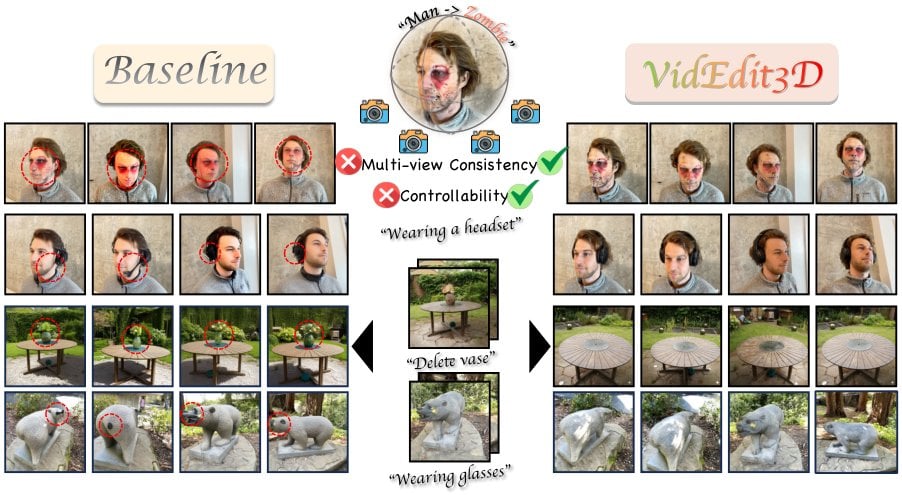
Yanming Yang, Chenxi Song, Tong Zhao and colleagues present VidEdit3D, which reformulates 3D Gaussian Splatting scene editing as a trajectory-based video editing task so that pre-trained video diffusion models can encourage semantic and structural coherence across views. Trajectory-Guided Rendering selects informative keyframes and builds smooth clips; Flow-Aligned Video Editing, a training-free framework with Editing Consistency Guidance, propagates edits from an anchor view; and Region-Selective 3DGS Refinement confines geometric and appearance updates to target primitives.

The authors report stronger instruction alignment and better multi-view consistency than the baselines.

Birth-death control for 3DGS uses a variational score instead of densification heuristics

arXivPapers

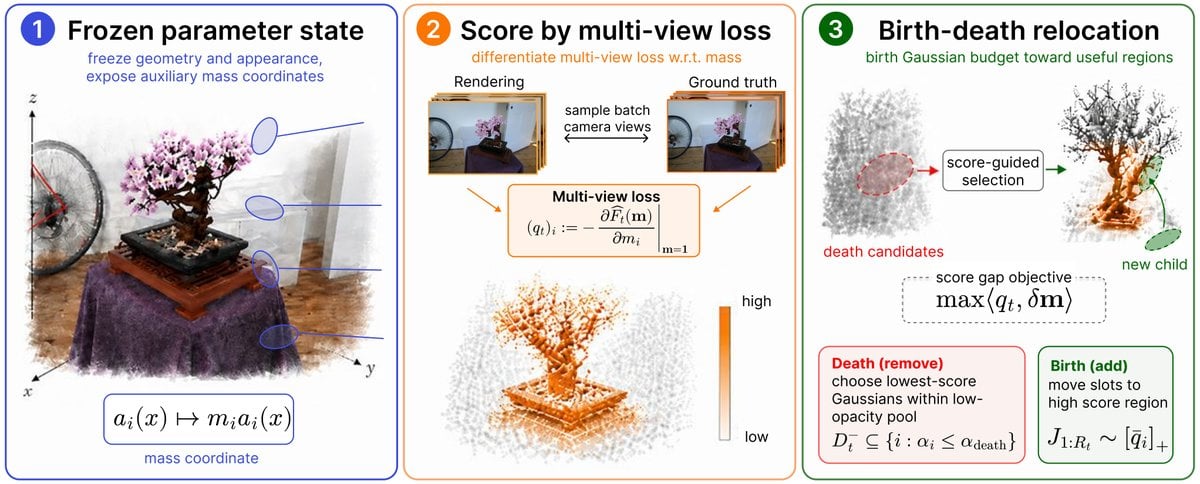
Quan Tran Hong, Long Nguyen-Chi and Binh T. Nguyen present first-variation birth-death control for 3D Gaussian Splatting, replacing heuristic cloning, splitting and pruning with a variational score derived from the reconstruction loss. At each structural update the current Gaussian population is frozen, auxiliary mass coordinates are attached to each primitive, and the multi-view loss is differentiated with respect to those coordinates.

High-score Gaussians are selected as birth sites, while low-score, low-opacity Gaussians are removed. Integrated into 3DGS-MCMC, the score yields state-of-the-art reconstruction quality, with the most significant gains under tight Gaussian budgets. Code is on GitHub.

BoundedGS keeps high-resolution 3DGS training's rendering working set near 1 GiB

arXivPapers

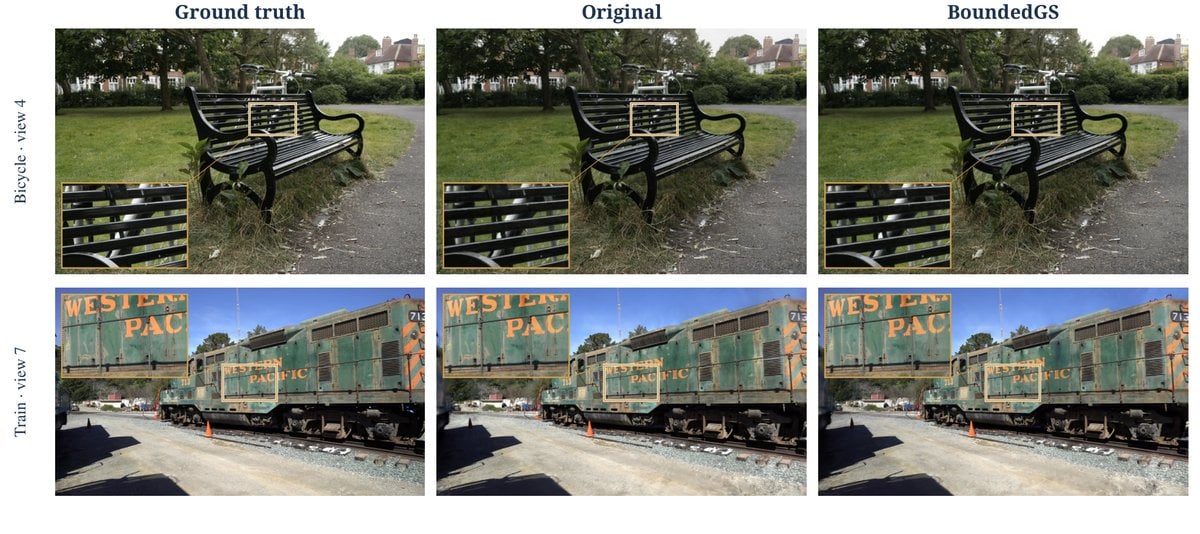
Xiaobin Deng, Changyu Diao, Min Li and Duanqing Xu present BoundedGS, a memory-efficient scheme for high-resolution 3D Gaussian Splatting training. High-resolution training expands rasterization caches that coexist with projection and gradient state at peak memory; BoundedGS separates rasterization and projection backward passes and bounds the active local rasterization working set according to its measured load.

In a resolution sweep at a fixed count of about 6 million Gaussians, the measured rendering working set stays within 1.073–1.077 GiB from 1K to 16K. Across five native 5K outdoor scenes, full training reduces the mean rendering working set from 9.97 to 1.76 GiB (82.3%), retains similar reconstruction quality, and shortens training time from 36.7 to 33.9 minutes.

LegoOcc++ predicts open-vocabulary 3D occupancy from language-embedded Gaussians

arXivPapers

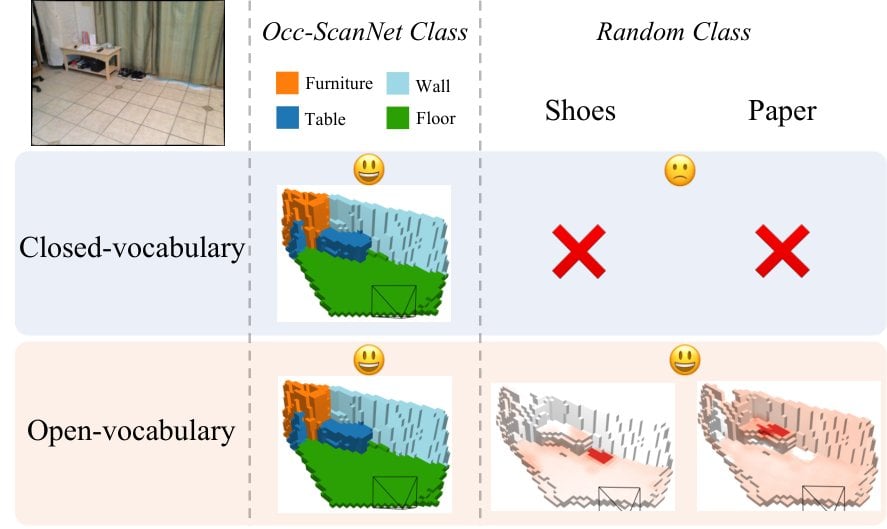
Changqing Zhou, Yueru Luo, Han Zhang, Zeyu Jiang and Changhao Chen present LegoOcc++, an open-vocabulary 3D occupancy method built on Language-Embedded Gaussians and trained with only binary occupancy labels rather than voxel-level semantic annotations. Geometry is learned with an opacity-aware Poisson-based Gaussian-to-occupancy formulation, and semantic features rendered from the Gaussians are aligned with a frozen open-vocabulary model, with Progressive Temperature Decay to reduce feature mixing during splatting.

Instance-Level Semantic Consistency and Covisibility-Aware Support-View Selection are added to reduce fragmented object predictions and redundant multi-view supervision. The authors report strong open-vocabulary occupancy performance on indoor and outdoor benchmarks, including driving scenes.

ParetoGS decodes many Gaussian-count budgets from a few adapted anchors

arXivPapers

Xiaobin Deng, Changyu Diao, Min Li and Duanqing Xu present ParetoGS, which lets one 3D Gaussian Splatting scene serve many Gaussian-count budgets without separately optimizing every requested count. The method alternates pruning and fixed-member adaptation to build nested anchors with persistent identities, encodes their parameter changes relative to the full model in a compact residual atlas, and at decoding interpolates shared members while gradually introducing new ones.

Across 13 scenes, ParetoGS attains better average PSNR, SSIM and LPIPS with fewer Gaussians than compared prefix methods at 10% of each method’s own full model, and encoding reduces mean additional state from 390.0 to 85.7 MB with an average PSNR change of 0.01 dB.

RacerGS compresses 3DGS with hash-projected features and an autoregressive context model

arXivPapers

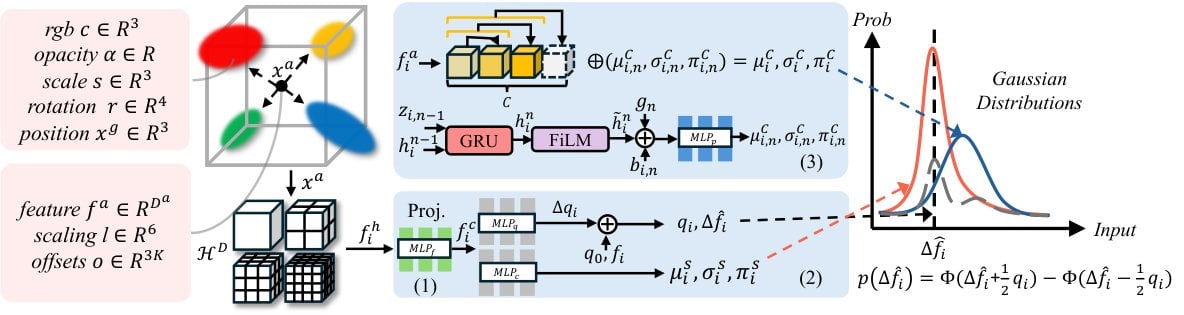
Wenqing Wang, Huimin Zeng and Yun Fu present RacerGS, a compact 3D Gaussian Splatting compression framework. A hash projection model converts anchor hash encodings into compact context features, a FiLM-modulated autoregressive GRU uses causal dependencies among anchor feature groups to refine entropy-model parameters, and quantized anchor-attribute residuals are adaptively entropy-coded relative to their context-predicted means.

Overall, RacerGS achieves more than 150× compression over vanilla 3DGS and 28× over Scaffold-GS, while providing comparable rendering quality. The authors report that it outperforms prior 3DGS compression methods in storage reduction and rate-distortion performance across five datasets.

RIDE-Splat strips windshield reflections out of driving video before fitting a clean 3DGS model

arXivPapers

Kevin David Hayes, Alex Hanson, Allen Tu, Pranav Asthana, Matthias Zwicker and Tom Goldstein present RIDE-Splat, a pipeline for reflection-free 3D reconstruction from posed driving video without clean images, reflection masks or pretrained networks. World-consistent transmission through the windshield is assigned to a 3DGS scene and the dominant camera-attached reflection to one shared, signed RGB image; after a first pass learns the geometry and that reflection, reflection-removed training images are used to fit a clean 3DGS model, and the reflection image is discarded at inference.

The authors also introduce the RIDE-Splat Dataset, with real driving scenes, physical windshield reflections in training views, and separately captured non-reflective evaluation images. Across that dataset, XLD and Wayve, RIDE-Splat outperforms 3DGS, DC-Gaussian and RobustSplat on all nine aggregate metrics, improving PSNR by up to 3.59 dB.

RelateGS refines unreliable semantics and under-observed relations for 3D grounding

arXivPapers

Seongjun Choi and Sangyoun Lee present RelateGS, a structured language-aware Gaussian representation for 3D visual grounding, accepted at WACV 2027. They argue that multi-view semantic aggregation can incorporate weak observations, and that object relations can remain under-observed along the available camera trajectory.

RelateGS suppresses unreliable observations during semantic feature uplifting, consolidates multi-view object observations into a persistent 3D graph, and guides targeted re-querying of informative existing frames to complement under-observed relations. On Sr3D+ and Nr3D it improves the previous best by 7.9 and 1.7 percentage points at Acc@0.25, respectively.

GEMS stores a persistent 3DGS map that updates only where the scene has changed

arXivPapers

Ling-Chia Chen, Abdelrhman Werby, Kaan Aytekin and Kai O. Arras present GEMS, a framework that combines a persistent spatio-temporal 3D Gaussian Splatting map with an agentic reasoning pipeline. The map is reconstructed once and then updated only in regions where the scene changes, storing those modifications while preserving visual detail across time, and the agent can render novel views on demand to answer spatio-temporal questions and ground objects from natural-language queries.

The authors also introduce GEMS-Bench, with 3 real-world and 12 synthetic environments and 473 question-answer pairs. GEMS outperforms recent baselines in 3D object grounding and spatiotemporal question answering, while achieving rendering quality on par with dedicated scene-update methods.

H-2DGS reconstructs a sharp, deformable cortical surface for neurosurgical navigation

arXivPapers

Zhang Zichuan, Bart Brouwers, Rembrandt Bakker, Maud Landers, Geert-Jan Rutten and Maxime Chamberland present height-field 2D Gaussian Splatting (H-2DGS) for reconstructing the exposed cortex during tumor surgery so it can be visualized with whole-brain MRI and tractography. Under limited surgical view coverage, conventional 3DGS can distribute opacity through a thick, geometrically ambiguous band; H-2DGS concentrates a robust 3DGS reconstruction, fuses its depth into a shared TSDF surface, and represents that surface with curved, surface-oriented Gaussian primitives.

The explicit surface also supports postoperative alignment, in which MRI-derived depth deforms the reconstruction. Across five real neurosurgical cases, H-2DGS gives low multi-view depth inconsistency, a compact 7.97 MB representation, and interactive rendering at 29–42 ms per frame.

RecallGS retrieves geometric-semantic context from an agent's past views, without a learned 3D branch

arXivPapers

Thanh-Khoi Nguyen, Thien-Phuc Tran and Minh-Triet Tran present RecallGS, a training-free mechanism for online semantic 3D Gaussian Splatting. Existing methods recover geometric context missing from image-derived semantic features with an additionally learned 3D network; RecallGS instead treats past observations as a non-parametric prior.

The pipeline retrieves relevant observations with CLIP, uses alpha-compositing weights to identify geometrically supported views, and aggregates their semantic features over each Gaussian’s rendered footprint. On ScanNet and ScanNet++, RecallGS achieves strong semantic segmentation performance at 2.48 frames per second.

AirPlayground benchmarks aerial navigation in 94 photorealistic 3DGS environments

arXivPapers

Rangya Zhang, Yujing Shang, Zhuoyuan Yu and colleagues introduce AirPlayground, a benchmark for training and evaluating aerial navigation policies across diverse reconstructed environments. They construct 94 photorealistic 3D Gaussian Splatting environments spanning indoor, urban outdoor and vegetation settings, with aligned collision geometry, and an automated expert-flight pipeline yields 94,000 demonstrations and 46.5 million synchronized observation-state-action samples at 50 Hz.

Seven baselines spanning four policy paradigms are benchmarked in seen and unseen environments. Scaling ACT’s training corpus from 5 to 70 scenes raises median success rates on seen and unseen environments from 30.6% and 16.8% to 41.2% and 29.4%, respectively.

AOV-GS steers 3DGS exploration toward semantically novel views, using frozen SAM and CLIP

arXivPapers

Rodion Shkokov, Tatiana Zemskova and Dmitry Yudin present AOV-GS, an active 3D Gaussian mapping system that guides exploration with frozen foundation models, published at AIST 2026. During coarse exploration it re-ranks geometrically promising candidate views by CLIP mask-embedding novelty computed from SAM instance segmentation, biasing the trajectory toward semantically informative regions, and a lightweight scene-specific language field is later fitted offline to the collected CLIP embeddings rather than to manually annotated masks.

In a controlled comparison that uses the same SAM-CLIP stack, AOV-GS improves average language-field mIoU over geometry-only active planning by 1.3 percentage points on Replica (34.6% on eight scenes) and by 1.8 points on Matterport3D (23.1% on five scenes). Novel-view PSNR stays comparable to the geometry-only baseline.

AutoPhyX predicts text-conditioned physical properties that work with Gaussian splats

arXivPapers

Bei Huang, Yixin Chen, Hongbin Zha, Yuru Pei and Siyuan Huang present AutoPhyX, a text-conditioned framework for predicting spatially varying physical properties for 4D simulation. Because appearance alone cannot distinguish properties such as the stiffness of rubber, the method trains on a part-controllable dataset that decomposes 3D assets into semantic components paired with physically plausible parameters and text descriptions, and uses text features to modulate visual features.

Property prediction is formulated as a voxel field, so the same output is compatible with meshes, point clouds, Gaussian Splatting and NeRF. The authors report physically plausible, text-driven parameter assignment in a single forward pass, with robust generalization to in-the-wild objects.

ClunoGS sparsifies and quantizes language 3DGS under one semantics-aware objective

arXivPapers

Jian Xu, Yi Li, Ying Huang, Siyi Wu, Bingzhe Li, Yuede Ji and Miao Yin present ClunoGS, a compact framework for Language 3D Gaussian Splatting. They note that pruning based only on RGB rendering quality can remove Gaussians that contribute little to color but are important for semantic prediction, and that later quantization cannot recover that information.

ClunoGS combines semantics-aware sparsification and vector quantization in a unified constrained objective that jointly considers rendering quality, semantic accuracy and compactness, optimized with alternating primal, sparsification, quantization and dual updates. On LERF and ScanNet-10, the authors report that the unified formulation substantially reduces the semantic degradation caused by sequential, semantics-agnostic compression.

NVIDIA Foundation4D predicts depth, objects, occupancy and Gaussians from driving video

arXivPapers

A 26-person NVIDIA team presents Foundation4D, a unified feed-forward model that, from multi-camera driving video, predicts camera poses and depth, 3D objects, semantic occupancy, and a set of Gaussians ready to render. A shared backbone uses factorized spatiotemporal attention; a Gaussian head places one Gaussian per pixel along each camera ray at the predicted depth, assigns it to static scenery or a tracked actor, and fills the sky from a learned background.

With benchmark-specific fine-tuning, Foundation4D reports the lowest depth AbsRel on Waymo and nuScenes, the highest detection mAP on nuScenes, and the highest occupancy mIoU on OpenOccupancy among the compared methods. Running on its own predicted poses and tracks, it scores 23.94 dB against 22.66 dB for the released Instant NuRec checkpoint across 99 internal clips. NVIDIA also releases the gated PAI-Foundation4D benchmark of 1,253 clips.

ReferGaussian grounds language queries in 4D Gaussian scenes without per-scene semantic training

arXivPapers

Bangpu Chen, Yaxuan Li, Shirui Peng and colleagues study Referring 4D Gaussian Splatting, a task for grounding temporally varying, multi-target, reasoning-intensive and zero-target expressions in dynamic 4D scenes, and introduce the R4D-Bench-QA benchmark. Their framework, ReferGaussian, is built on 4DGS and organizes mask-supported Gaussian entities in an EntityBank; multimodal large language models decompose complex queries into trackable object phrases and structured constraints, and constraint-aware grounding runs without scene-specific semantic optimization.

On R4D-Bench-QA and the 4D LangSplat protocol, the authors report improved temporal target selection and competitive spatiotemporal grounding without scene-specific semantic training. The paper is accepted at ACM Multimedia 2026.

SplatLab autonomously reproduces 3DGS papers, proposes extensions and writes the manuscript

arXivPapers

Seemandhar Jain and Manmohan Chandraker present SplatLab, an autonomous research system for 3D Gaussian Splatting, accepted at NeurIPS 2026. Given a research prompt, a target-paper URL, or no input at all, it reproduces a published baseline, proposes an extension, trains and ablates across Mip-NeRF 360 and LLFF, writes the manuscript, and binds every reported number to a logged training run, refusing to terminate while any claim is unbacked.

Candidates mutate plugins from a verified-reproduction backbone and are scored in a cascade-weighted Elo tournament on measured GPU PSNR. On PSNR-targeted runs, SplatLab’s manuscripts beat their reproduced targets by +0.18 to +3.78 dB, including +3.78 dB on astrophotographic nebula rendering, for which the authors say no prior 3DGS method exists.

TerraTransfer++ trains end-to-end driving planners without human demonstrations, and tests them in 3DGS

arXivPapers

Zikang Xiong, Weixin Li, Zhouchonghao Wu and colleagues present TerraTransfer++, a demonstration-free recipe for end-to-end autonomous driving. A policy is pretrained by self-play in a vectorized simulator, its rollouts are distilled into a flow-matching trajectory teacher, and lightweight adapters on a frozen vision backbone are trained to reproduce that teacher’s latent space, so alignment never supervises against a logged trajectory.

From that one self-play teacher the authors obtain a closed-loop policy that they say outperforms every published imitation-based end-to-end method on the photorealistic 3D Gaussian splatting benchmark HUGSim, and a planner that reaches 59.4 EPDMS on NAVSIM navhard, above DriveZero-Scale at 57.1, and 95.5 PDMS on navtest, without human demonstrations.

AEON generates 4D Gaussian worlds from video-model latents

arXivPapers

Weiqi Zhang, Wenyuan Zhang, Yu-Shen Liu and Junsheng Zhou present AEON, a unified world model accepted at NeurIPS 2026 that operates in a text- or image-conditioned video latent space while producing renderable 4D Gaussian Splatting primitives as the explicit world representation. A 4D reconstruction model is trained to predict both 4DGS and camera poses from monocular videos, and a domain adapter translates generative video latents into reconstructive 4D latents through distillation on the video VAE.

AEON can render 4DGS along predicted camera trajectories and also construct a persistent 4D environment with scene dynamics. The authors report state-of-the-art performance on standard benchmarks and a range of world-modeling applications.

Coded-aperture cameras are designed end-to-end against 3DGS scene representations

arXivPapers

Chengyang Yan and Donald G. Dansereau present a differentiable framework for jointly designing complex camera systems and downstream perception tasks. They use it to design two coded-aperture depth-from-defocus cameras, monocular and stereo, by jointly optimizing the coded-aperture mask, camera parameters, and a depth-estimation network end-to-end.

Scenes are represented with 3D Gaussian Splatting reconstructed from real-world captures, providing a differentiable image-formation process for gradient-based optimization over design spaces the authors say were intractable for prior differentiable approaches. They report that the method improves over existing coded-aperture design and non-differentiable camera-design baselines.

CrossFit-GS estimates COLMAP-free poses against a frozen opposite submap

arXivPapers

Zijian Wu, Jinliang Wang, Mingfeng Jiang, Zidian Lin, Ying Song and Ziqian Lu present CrossFit-GS, a deferred-commitment progressive framework for pose-free 3D Gaussian Splatting from unposed image sequences. The input is partitioned into interleaved subsets that maintain two complementary submaps, and each candidate pose is cross-refined against a frozen opposite submap that has never been optimized using the target frame, providing an independent geometric reference.

Checkerboard validation and spatial coverage safeguards reject unreliable updates, and only verified poses are committed. Once the trajectory is refined, the intermediate submaps are discarded and the final global representation is trained from scratch with the fixed poses. Across multiple benchmarks, the authors report substantially reduced cumulative trajectory drift and improved camera-pose estimation and novel-view synthesis.

KoalaGS uses image complexity to decide which Gaussians to keep as the budget shrinks

arXivPapers

Radu Beche and Raoul de Charette present KoalaGS, a complexity-aware continuous level-of-detail method for Gaussian Splatting, accepted as a NeurIPS 2026 Spotlight. A pilot study on 3DGS-MCMC reconstructions shows that image complexity computed from the input views before optimization predicts where reconstruction error concentrates, and that simple regions often contain too many Gaussians and degrade as much as complex ones at lower budgets.

During training, this complexity prior biases relocation toward poorly reconstructed areas. A primitive importance score then enables low-capacity inference while preserving scene structure. Across three datasets, KoalaGS maintains competitive full-capacity quality while improving quality across the budget spectrum, with smoother LoD transitions and faster progressive streaming.

Automatic 3DGS edits train an online Bayesian scene-change detector

arXivPapers

Changrui Zhu and Simon Julier present a method for online scene change detection that updates change beliefs as new images arrive using generalised Bayesian evidence fusion. The prior probability of change and the evidence models are unknown beforehand, so they are learned offline from automatic edits to a reference 3D Gaussian Splatting model, which generate labelled training views without manual annotations.

Online prediction combines current evidence with historical support, and closed-form local Bayes factors update an accumulated 3D Gaussian field, with object-guided refinement producing the final masks. The method reaches 67.64% mIoU on PASLCD and 75.82% on CCS3D, and on PASLCD the complete pipeline runs at 17.2 frames per second over complete query sequences, the fastest among the evaluated online methods.

OV-Foam lifts open-vocabulary features onto non-overlapping PowerFoam primitives

arXivPapers

Yousef Rajeh, Alejandra Esparza Pelcastre, Ivan Viola and Dominik Engel present OV-Foam, which studies how the choice of 3D representation shapes semantic feature lifting for open-vocabulary segmentation. In 3D Gaussian splatting, primitives overlap heavily, so many primitives share a ray and simple backprojection is a poor way to assign features.

OV-Foam instead uses PowerFoam, whose power diagram partitions the scene with zero overlap between primitives and fewer primitives per ray, which the authors say reduces lifting to a closer-to-optimal assignment. They report that the space-partitioning primitives reach near-optimal assignment and improve open-vocabulary segmentation over Gaussian baselines.

PanoGraphGS learns panoptic Gaussians and builds a floor-to-object scene graph

arXivPapers

Jinghan Gao, Siyu Wang, Dongyu Feng, Yiyuan Pan and Rong Xiong present PanoGraphGS, which integrates panoptic 3D Gaussian representation learning with hierarchical 3D scene-graph construction. Semantic and instance features are learned on shared Gaussian geometry, supporting novel-view panoptic segmentation and direct Gaussian-level panoptic decoding, and a semantic-aware module recovers a floor-room-stuff-object hierarchy with containment and spatial relations.

The authors also release NaviGS, a real-world dataset with 3DGS, mesh, RGB, semantic and depth data. For 3D scene-graph identification, PanoGraphGS outperforms the strongest evaluated baseline in object-node accuracy by more than 50 percentage points on average across Replica and NaviGS, and also reports state-of-the-art 2D panoptic segmentation among the evaluated methods.

Real2Sem2Real turns one human RGB video into thousands of robot demonstrations

arXivPapers

Matthew Strong, Ankush K. Dhawan and colleagues present Real2Sem2Real, a pipeline that turns one monocular RGB video of a human demonstration into thousands of robot demonstrations across semantic object instances of a category. Object SE(3) poses are tracked with DINOv3-distilled Gaussian splats, which the authors say outperform existing methods and FoundationPose with estimated metric depth, and digital cousins generated from one or a few photographs are aligned to the demonstrated objects, including functional regions such as a coffee machine’s tray.

Robot demonstrations are generated in IsaacSim or MuJoCo, and the system can produce over 2,000 episodes in about two hours. On two real robots and four tasks, policies trained on data from one human video per task match or exceed policies trained on teleoperation across diverse object instances.

RLSplat shrinks feed-forward 3DGS size, latency and memory linearly with the budget

arXivPapers

Injae Kim, Minseok Joo, Jihwan Park, Sehyung Kim, Minseong Bae and Hyunwoo J. Kim present RLSplat, a resource-linear budget-controllable feed-forward 3D Gaussian Splatting framework. Prior methods first predict a dense set of Gaussians and then prune, so inference latency and peak memory stay nearly constant regardless of the requested budget.

RLSplat instead learns an allocation policy that distributes the budget across local scene regions and generates exactly the requested number of Gaussians, then refines them with resource-linear decoding in which each Gaussian attends only to nearby neighbors found by a hierarchical search. In zero-shot evaluation it outperforms prior budget-controllable methods at every budget, surpassing the strongest baseline even with 4× fewer Gaussians, and at low budgets runs up to 4.1× faster with 9.6× less peak memory.

World2HOSI orchestrates experts inside 3DGS scenes to generate long-horizon interactions

arXivPapers

Jiushu Li, Haoran Wang, Yumeng Liu, Zhiyang Dou, Yuan Liu, Yuexin Ma and Cheng Lin present World2HOSI, a multi-expert orchestration harness that generates continuous human-object-scene interaction data from 3D Gaussian Splatting scenes and natural-language instructions. A persistent scene state is built from decoupled background and object assets; a harness plans action stages, invokes existing HOI and HSI experts through their native interfaces, and writes each action’s effects back into the world.

Bounded residual optimization and contact-driven physics simulation are used to reduce physical artifacts while preserving interaction intent. Experiments and a perceptual user study show that World2HOSI achieves the best task completion and interaction quality on the evaluated HOSI tasks, while generating more diverse data.

A monocular flight planner trained in a 3DGS simulator avoids obstacles at 6.5 m/s

arXivPapers

Wencan Feng, Bailing Tian, Yulin Hui, Zhiyu Li and Junjie Lu present a geometry-aware monocular visual planning framework that predicts trajectories from two image frames, their relative pose, and the micro-aerial-vehicle state, without explicitly reconstructing depth. A privileged depth expert is trained first, its planning features are distilled into a monocular branch on paired RGB-D observations, and the planner is then adapted to the downstream trajectory objective.

A 3D Gaussian Splatting simulator renders visual observations for data collection, paired RGB-D supervision and simulation evaluation. The planner trained in simulation is deployed in real-world environments without real-world fine-tuning, achieving obstacle avoidance at speeds of up to 6.5 m/s.

Occlusion-aware densification counts only the views a Gaussian actually contributes to

arXivPapers

Marcel Rogge, René Schuster and Didier Stricker argue that standard 3DGS adaptive density control uses a frustum visibility filter that is blind to occlusion, so fully occluded Gaussians still count as observed and dilute the averaged gradient. They add an occlusion-aware filter that restricts densification statistics to views in which a Gaussian actually contributes, and replace the criterion’s raw view-count normalizer with an average-contribution one.

Integrated into a StopThePop-based framework, the two changes improve every image-quality metric over the occlusion-blind baseline on occlusion-heavy scenes, by up to 6% lower LPIPS, at less than half the Gaussians a view-count normalizer requires. The paper is accepted as an oral at ACCV 2026, and code is on GitHub.

RxGS stylizes a 3DGS scene by editing only the recovered albedo, so it can still be relit

arXivPapers

Wanrong Hong, Liu Jiang, Mukesh Prasad and Jun Li present RxGS, a relightable 3D scene stylization framework built on a BRDF-aware 3D Gaussian representation. Rather than optimizing a combined per-point RGB color, which bakes the illumination present during stylization into the stored appearance, RxGS optimizes only the diffuse albedo field recovered by inverse rendering and leaves roughness, metallicity, surface normals and the estimated environment lighting unchanged.

The albedo field is optimized with a nearest-neighbour feature matching loss and a spatial smoothness prior over Gaussian centres. Using a Geometry Consistency Cost based on optical-flow warping error, RxGS achieves the lowest GCC on all evaluated NeRF-Synthetic scenes and remains competitive on real captures, while supporting relightable stylization that existing reference-based methods do not provide.

A few-shot take on sparse-view 3DGS won the SIGGRAPH Asia 2025 volumetric video challenge

arXivPapers

Lejia Ye, Bin Wu, Jingjing Gao, Yiyang Wu and Xiaohu Zhang reframe sparse-view 3D Gaussian Splatting as a few-shot learning problem, treating each Gaussian primitive as a neuron and applying deep-learning regularization. Supervision from scarce observations is enriched with optical-flow-guided pseudo-view synthesis and joint camera-scene optimization, and training-time motion-aware dropout and early stopping are used to suppress overfitting while preserving dynamic-scene stability.

On the SIGGRAPH Asia 2025 volumetric video challenge sparse-view dataset, the system improved over optimization-based and feed-forward baselines and won first place in the sparse-view track. The paper is five pages and reports that result as its main evaluation.

SplatXR is a Unity toolkit for multi-layered XR built on on-headset 3DGS

arXivPapers

Cyrus Vachha, Mohamed Kari and Parastoo Abtahi present SplatXR, a Unity toolkit for interactive extended reality that treats 3D Gaussian splatting as a first-class primitive. Because splats lack explicit surface geometry, standard graphics techniques such as shadows and collision handling are awkward; SplatXR organizes XR as a multi-layered reality of interacting primitives and ships a standalone renderer, splat-to-mesh reconstruction, splat physics, splat blending, and offloaded splat-object reconstruction from on-headset capture.

The authors validate the toolkit through demonstrative applications and a small developer study, and a project page is at splatxr.github.io. The work is aimed at UIST 2026.

FineSplat uses fine image patches and dual grouping for feed-forward 3DGS

arXivPapers

Hyebin Kim, Hwasik Jeong, Joonhyuk Park, Gyeongjin Kang, Jungwoo Kim, Younghyun Kim and Eunbyung Park present FineSplat, a feed-forward 3D Gaussian Splatting framework built around fine-grained image patches. Because global multi-view attention becomes expensive at high token resolutions, a dual-grouping strategy combines view-wise grouping among neighboring views with 3D spatial grouping that reconnects geometrically related tokens in scene space.

Reconstruction error is used as direct feedback to recover fine structures after a one-pass prediction, and a compact Gaussian generation scheme preserves those fine features without unnecessarily increasing the primitive count. The authors report state-of-the-art results by a substantial margin under the same or smaller Gaussian budgets than existing methods.

GOFusion anchors Gaussians to occupancy submaps for real-time robot navigation

arXivPapers

Boxin Bu, Simon Boche, Haoming Zhang and colleagues present GOFusion, a real-time visual mapping system that anchors Gaussian primitives to local occupancy maps so a robot has both spatial awareness for planning and high-fidelity appearance for information-driven navigation. 3D Gaussian maps are built from visual-inertial SLAM poses and local occupancy, optimization is restricted to active submaps to bound GPU memory, and a rasterizer-integrated Fisher approximation quantifies per-primitive sensitivity for pruning and next-best-view planning.

The authors report that GOFusion outperforms several baselines in mapping quality on public datasets and in real-world drone flights, and they demonstrate fully autonomous drone exploration for Gaussian map refinement using the Fisher-informed heuristic. Code is available on GitHub.

LENS runs localization and Gaussian splat rendering on an AMD KR260 FPGA

arXivPapers

Haohua Que, Mingkai Liu, Tianle Zhu and Handong Yao present LENS, an edge scene-memory system that brings an ACEsplat-style workload of scene-coordinate regression and 3D Gaussian splat rendering to a low-power AMD KR260 FPGA and ARM platform. An INT16 SCR accelerator preserves pose accuracy, and a bit-exact fixed-point ordered 3DGS renderer rewrites alpha transmittance as a log-sum-exp recurrence and drops provably useless streamed Gaussians.

All reported figures are board-measured. The SCR engine preserves DSAC* localization accuracy at 25.42 ms, the on-board renderer reaches 34.11 dB on Cambridge against ACEsplat’s 33.20, and novel-view synthesis on RealEstate10K reaches 27.84 dB against 26.11. LENS wins performance per watt over a Jetson Orin NX on every deployment task, by 1.9× to 5.7× at about a quarter of the power.

MCSplat keeps feed-forward driving-scene Gaussians consistent across cameras

arXivPapers

Yifei Wang, Wei Tian, Wenhua Bao and colleagues present MCSplat, a multi-view consistent feed-forward Gaussian splatting framework for driving scenes, accepted at NeurIPS 2026. They argue that exposure, ISP and illumination differences across cameras can be incorrectly absorbed into Gaussian geometry, and that normal-based constraints are unreliable near depth discontinuities.

MCSplat builds a canonical appearance space from depth-guided multi-camera correspondences, restores raw camera appearance with a multi-scale Bilateral Grid Transformer, and uses Fisher-information uncertainty from photometric sensitivity to weight surface-oriented self-supervision. The authors report improved reconstruction quality and generalization, with fewer geometric artifacts and more coherent structures across overlapping views.

CCT-GS learns a codec-friendly transform for spherical-harmonic coefficient maps

arXivPapers

Feiyang Yu, Qi Yang, Wenjie Huang, Yunfeng Guan, Yiling Xu and Zhu Li present CCT-GS, a codec-compatible learned transform for video-based 3D Gaussian Splatting compression, accepted at VCIP 2026. High-dimensional non-DC spherical harmonic maps account for a dominant portion of the bitstream but have statistics unlike natural images; CCT-GS first learns a generalized transform that converts those maps into compact, codec-friendly bottlenecks, then uses LoRA-based scene adaptation to recover scene-specific appearance with lightweight side information.

On MPEG GSC sequences, CCT-GS consistently outperforms representative video-based baselines, with an average BD-rate reduction of 51.30% over the video-based anchor.

DaFISH factors co-mounted flash lighting out of NeRF and Gaussian splat color

arXivPapers

Yimeng Dou, Adam M. Saunders and colleagues present DaFISH, a plug-in for novel-view synthesis pipelines such as NeRF and Gaussian Splatting, aimed at captures where an active light is rigidly attached to the camera. As the camera moves, that co-mounted light changes the illumination direction at each surface, and neural renderers often bake the resulting appearance into surface color.

DaFISH factorizes per-point emitted color into albedo and a spherical-harmonic illumination factor, evaluates the SH illumination directly during training, and generalizes illumination to new camera poses without retraining. Averaged over held-out frames of five scenes, it attains the best mean PSNR (38.91 dB), SSIM (0.9613) and LPIPS (0.0582) among the compared methods. The work has been submitted to ICRA.

GTSM reconstructs and predicts thermal fields on static and dynamic Gaussian scenes

arXivPapers

Yunpeng Zhao, Haoxiang Zhang and Chao Liu present the Gaussian Thermal State-Space Model (GTSM), which recovers a four-dimensional spatio-temporal thermal state field from two-dimensional observations without a predefined 3D model, thermodynamic equation, or prescribed heating or cooling trajectory. Thermal evolution is represented through a shared scene-level latent process and Gaussian-specific local thermal states, propagated with differentiable RK2 integration so the field can be extrapolated beyond the observed interval.

GTSM is designed as a backbone-agnostic module for both static 3DGS and dynamic 4DGS, and supports novel-view thermal rendering and future-time prediction. On real infrared sequences and synthetic dynamic thermal data, the authors report improved reconstruction accuracy and substantially stronger temporal extrapolation than representative baselines.

HumanSkill-4D queries animatable Gaussian avatars with language, without training

arXivPapers

Junsu Kim, Naeun Kim, Dongyoon Han and Seungryul Baek present HumanSkill-4D, a training-free framework for avatar referring segmentation, which selects regions of animatable Gaussian avatars from language queries and can also specify a pose or motion to select matching intervals. A semantic memory links body-part and garment categories to persistent Gaussian regions, and a multimodal large language model selects categories and composes operators into programs that check conditions on stored joint trajectories.

The authors introduce three human-annotated benchmarks and report that HumanSkill-4D outperforms baselines in part segmentation and in 3D and 4D referring segmentation, with compact memories and only minutes of setup per avatar.

O-SCD++ fuses online scene-change evidence without replaying past views

arXivPapers

Chamuditha Jayanga Galappaththige, Jason Lai and colleagues present O-SCD++, a replay-free formulation of online scene change detection over a 3D Gaussian splatting map. Their earlier O-SCD closed the accuracy gap with offline methods at over 10 frames per second, but refitting a change field to all past observations at every frame consumed more than half of the per-frame budget.

Because the reference map stays fixed, each new observation is carried onto the map’s Gaussians by a single backward pass and fused by a two-scalar recursion per Gaussian, and past observations are never stored. On PASLCD, O-SCD++ improves change-detection mIoU from 0.489 to 0.575 and throughput from 11.8 to 25.6 frames per second, exceeding O-SCD’s offline result while remaining causal.

RoMo-GS integrates motion blur over the exposure interval for online robot mapping

arXivPapers

Sangwoo Jung, Di Deng, Jiahui Fu, Laura Herlant, Ayoung Kim and Yafei Hu present RoMo-GS, an online 3D Gaussian Splatting system for robot mapping that addresses motion-blurred images from rapid maneuvers and unbounded Gaussian growth. Instead of averaging N discrete sub-frames, it analytically integrates each projected Gaussian over the exposure interval at O(1) cost per Gaussian, and bounds growth with a Hessian-based pruning score while jointly refining pose, velocity and Gaussians.

On public datasets and a self-collected set, RoMo-GS matches or exceeds offline deblurring 3DGS methods in rendering quality while running 15–150× faster, and operates online at competitive quality with about 20% fewer Gaussians than an online 3DGS baseline.

SwitchSplat models doors, switches and moved objects as discrete states in a 3DGS scene

arXivPapers

Yizheng Xie, Yalda Foroutan, George Shramko, Daniel Rebain, Shrisudhan Govindarajan and Andrea Tagliasacchi present SwitchSplat, a 3D Gaussian Splatting representation for casual captures in which a user interacts with the environment, opening doors, toggling switches or moving objects. A shared static base holds the invariant scene, while each slot independently stores the two binary states of one interactable object, and the assignment of Gaussians to slots is fully differentiable so the model discovers each state’s geometry from video without manual annotation.

At inference, slot states can be freely combined and rendered from any viewpoint, including combinations never seen during capture. The authors validate the method on a new casual-capture dataset and report better novel-view synthesis than static and dynamic baselines. The paper is accepted at SIGGRAPH Asia 2026.

Direct conditional parameters speed N-dimensional Gaussian and Beta splatting

arXivPapers

Zhongpai Gao, Benjamin Planche and colleagues, in a NeurIPS 2026 paper, introduce direct conditional parameterization for N-dimensional splatting, which extends 3D Gaussian Splatting with view direction and time. Prior methods recover a conditional mean, opacity and covariance with per-primitive matrix inversions in every forward pass; the new parameterization replaces that readout with explicit per-effect parameters, including a Cholesky precision factor for opacity and a factorized query-to-position regression operator.

Applied to both kernels, the parameterization yields dGS (Gaussian) and dBS (Beta). Across five static and dynamic benchmarks they match or exceed covariance-derived counterparts, with gains of up to +1.26 dB in the main MCMC evaluation, and production slicing is 6.9–7.7 times faster than on-the-fly covariance-derived conditioning.

EGGHead builds a generalizable Gaussian head from a single image under a fixed budget

arXivPapers

Pilseo Park, Andrew Hou, Michel Sarkis, Ning Bi, Yiying Tong and Xiaoming Liu present EGGHead, which builds photorealistic human heads as Gaussian splats from a single image in one forward pass. A Gaussian allocation algorithm assigns primitives to the head’s semantic regions given a fixed Gaussian budget, reducing the number of Gaussians while aiming to limit the impact on representation power.

The authors report that EGGHead outperforms previous single-image face modeling methods in reconstruction quality, novel-view synthesis and rendering speed, and that enrollment does not require a long per-head optimization.

A frozen VGGT plus TokenGS works once frame and scale mismatches are fixed

arXivPapers

Viruthshaan Vinasirajan and Ranga Rodrigo study two-stage feed-forward 3D Gaussian Splatting from sparse unposed images, pairing a frozen VGGT pose estimator with a frozen TokenGS reconstruction backbone. Prior work had blamed quality drops on noisy poses and added learned refinement. Across 107 scenes from DL3DV and MipNeRF360, the authors find that rotation error after alignment is small (median 1.6 degrees), while translation scale is offset by a large, dataset-consistent factor.

Controlled ablations over 140 DL3DV scenes indicate that the main obstacles are a coordinate-frame inconsistency and a translation-scale mismatch, both of which can be corrected deterministically. With those fixes, the frozen pair reaches 22.47 PSNR.

X-Splat reconstructs RGB and X-ray together with one shared Gaussian geometry

arXivPapers

Wangze Xu, Chu Zhou, Mae Yamaguchi, Linrui Dai, I-Chao Shen, Takashi Ijiri and Imari Sato present X-Splat, a unified Gaussian splatting representation for joint RGB and X-ray 3D reconstruction, accepted as a SIGGRAPH Asia 2026 Conference Paper. All Gaussian primitives share a single set of geometric parameters, and only surface-proximal primitives also carry appearance attributes. Cross-modal registration uses multi-view stereo and X-ray geometric proxies rather than aligning two independently optimized Gaussian sets.
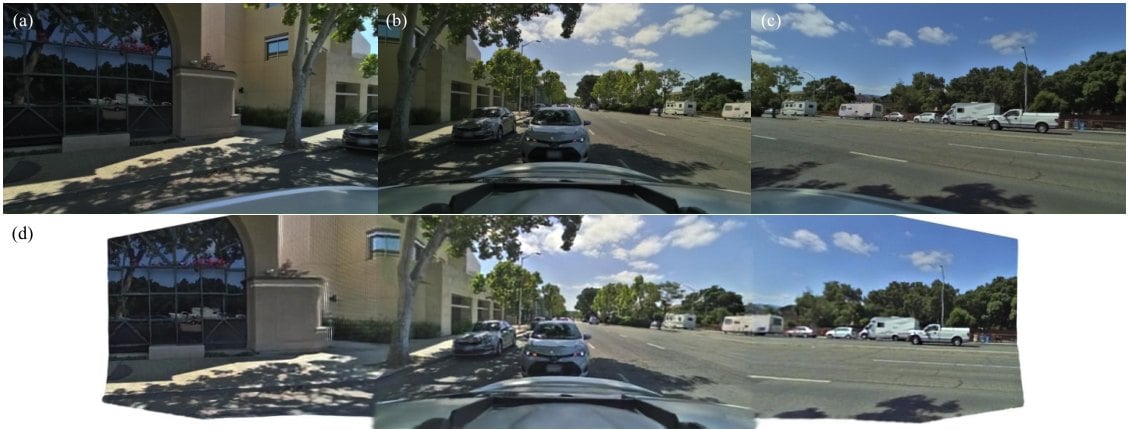
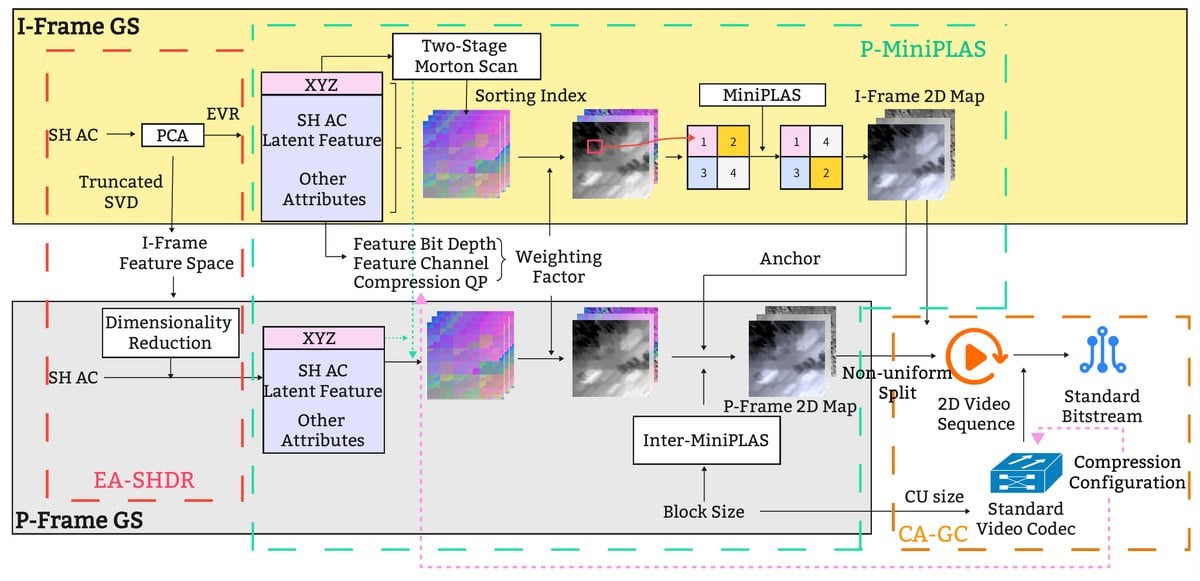
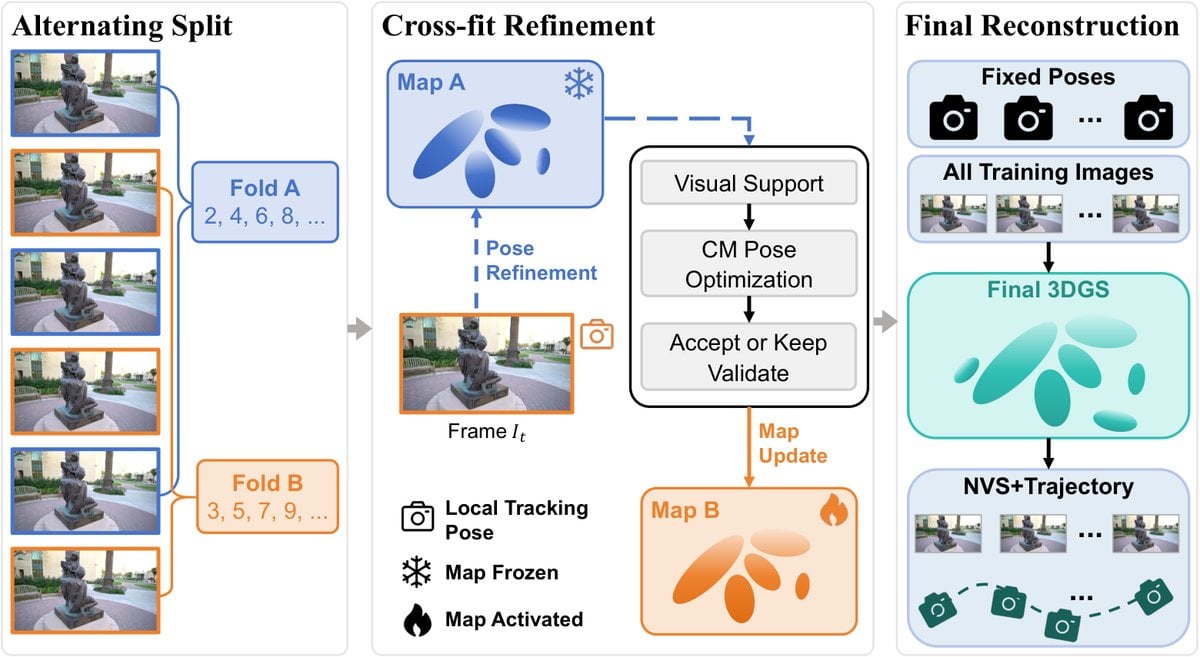
Joint optimization is supervised by both modalities, with a surface-depth consistency loss from X-ray geometry guiding the RGB reconstruction. On the InsideOut dataset and a Flower & Insect dataset, the authors report more robust alignment, higher RGB rendering quality without compromising X-ray reconstruction, and a more compact representation than two independent geometries.

Anchor3DGS predicts feed-forward splats from compact anchors, not one Gaussian per pixel

arXivPapers

Sheng Ye, Jiangke Lin, Fudong Wang, Yi Yuan, Zhen-Hui Dong and Yong-Jin Liu present Anchor3DGS, a pose-free feed-forward 3D Gaussian Splatting framework accepted at NeurIPS 2026. Instead of predicting one Gaussian per input pixel, it places a set of 3D anchors guided by information entropy, concentrating them in visually complex regions while keeping broad spatial coverage.

Each anchor aggregates multi-view image features with occlusion awareness, exchanges information with other anchors, and is decoded into a set of local Gaussians, with a lightweight module refining the coarse RGB output. The authors report state-of-the-art novel-view synthesis on diverse benchmarks while using an order of magnitude fewer Gaussian primitives than pixel-aligned feed-forward methods.

DriveWorld3D proposes evidence-constrained world modeling, with claims still to be validated

arXivPapers

Wei Wang, Yiru Veronika Wang, Yihan Wang, Zihao Li and Xiaohui Liang propose DriveWorld3D, a framework that combines temporal video learning, multi-sensor measurement constraints and offline generative simulation for autonomous driving. An online component maintains a unified world state of road surfaces, occupancy, dynamic entities and road relations, while separately representing physical occupancy, observability and evidence provenance.

An offline component reconstructs recorded scenes with neural radiance fields or 3D Gaussian Splatting, then expands long-tail conditions with generative models while restricting generated content from being used as geometric ground truth. The authors state that all performance claims remain subject to experimental validation.

Edit4D builds editable text-to-4D scenes from a separate background and character

arXivPapers

Chanwoo Kim, Tackgeun You and Hwasup Lim present Edit4D, a text-to-4D generation framework that keeps the background and the dynamic character as separate representations so object-level edits and camera control stay possible. A user instruction is split into stage-specific prompts; multi-view scene images are synthesized and reconstructed as a background 3D Gaussian splatting model, while a character is animated, reconstructed as a 4D mesh, and bound to Gaussian primitives.

The two components are composed through text-guided segmentation and contact-aware optimization, followed by a global refinement for harmonization and rendering consistency. The authors say this staged construction enables controllable camera motion and flexible object-level editing. A project page is at chanwo0kim.github.io/Edit4D.

KFS⁴LAM adapts keyframe selection for endoscopic Gaussian-splatting SLAM

arXivPapers

Xinwei Ju, Zhehua Mao, Tianyi Song, Danail Stoyanov, Sophia Bano and Francisco Vasconcelos present KFS⁴LAM, a Gaussian-splatting SLAM system for colonoscopy that couples motion-guided adaptive keyframe selection with structurally supervised mapping. They argue that fixed intervals and simple pose- or overlap-based keyframe rules are unreliable under non-uniform camera motion, repetitive anatomy, specularities and visual artifacts.

Accumulated motion guides keyframe selection, with complementary cues suppressing redundant or unreliable candidates. Density-aware mapping with anatomical contour supervision on colon folds emphasizes structurally informative regions, and restricted temporal deformation accommodates local tissue dynamics. The method is evaluated against Gaussian-SLAM baselines on C3VD and C3VD-v2.

An infinity-norm warp compresses unit quaternions, including those in Gaussian splatting

arXivPapers

Carsten Faber, Bastian Kuth, Rinaldo Schuster, Daniel Pauls and Quirin Meyer present a method for encoding uniformly distributed unit quaternions, comparing several parameterizations on theoretical error, quantization, computational cost and memory efficiency. They report that an infinity-norm parameterization with their optimized warp function consistently offers the smallest maximum error and the best storage efficiency, at a decompression cost equal to or lower than parameterization methods found in practice.

The authors demonstrate the approach in tangent-space normal mapping, skeletal animation with blend weights, and Gaussian splatting.

ResStreamGS streams only residual-sensitive Gaussians for mobile volumetric video

arXivPapers

Haoran Liu, Di Wu, Wang Luo, Hengyuan Na, Miao Hu and Guocong Quan present ResStreamGS, a residual-sensitive dual-stream framework for mobile volumetric video. They argue that systems such as V³ treat all Gaussians as frame-varying signals, which is a poor fit for full-scene content where large regions stay temporally stable, and that coding every Gaussian as video can degrade quality in those stable regions.

ResStreamGS identifies residual-sensitive primitives through lightweight probe adaptation, transmits stable Gaussians once per Group of Pictures, and leaves only residual-sensitive Gaussians in the frame-wise hardware-decodable video stream. On complex full-scene volumetric videos, it improves post-codec PSNR by 7.51–8.35 dB over a controlled V³-style all-Gaussians baseline and reduces amortized payload by up to 56.5%.

A training-free refinement helps 3DGS language maps find user-specified targets

arXivPapers

Sibaek Lee, Kyeongsu Kang and colleagues present a training-free, target-aware refinement of an already-distilled 3D Gaussian language map. Guided by a text-promptable segmenter, the visual embedding inside each detected target region is blended with the target text embedding, while non-target regions are left untouched. For each target they compute, in closed form, the smallest blend coefficient that still lets the target win, leaving no hyperparameters to tune.

They also identify a failure mode in which shared components of text embeddings make the standard cosine read-out query-agnostic after injection, and remove it with a centering step. Across three benchmarks the refinement consistently improves open-vocabulary segmentation, roughly doubling the base mIoU on Replica, and transfers as a plug-in to off-the-shelf field-based maps.

A reusable allocator places a fixed budget of Gaussians for cinematic CT

arXivPapers

Bowen Xiang, Dingjie Su, Jon S. Heiselman and Michael I. Miga address where a fixed budget of B Gaussians should be placed in cinematic CT renderings, rather than leaving that decision to per-patient densification. A reusable, label-aware front end maps a patient’s CT, labels and transfer function to a density over 2 mm cells and draws exactly B positions from it without per-patient optimization; the other Gaussian attributes are still fitted per patient.

The front end is learned once from per-patient optimized scenes and comes as a population-trained neural prior and an interpretable seven-parameter visibility-aware closed form (VACF). On 20 held-out patients at 10K–100K Gaussians, both raise vessel-masked PSNR over uniform allocation by 4.5–7.1 dB, and the neural prior does not differ significantly from per-patient optimized allocation at any budget.

GS-PRM builds a navigable visual roadmap directly from 3DGS renderings

arXivPapers

Ashraf Siddique, Kyung Min Han and Young J. Kim present GS-PRM, a Gaussian visual roadmap for image-goal navigation whose milestones, local connections and visual references are constructed through 3DGS rendering, without deriving an occupancy grid or signed distance field. Panoramic depth supplies conservative clearance for milestone validation, and edge-aligned orthographic rendering tests the robot’s swept volume.

The authors establish conditional soundness and sufficient conditions for deterministic query completeness and probabilistic construction completeness. In simulated and real-world tests, they report that a GS-PRM-guided system reaches up to twice the average success rate of a state-of-the-art 3DGS navigation baseline and reduces travel time by up to 57.2% when both systems complete the task.

Holi-Spatial 360 turns sparse real-estate panoramas into annotated 3DGS homes

arXivPapers

Yuanyuan Gao, Zhirui Liu and colleagues present Holi-Spatial 360, a generative reconstruction and curation framework that converts sparse online real-estate panoramas into annotated multi-room 3D environments. Correspondence-Guided Geometric Optimization turns feed-forward reconstruction priors into cross-view constraints and builds a coherent 3D Gaussian Splatting representation as 3D spatial memory, after which adapted image and video priors restore appearance and complete trajectories while preserving observed content.

The Holi360 dataset contains over 1,000 multi-room 3DGS scenes, more than 100,000 instance annotations, and 2 million spatial question-answer pairs, together with a benchmark for spatial understanding of vision-language models in real multi-room interiors. The authors report that fine-tuning VLMs on Holi360 improves spatial reasoning.

HyperLoop tests hyperspectral loop closures in a 3DGS SLAM system for planetary rovers

arXivPapers

Annie Bhalla, Dennis Rotondi, Riccardo Giubilato, Kai O. Arras and Wolfgang Stuerzl present HyperLoop, which adds hyperspectral imaging to the loop-closure module of a 3DGS-based SLAM system for planetary exploration. Two descriptor families, Bag-of-Spectral-Words and PCA-K VLAD, are fused with SIFT-VLAD and NetVLAD RGB descriptors on a custom dataset from the Moon-Mars Outdoor Test Site at DLR, covering four analog traverses totaling 65.5 m.

A key finding is that the sensor’s Red-NIR range of 600–860 nm offers limited discriminability for rock terrain: the best hyperspectral fusion (SIFT-VLAD + BoSW, Strict-AND) reached 5.04 cm ATE RMSE, within 1.8% of SIFT-VLAD alone at 4.95 cm. The authors say this motivates future SWIR sensors that capture mineral absorption features absent from that band. The paper is accepted at the International Astronautical Congress 2026.

MFGS encodes multi-view features instead of compressing already-built Gaussians

arXivPapers

Seungmi Choi, Ji-Hyoun Choi, Suhyun Jo, Tae-Gwon Park and Hui Yong Kim present MFGS, an end-to-end feed-forward scene-coding framework for 3D Gaussian Splatting. Instead of a generate-then-compress pipeline, it extracts multi-view features from the input images, encodes them into a compact bitstream, and lets the receiver predict Gaussian attributes from the decoded features, with importance-guided selection so the same bitstream can be rendered under different Gaussian budgets.

Across RE10K, ACID and DL3DV, the authors report 99.76–99.86% bitrate savings over the generate-then-compress pipeline, as measured by BD-rate, while reducing total GMACs by 52–55%. The manuscript has been submitted to IEEE TCSVT.

RDCompGS folds an estimated coding rate into 3DGS training before image-codec compression

arXivPapers

Huiping Ren, Shuai Wan, Luqian Bai, Zhang Chen and Fuzheng Yang present RDCompGS, a 3D Gaussian Splatting compression method that maps Gaussian attributes to 2D representations and then uses mature image codecs. A differentiable estimate of the coding rate is added to the rate-distortion objective alongside rendering distortion, so Gaussians that look similar but cost very different amounts to code are no longer treated the same during optimization.

A rate-constraint adjustment model further regulates the trade-off across compression conditions. On three benchmark datasets, the authors report average Bjøntegaard Delta Rate reductions of 37.84% with H.265/HEVC and 49.31% with JPEG XL. The manuscript has been submitted to IEEE Transactions on Multimedia.

VisibilitySplat adds a sparse ray-traced occlusion oracle to 3DGS inverse rendering

arXivPapers

Sven Kluge and Oliver Staadt present VisibilitySplat, which augments rasterized 3D Gaussian Splatting with a sparse visibility oracle for relighting and for material and light decomposition. The oracle is a point-based ray tracer accelerated by a bounding volume hierarchy, queried sparsely from sampled lighting directions, while the original 3DGS loop is kept for training, visualization and tooling. Shading uses a microfacet BRDF and low-resolution HDR environment maps.

On the TensoIR synthetic dataset, the authors report competitive novel-view synthesis, albedo reconstruction and relighting against NeRF, tensor and 3DGS baselines, and say ablations show that explicit visibility modeling helps relighting and material-illumination disentanglement. The work is published at WSCG 2026.

DoReMe reconstructs free-breathing abdominal MRI with Gaussian motion primitives

arXivPapers

Majd Helo, Dominik Nickel and Thomas Kuestner present DoReMe, a coupled reconstruction and motion-estimation method for self-navigated free-breathing abdominal MRI. Respiratory motion is represented with compact Gaussian primitives and jointly refined with the image estimates during iterative reconstruction, without pre-estimated motion fields or external respiratory surrogate signals.

The method was evaluated on self-navigated free-breathing Cartesian gradient-echo acquisitions in four healthy volunteers, including retrospective scan-shortening experiments, and was compared with regularized compressed sensing. Respiratory motion states were reconstructed in approximately 1.5 minutes, and the authors report improved visual quality, particularly in coronal liver views, as a proof of concept.

A survey maps Gaussian splatting methods, systems and trade-offs for real-time reconstruction

arXivPapers

Ashim Dahal, Rabab Abdelfattah and Nick Rahimi survey 3D Gaussian Splatting for real-time scene reconstruction, in an accepted manuscript for Elsevier Pattern Recognition. They group work into five overlapping families: single-shot generation, dynamic representations, efficiency and compression, streaming and immersive systems, and Gaussian Splatting SLAM.

The survey distinguishes render-only throughput from the costs of constructing, updating, tracking and optimizing a scene, and combines controlled sparse-view benchmarking with native evaluations to compare quality, latency, memory and update-cost trade-offs across those families.

PLEDGE compresses 3DGS with four user-declared, per-primitive error bounds

arXivPapers

Mingze Xia, Yuxiao Li and colleagues present PLEDGE, a training-free, progressive, error-bounded codec for 3D Gaussian Splatting. It translates four user-declared tolerances into per-primitive quantization bounds for screen-space position, footprint deformation from rotation and scale, view-dependent color, and opacity, and those bounds are required to hold throughout a declared camera domain, including previously unseen viewpoints.

Quantized residuals are packed into a progressive bitstream with explicit error bounds for every valid prefix. Experiments across thirteen scenes verify all declared per-mechanism bounds and show competitive rate-distortion performance, with the four tolerances incurring substantially different rate costs.

PUGS models underwater Gaussian motion as a distribution, not a single trajectory

arXivPapers

Tingjun Li, Yuxi Wang, Guoqiang Zhong and Zhaoxiang Zhang present PUGS, a physics-guided uncertainty model for underwater dynamic 3D Gaussian Splatting. They argue that deterministic deformation fields break down underwater, where scattering, refraction, marine snow and low visibility make captured images physically ambiguous.

Instead of a single displacement, PUGS parameterizes each Gaussian’s motion as a probability distribution with an expected deformation and a physical uncertainty, and uses stochastic deformation optimization with local reparameterization to sample trajectories during training. Uncertainty stochastic annealing and a dual-path self-consistency distillation then convert that exploration into a deterministic reconstruction. The authors report improved rendering quality, temporal consistency and robustness on underwater dynamic datasets and physics-aware benchmarks.

ReStep predicts a system's final state first, then fills in the trajectory for 3DGS physics

arXivPapers

Leyan Zhang, Nantian He, Jiajun Ma, Yanpeng Zhao and Yunbo Wang present ReStep, a cascaded model for long-horizon particle dynamics. Observing that final states in dissipative systems are often more predictable than transients, ReStep first predicts the final state with a stochastic model, then uses Anchored Diffusion to generate goal-conditioned intermediate trajectories conditioned on both boundary states.

The authors integrate ReStep as the physical engine inside a 3D Gaussian Splatting pipeline, so dynamics can be inferred from images in a unified physical-visual framework. On rigid and non-rigid collision datasets, they report better long-term accuracy and less error accumulation than conventional forward-prediction rollouts.

YUBI-Real2Sim checks whether a 3DGS scene is good enough for VLA policy evaluation

arXivPapers

Hiroki Nishizawa, Takehiko Ohkawa, Nicola Scianca, Tatsuya Matsushima, Shigeo Morishima and Kei Ota present YUBI-Real2Sim, a framework for 3DGS-based scene reconstruction and real-to-sim policy evaluation under dual fisheye wrist views. They note that policies relying on wrist-mounted fisheye cameras are heavily exposed to holes and floaters in wide-angle views, and that the reconstruction quality needed for reliable evaluation has been unquantified.

The pipeline combines 200-degree fisheye capture, 3DGS training, 3D foundation models for object modeling, and MuJoCo-based physical simulation, and reproduced the observed real-world policy ordering in eight of nine scene-task comparisons. A benchmark across two bimanual robot platforms, three scenes, three tasks and dual pi0.5-based policies measures rank agreement and policy sensitivity to counterfactual 3DGS artifacts and capture disturbances. The paper is under submission.

DIGS keeps a label distribution on each Gaussian for training-free open-vocabulary segmentation

arXivPapers

Zhifan Zeng, Wenbo Xiao, Arcot Sowmya and Changming Sun present DIGS, a training-free framework for open-vocabulary 3D Gaussian segmentation, accepted at NeurIPS 2026. Instead of binding each primitive to a single feature, DIGS maintains an explicit top-M label distribution per Gaussian, updated by a tempered Dirichlet rule, so boundary primitives that span several 2D instances can stay multi-peaked until a late-argmax renderer recovers instance boundaries.

A later encoding stage fuses the CLIP visual embedding of each instance’s isolated 3D footprint with the CLIP-text embedding of an LLM-generated attribute description. On a single A100, DIGS completes mapping and instance encoding on LERF-OVS in 1.0–3.2 minutes per scene, depending on whether LLM fusion is enabled.

SG-GS uses SAM semantics to steer densification in fine-grained urban reconstructions

arXivPapers

Yueling Liao, San Jiang, Xing Zhang and Zhongwen Hu present SG-GS, a semantic-guided 3D Gaussian Splatting method for fine-grained urban structures. The approach takes Segment Anything Model (SAM) segmentation as a constraint, assigning gradient thresholds by semantic region and adding a boundary-enhanced densification strategy so new Gaussians are directed to structurally critical areas.

A multi-feature loss is introduced gradually through phased training, which the authors say reduces artifacts that appear when the basic 3DGS loss lacks semantic constraints. On three datasets, they report that PSNR rises by approximately 2.7% to 5.2% compared with the original 3DGS, with fewer artifacts on linear structures and less boundary blur.