

P-MGS allocates mesh-based Gaussians by appearance complexity, not face count
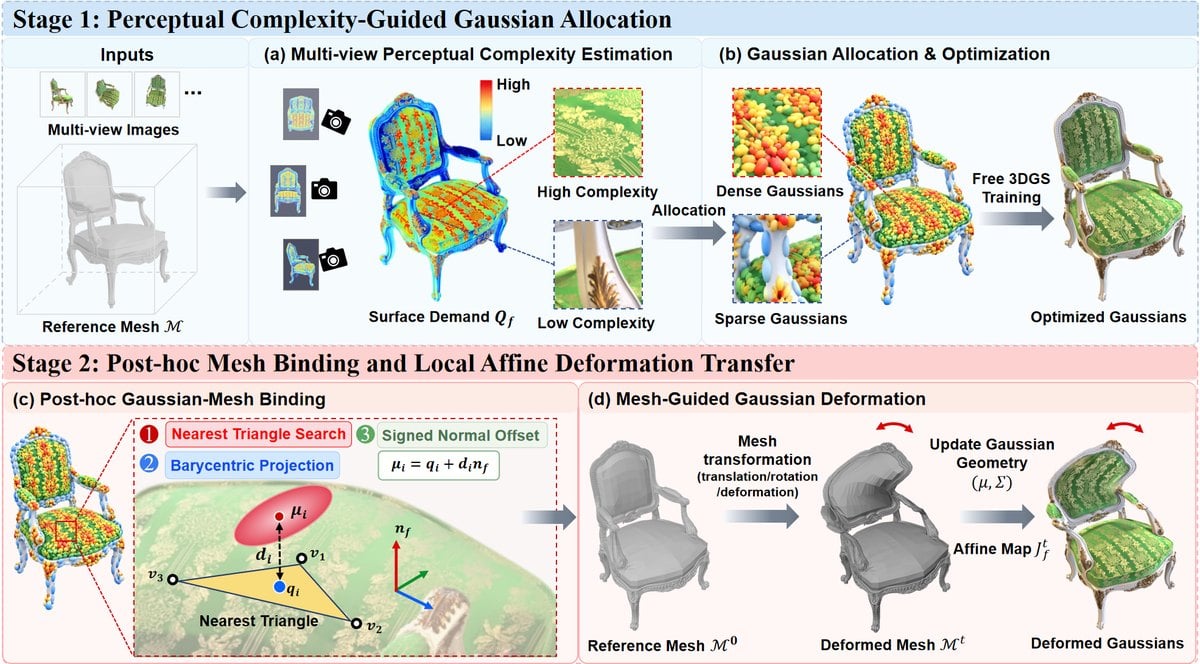
Yuting Wang et al. propose P-MGS, a mesh-based 3D Gaussian Splatting framework that separates appearance modeling from geometric control. Existing methods that pin a fixed number of Gaussians to each mesh face, the authors argue, ignore that reconstruction capacity should follow local appearance complexity rather than tessellation density.
A perceptual-complexity-guided allocation distributes Gaussians according to surface appearance estimated from multi-view observations, while still leaving the Gaussians free enough to reconstruct well and keeping the mesh available for geometric editing. The paper presents this as a route to high-quality rendering, a more compact representation, and flexible mesh edits.