

DepthGS uses depth-guided adaptive regularization for Gaussian surface reconstruction
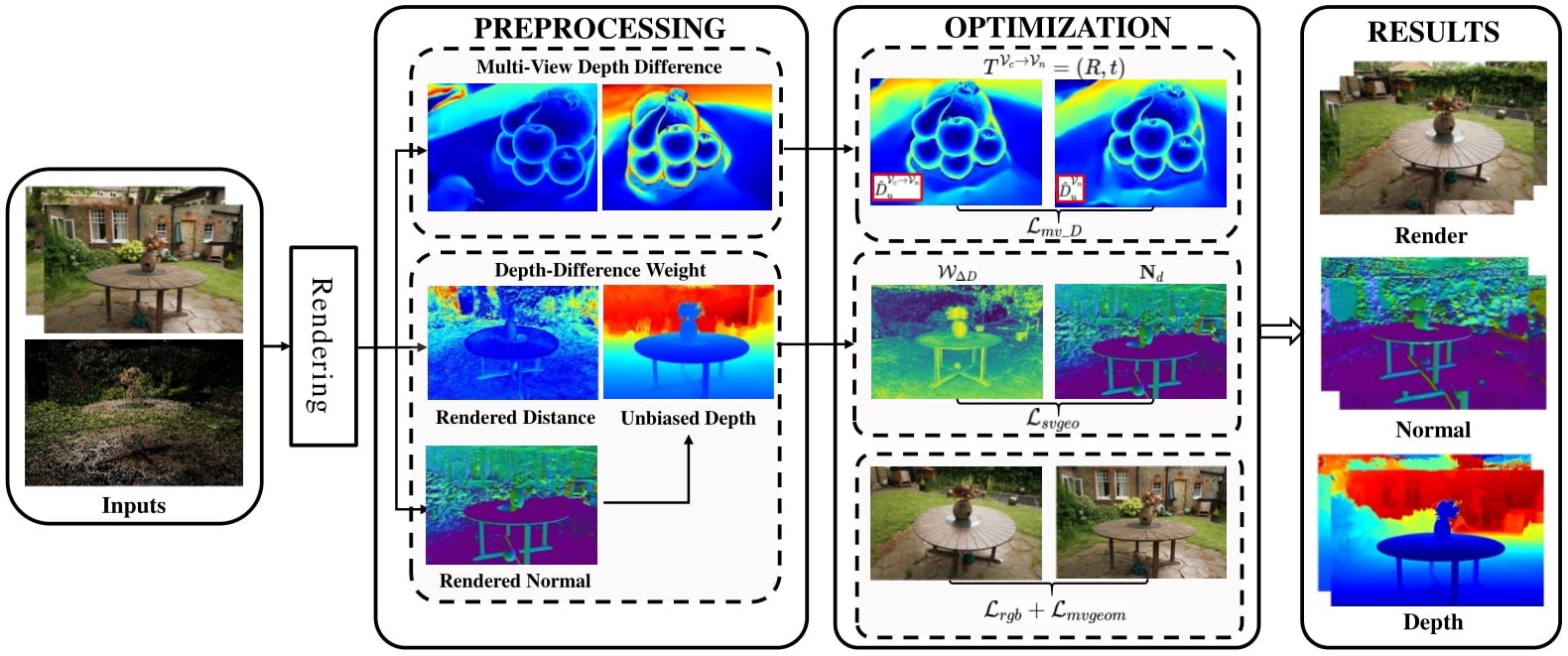
Xiao Ren, Yu Liu, Ning An, Jian Cheng, Xin Qiao, You-Fu Li and He Kong introduce DepthGS, submitted to arXiv on 10 November 2026, a depth-guided Gaussian Splatting method aimed at surface reconstruction. The authors derive relationships, and upper bounds, between depth discrepancies and reconstruction error in single-view and multi-view settings, then use that analysis to design two regularizers. A single-view term weights a normal constraint by a reliability score from local depth differences, applying a stronger constraint where the depth difference is small and a weaker one where it is large. A multi-view term encourages consistency between neighbouring-view depth maps and depths obtained by transforming the current view into those neighbours.
On DTU, DepthGS reports a mean Chamfer distance of 0.51 mm in 17.6 minutes, compared with 0.53 mm for PGSR under a similar setting, ranking second among the methods in their table. On Tanks and Temples it reports a mean F1-score of 0.503, close to GSPrior’s 0.507. On Mip-NeRF 360 it reports the lowest LPIPS of the compared methods for outdoor, indoor and overall averages, with competitive PSNR and SSIM.