

Déjà View, a NeurIPS 2026 oral, loops one transformer block for multi-view 3D reconstruction
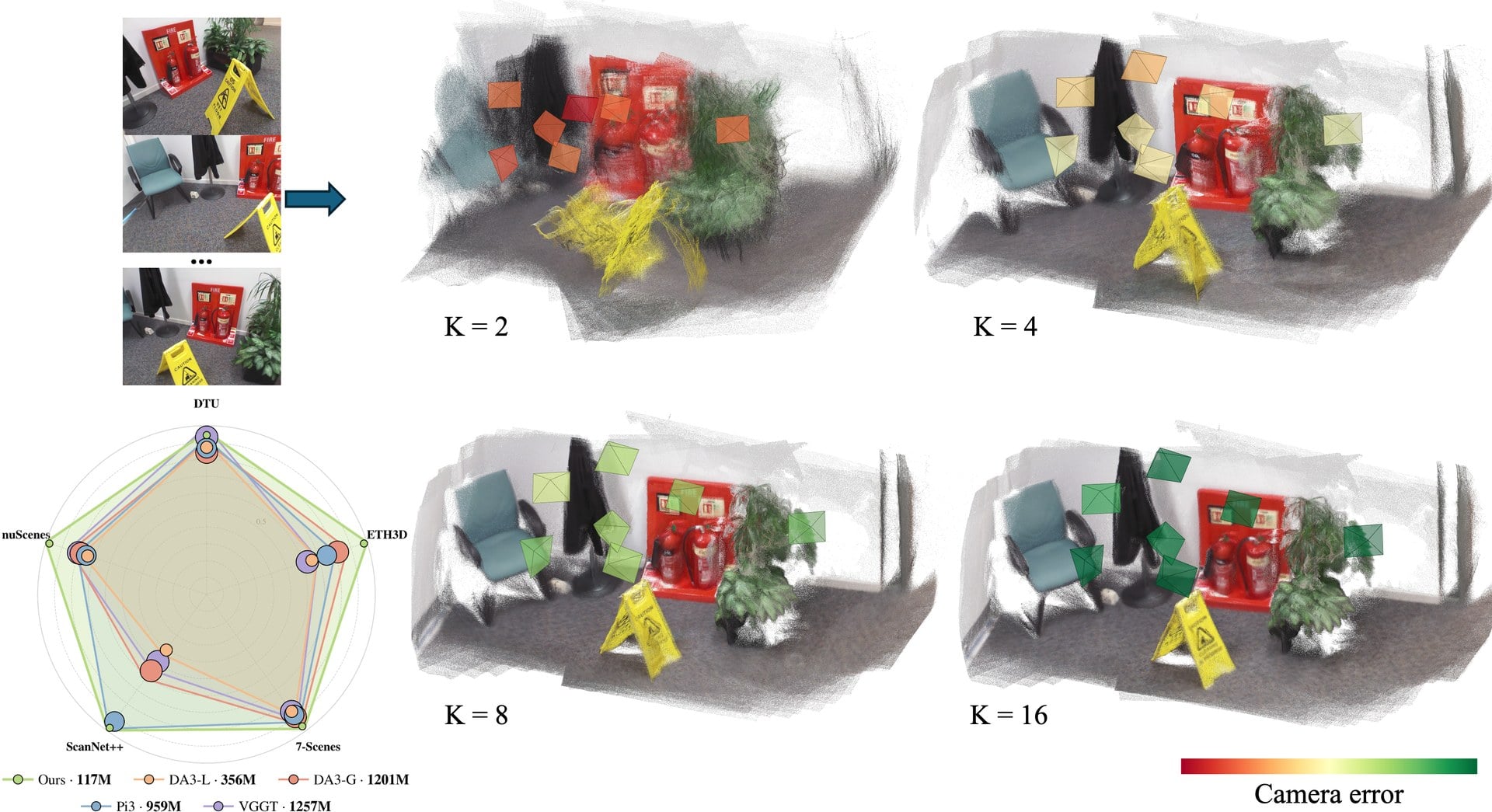
NVIDIA AI posted on 11 November about Déjà View, a NeurIPS 2026 oral paper that reconstructs camera poses and dense geometry from unposed multi-view photographs by applying a single transformer block recurrently. The method, on arXiv since 28 May 2026, is not a Gaussian Splatting pipeline: two lightweight heads decode the looped state into per-view depth and ray maps. A project page and code on GitHub accompany the paper. Alessandro Burzio and Tobias Fischer are listed as equal first authors, with colleagues at NVIDIA, the University of Modena and Reggio Emilia, the University of Toronto and ETH Zürich.
The authors describe a 117-million-parameter model that, once trained, exposes the loop count K as an inference-time compute knob. They report that it matches or outperforms much larger feed-forward baselines across five reconstruction benchmarks spanning indoor, outdoor, object-centric and driving scenes, using 8–10× fewer parameters and 1.9–2.3× less compute than π³ and Depth Anything 3. Per-view features are initialized from a pretrained DINOv2 encoder.