

KoalaGS uses image complexity to decide which Gaussians to keep as the budget shrinks
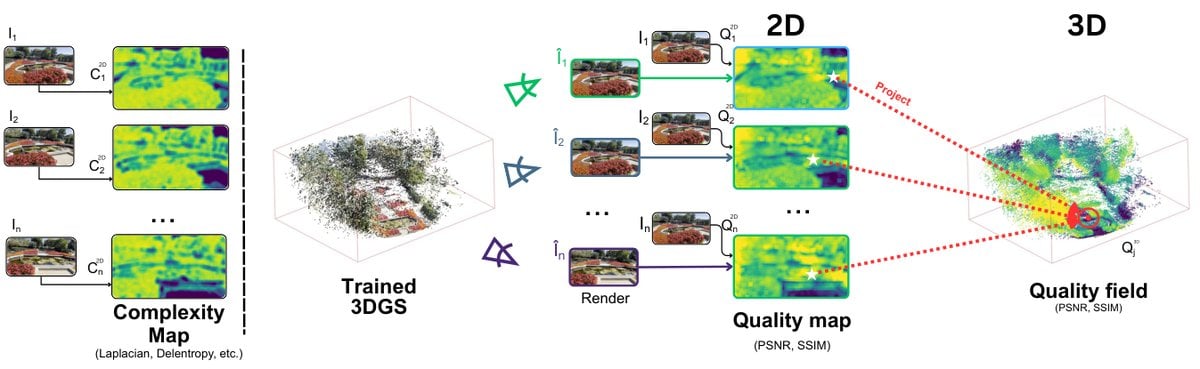
Radu Beche and Raoul de Charette present KoalaGS, a complexity-aware continuous level-of-detail method for Gaussian Splatting, accepted as a NeurIPS 2026 Spotlight. A pilot study on 3DGS-MCMC reconstructions shows that image complexity computed from the input views before optimization predicts where reconstruction error concentrates, and that simple regions often contain too many Gaussians and degrade as much as complex ones at lower budgets.
During training, this complexity prior biases relocation toward poorly reconstructed areas. A primitive importance score then enables low-capacity inference while preserving scene structure. Across three datasets, KoalaGS maintains competitive full-capacity quality while improving quality across the budget spectrum, with smoother LoD transitions and faster progressive streaming.