

RetinexGS reconstructs low-light scenes from noisy RAW images with factorized Gaussian colour
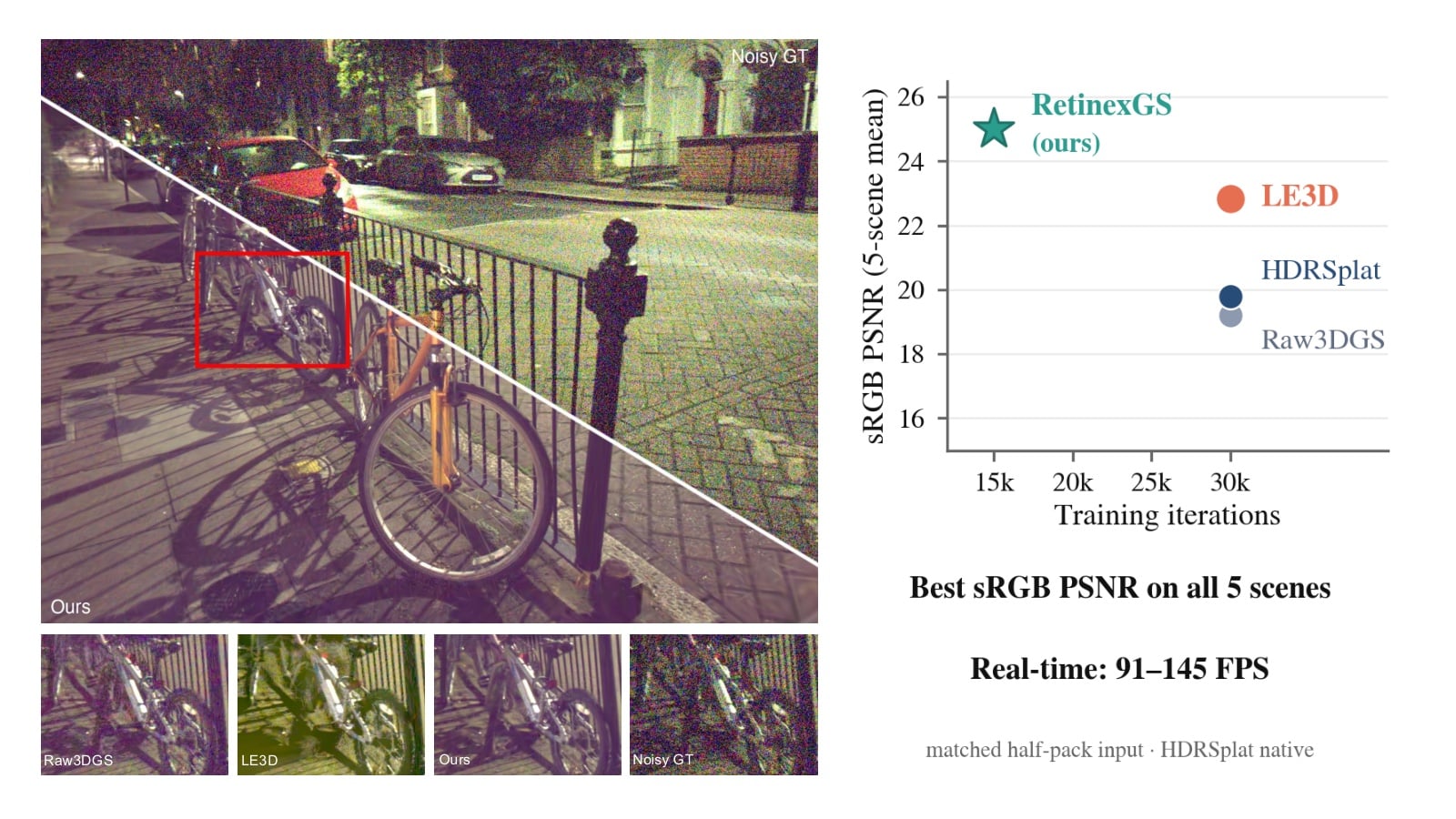
Yulang Fei, Huaiyuan Weng and Chul Min Yeum of the University of Waterloo present RetinexGS, submitted to arXiv on 9 November 2026, a RAW-domain 3D Gaussian Splatting method for novel-view synthesis from severely underexposed photographs. Standard 3DGS pipelines often produce unstable colours, floating artifacts and missing geometry in the dark. RetinexGS works on linear RAW measurements and, inspired by Retinex theory, factors each Gaussian’s colour into a view-independent base colour and a shared, position- and view-dependent modulation field, regularizing the two parts separately.
The reconstruction loss is weighted with DNG noise metadata so that signal-dependent noise is taken into account, and lens distortion is handled in the rasterizer so RAW targets are not spatially resampled. Depth-guided initialization adds points in dark regions where structure-from-motion is sparse. Across three public RawNeRF scenes and two custom low-light captures, and with all methods trained on the same RAW inputs per scene, the authors report that RetinexGS outperforms LE3D and RawNeRF in mean sRGB PSNR by 2.18 dB and 2.71 dB respectively, while rendering in real time (91–145 FPS at 2016×1512 on one RTX 4090).