

CiGS reads the temperature inside an object from Gaussian splats and thermal images
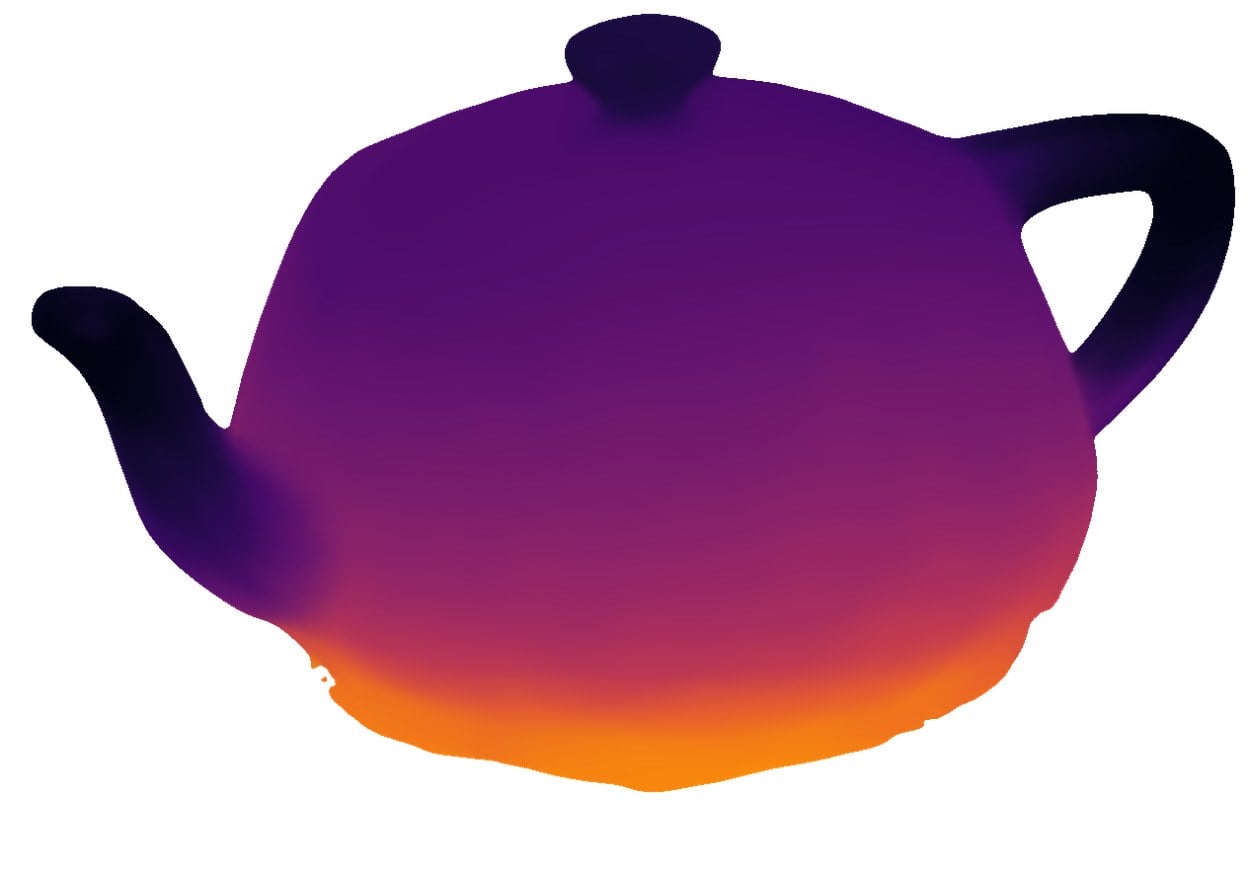
Researchers from ETH Zürich, Carnegie Mellon University and Google DeepMind have posted CiGS: Conduction in Gaussian Splats for Interior Temperature Field from Thermal Images on arXiv (15 November 2026). The method infers the temperature distribution inside a solid object from registered multi-view visible-light and thermal images, even when the thermal views cover only part of the surface.
CiGS treats steady-state heat conduction as a Laplace boundary value problem and solves it with a boundary integral equation discretised directly over a point cloud. A Gaussian splat reconstruction from the RGB images supplies the boundary geometry, and the thermal images supply the surface temperatures. No surface or volume mesh is built at any stage: collocation points are sampled from rendered depth, skipping pixels at depth discontinuities, and a density subtraction keeps the interior evaluation accurate right up to the surface.
In the headline experiment, 360 RGB and thermal images of a cast plaster teapot on a hot plate were turned into splats carrying surface temperature, and the predicted interior temperature matched three cast-in probes to 1.4 °C on average. Because the whole chain is differentiable, the authors also use it to recover the position and depth of heating pipes, insulation defects and the shape of cracks from thermal images. On synthetic and real data, the paper reports that the method matches analytical solutions and is more accurate than FEM solvers.