

MatrixSplat maps Gaussian splat feature rendering onto GPU Tensor Cores
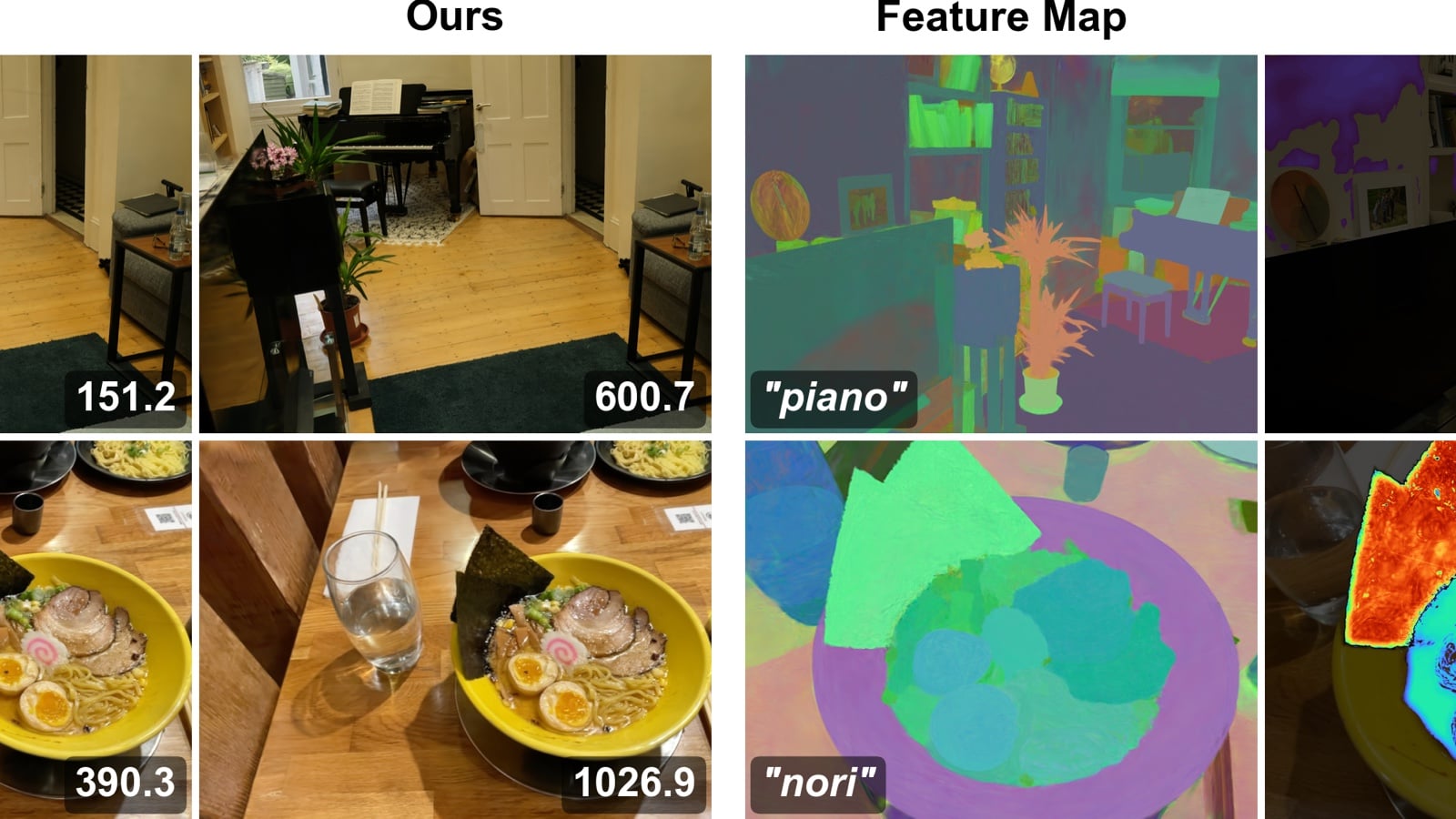
Yangming Zhang and colleagues at the University of Texas at Arlington, with co-authors at Snap, the University of Texas at Dallas, the University of Georgia and Argonne National Laboratory, present MatrixSplat, a paper submitted to arXiv on 11 November 2026, for rendering 3D Gaussian splats, including high-dimensional semantic features, on modern GPUs.
They argue that standard 3DGS pipelines are a poor fit for current hardware: depth-sorted alpha compositing creates strong per-pixel dependencies, so execution stays on scalar fused-multiply-add units and leaves high-throughput matrix units such as Tensor Cores unused. That cost grows quickly when each splat also carries a wide feature vector.
MatrixSplat switches feature rendering to an order-independent weighted accumulation, so the work can be expressed as matrix operations. A tile-based splatting pipeline maps feature accumulation to warp-level matrix-multiply-accumulate on Tensor Cores. A warp-granularity packing step groups Gaussians to improve feature reuse, and a lazy, channel-batched fetch keeps shared-memory use down and overlaps memory access with matrix work.
On Mip-NeRF 360, LERF and 3D-OVS, the authors report up to a 3.8 times speedup over 3DGS and a 2 times speedup over TC-GS, with rendering quality and semantic accuracy held. For high-dimensional features they report render-kernel time reductions of up to 36.7 times. When the method is added to existing fast renderers, they measure a further 1.69 to 2.84 times speedup, including about 2.3 times over FlashGS on an RTX 4090, an RTX 6000 Ada and an H100.