

ReStep predicts a system's final state first, then fills in the trajectory for 3DGS physics
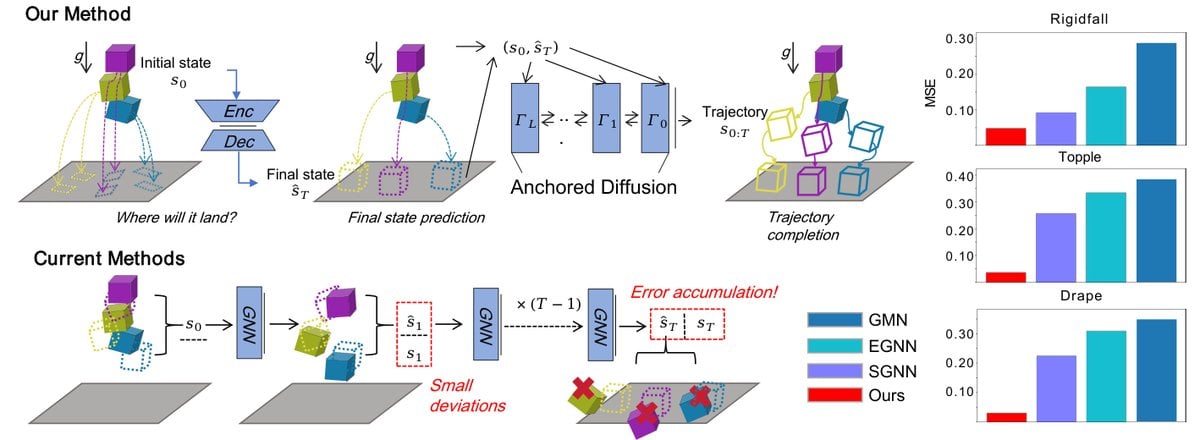
Leyan Zhang, Nantian He, Jiajun Ma, Yanpeng Zhao and Yunbo Wang present ReStep, a cascaded model for long-horizon particle dynamics. Observing that final states in dissipative systems are often more predictable than transients, ReStep first predicts the final state with a stochastic model, then uses Anchored Diffusion to generate goal-conditioned intermediate trajectories conditioned on both boundary states.
The authors integrate ReStep as the physical engine inside a 3D Gaussian Splatting pipeline, so dynamics can be inferred from images in a unified physical-visual framework. On rigid and non-rigid collision datasets, they report better long-term accuracy and less error accumulation than conventional forward-prediction rollouts.