

GEMOR-GS refines LiDAR–camera extrinsics and relocalizes inside a Gaussian SLAM map
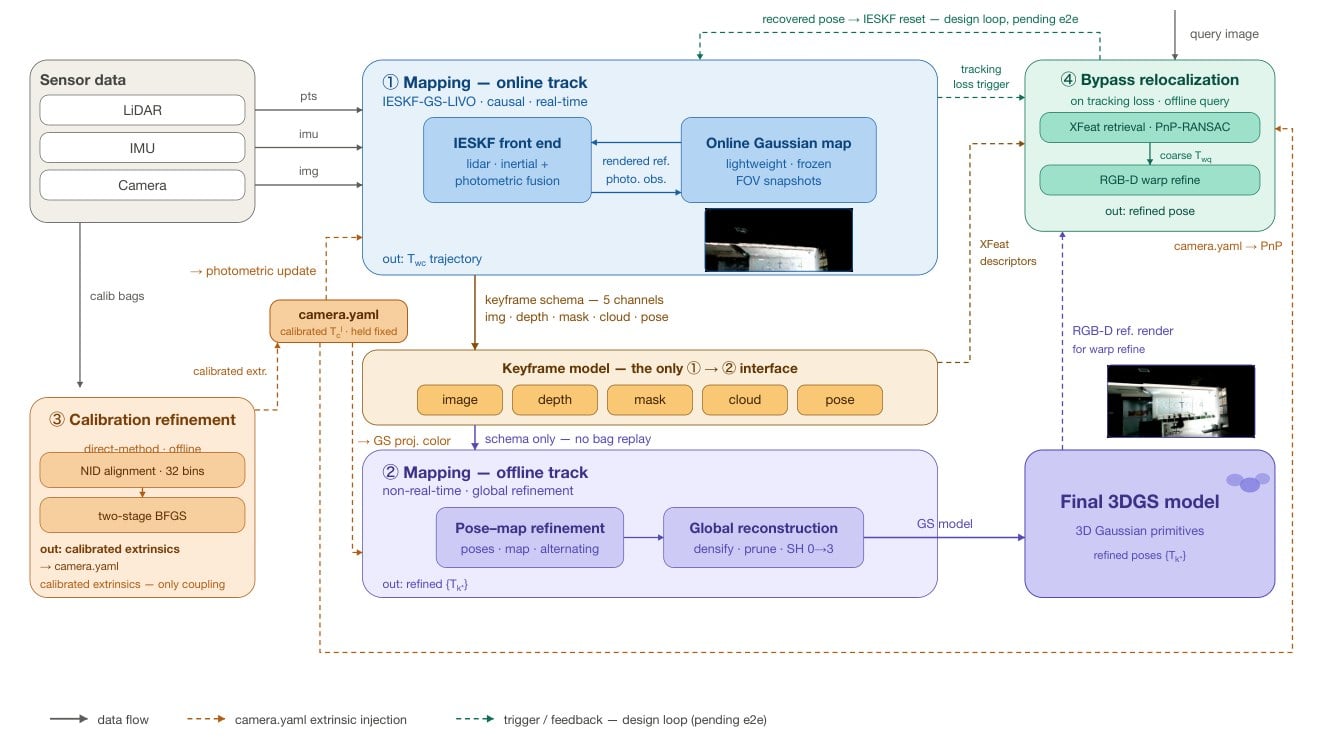
Yuchen Yang, Ming Ding, Xinyu Wu and Hesheng Wang present GEMOR-GS, submitted to arXiv on 10 November 2026, a LiDAR–inertial–visual SLAM method that aims to make a 3D Gaussian map geometrically accurate, globally refined and re-enterable after tracking loss. Before mapping, the LiDAR–camera extrinsic is estimated offline by direct-method alignment over dedicated calibration segments and then reused. Under that calibrated geometry, keyframe poses and Gaussian parameters are refined alternately under a gated differentiable-rendering and LiDAR-projection objective, after which a final global reconstruction is rebuilt from the refined keyframes.
For relocalization, the method recovers pose from the Gaussian map through an XFeat bypass map, RANSAC-PnP coarse localization and Gaussian RGB-D warp refinement. On one self-collected and five public sequences, the authors report that the offline reconstruction improves on the online map by 14.3–19.9 dB on all paired keyframes, improves PSNR by approximately 9 dB over Gaussian-LIC2, and achieves 86–100% held-out relocalization success on most estimated sequences, with reliability tied to extrinsic quality. The paper lists a public repository at github.com/Vector-4D/gemor-gs; that URL returned 404 when checked on 12 November 2026.