

Loss-aware density control predicts how much a split, clone or opacity change will help
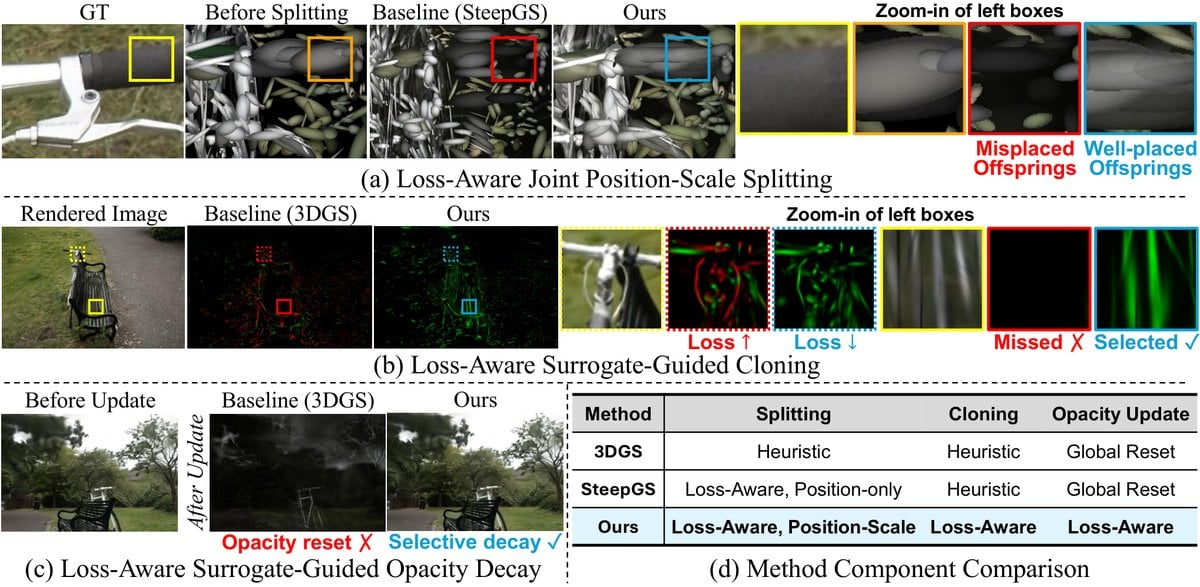
Tae-Young Kim, Jiwoo Chung and Jae-Pil Heo recast 3DGS adaptive density control as a collection of local loss-reduction decisions, in a NeurIPS 2026 paper. Instead of heuristic view-space gradients, scale thresholds and global opacity resets, they derive efficient Taylor-based per-Gaussian surrogates that predict the objective change caused by splitting, cloning and opacity decay.
Second-order splitting is extended to a normalized joint position-scale space, duplicate cloning selects only Gaussians whose duplicated contribution is predicted to help, and global opacity reset is replaced with selective soft opacity decay. Across standard 3DGS benchmarks, the method produces more targeted primitive allocation and improved rendering quality with comparable or smaller Gaussian budgets.