

GaussianSpline models 4DGS motion with adaptive, non-uniform Bézier splines
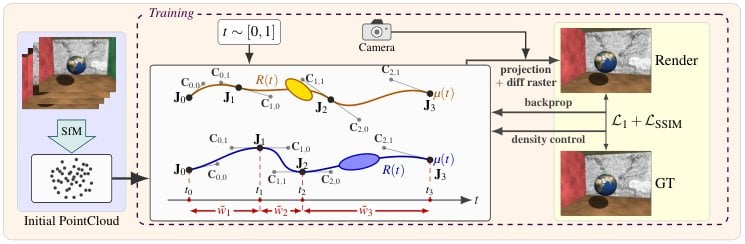
Tom Yachil and Andrei Sharf present GaussianSpline, a dynamic 4D Gaussian Splatting method that models per-Gaussian motion with adaptive, non-uniform piecewise cubic Bézier splines. Unlike global deformations, fixed-order polynomials or uniformly parameterized splines, it jointly learns the Bézier control points and the temporal partition of each Gaussian’s trajectory, allocating more temporal capacity to highly dynamic regions.
G¹ continuity between consecutive segments is enforced with a reflection-based constraint on control points, producing smooth, fully differentiable trajectories. On the Neural 3D Video benchmark, the Google Immersive dataset and synthetic scenes, the authors report substantially better reconstruction of highly non-uniform dynamics, while remaining competitive on general dynamic scenes.