

DIGS keeps a label distribution on each Gaussian for training-free open-vocabulary segmentation
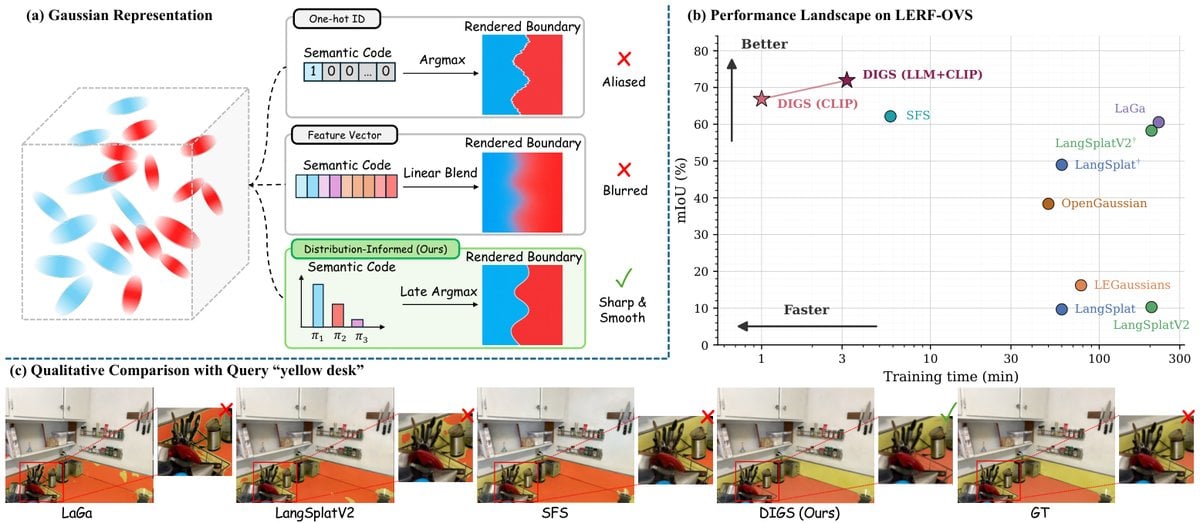
Zhifan Zeng, Wenbo Xiao, Arcot Sowmya and Changming Sun present DIGS, a training-free framework for open-vocabulary 3D Gaussian segmentation, accepted at NeurIPS 2026. Instead of binding each primitive to a single feature, DIGS maintains an explicit top-M label distribution per Gaussian, updated by a tempered Dirichlet rule, so boundary primitives that span several 2D instances can stay multi-peaked until a late-argmax renderer recovers instance boundaries.
A later encoding stage fuses the CLIP visual embedding of each instance’s isolated 3D footprint with the CLIP-text embedding of an LLM-generated attribute description. On a single A100, DIGS completes mapping and instance encoding on LERF-OVS in 1.0–3.2 minutes per scene, depending on whether LLM fusion is enabled.
 «Just Ask» Comic