

OV-Foam lifts open-vocabulary features onto non-overlapping PowerFoam primitives
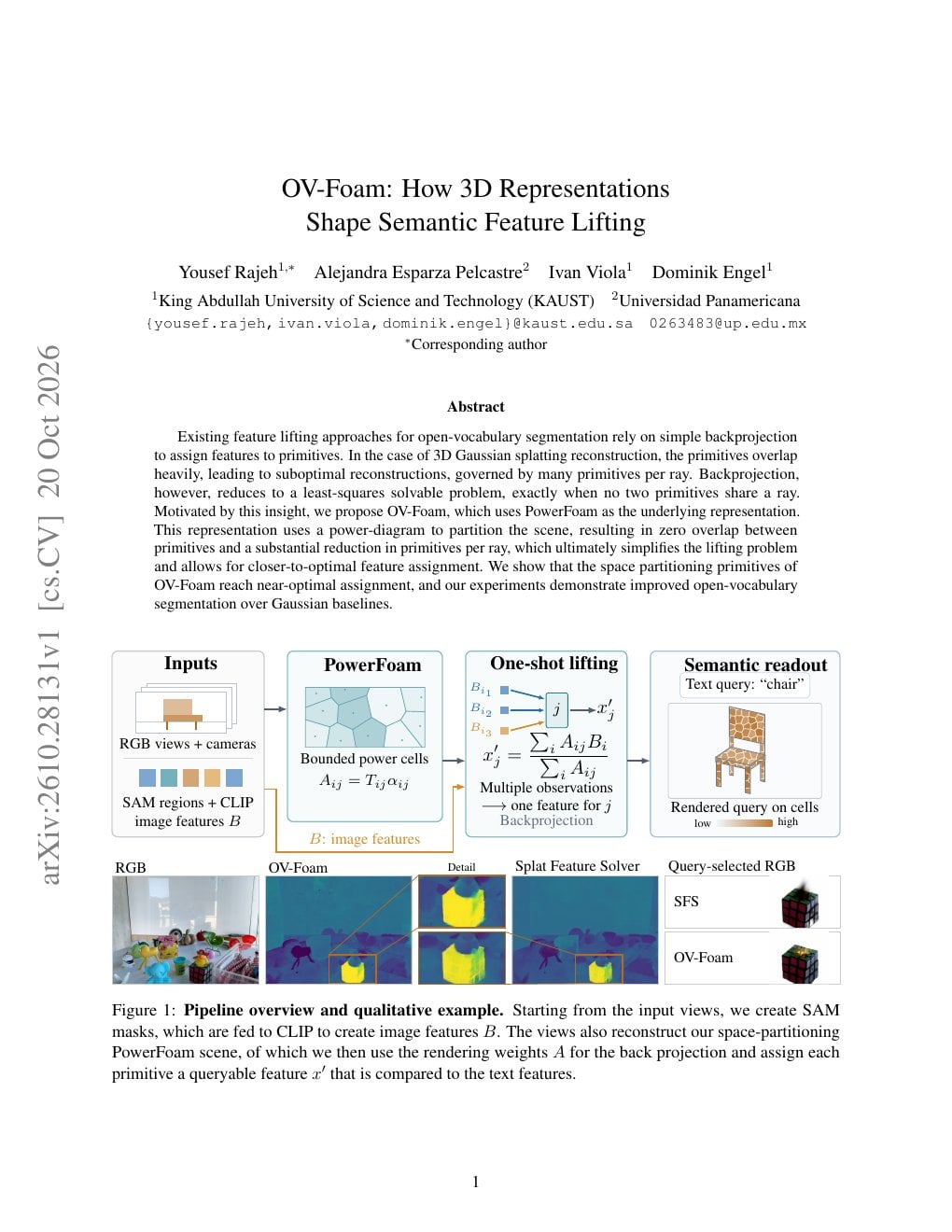
Yousef Rajeh, Alejandra Esparza Pelcastre, Ivan Viola and Dominik Engel present OV-Foam, which studies how the choice of 3D representation shapes semantic feature lifting for open-vocabulary segmentation. In 3D Gaussian splatting, primitives overlap heavily, so many primitives share a ray and simple backprojection is a poor way to assign features.
OV-Foam instead uses PowerFoam, whose power diagram partitions the scene with zero overlap between primitives and fewer primitives per ray, which the authors say reduces lifting to a closer-to-optimal assignment. They report that the space-partitioning primitives reach near-optimal assignment and improve open-vocabulary segmentation over Gaussian baselines.